Landing Page Compliance: The Legal Traps That Kill Campaigns
I've watched too many profitable campaigns get torched overnight because marketers treated compliance like an afterthought. The brutal truth? Your landing page compliance strategy is either bulletproofing your business or setting it up for a spectacular failure.
The compliance landscape shifted dramatically in recent years—and most affiliates are still operating with outdated playbooks. Platform policies tightened. Privacy laws multiplied. The FTC started swinging harder at misleading claims.
What used to be a slap on the wrist now means account bans, traffic source suspensions, and legal headaches that can sink your entire operation.
The Foundation: Understanding Modern Compliance Requirements
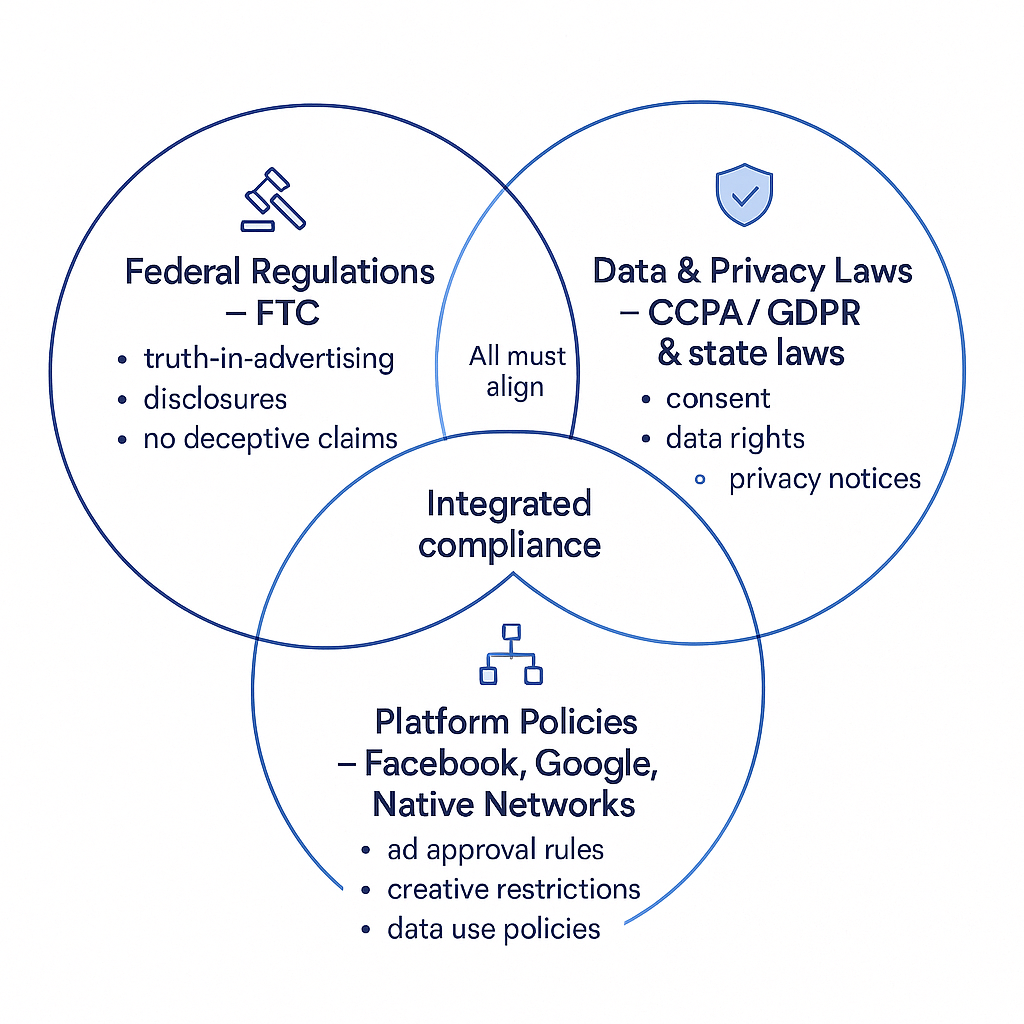
Compliance isn't just about avoiding lawsuits anymore. It's about maintaining access to the traffic sources and platforms that fuel your campaigns. Facebook, Google, Taboola, and native networks all have their own interpretation of what flies—and they're not afraid to cut you off.
The regulatory environment operates on multiple levels. You've got federal requirements like FTC guidelines governing endorsements and material connections. State-level privacy laws that vary wildly (California's CCPA versus Florida's approach, for instance). International regulations if you're targeting global audiences—GDPR being the 800-pound gorilla that still trips up American marketers.
Platform-Specific Policy Variations
Here's what most people get wrong: they assume compliance is universal. It's not.
Facebook's ad policies differ significantly from their organic content guidelines. Google Ads has stricter requirements for health claims than Microsoft Ads. Native platforms like Taboola and Outbrain each maintain their own editorial standards—and they change them quarterly.
I've seen campaigns that sailed through Outbrain's approval process get rejected instantly on Revcontent for identical creative and landing page combinations. The devil lives in these details.
The Real Cost of Non-Compliance
Account suspensions aren't just temporary inconveniences. When Facebook flags your business manager, that follows you. Google blacklists don't expire quietly. Native network bans often extend to sister platforms you didn't even know were connected.
The financial impact compounds quickly. Say you're running a supplement offer through Taboola with a $2,000 daily spend and 150% ROI. One compliance violation doesn't just stop today's profit—it kills your access to a traffic source that might have generated $500K annually.
FTC Guidelines: The Non-Negotiable Basics
The Federal Trade Commission updated their endorsement guidelines significantly in 2023, and the changes caught many affiliates off-guard. The core principle remains simple: material connections must be disclosed clearly and conspicuously.
But "clearly and conspicuously" means something very specific in FTC-speak.
Disclosure Requirements That Actually Work
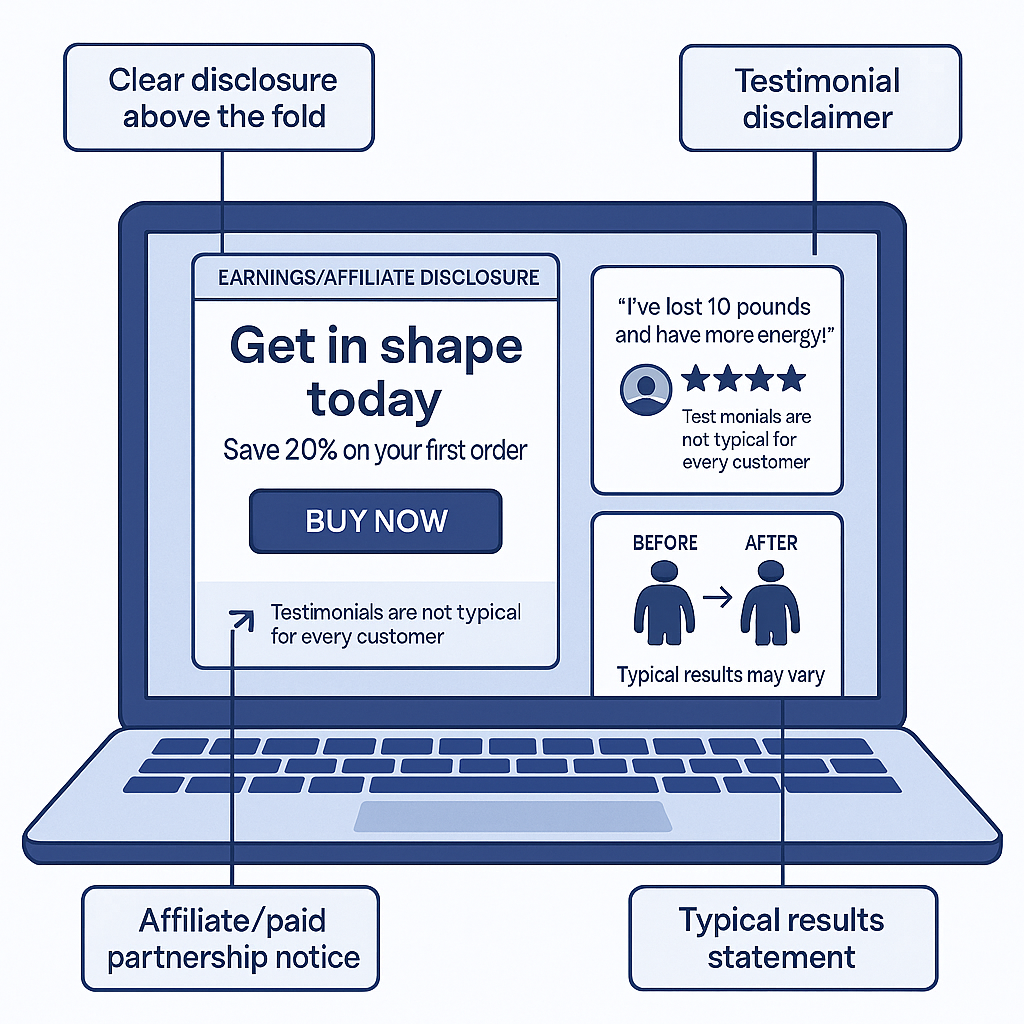
Disclosure placement matters more than most marketers realize. Burying an affiliate disclaimer at the bottom of your page—or worse, on a separate "disclosures" page—won't protect you when regulators come knocking.
Effective disclosures appear before the user needs to make a decision. If you're promoting a software tool with affiliate links, the disclosure needs to be visible before they click through to the vendor. Not after. Not in fine print. Right there in the flow of your content.
The language matters too. "I may earn a commission" is weaker than "I earn a commission when you purchase through my links." The FTC prefers definitive statements over hedged language that obscures the relationship.
Health and Income Claims: The Danger Zone
Health and income-related offers operate under microscopic scrutiny. The supplement space got hammered in 2024 when the FTC launched coordinated actions against misleading weight loss claims. Income opportunity promotions face similar pressure.
Testimonials require substantiation. User-generated content needs disclaimers. Before/after photos must include typical results disclosures. The "results not typical" disclaimer isn't enough anymore—you need to specify what results are typical based on available data.
Privacy Compliance: GDPR, CCPA, and Beyond
Privacy regulations multiplied faster than most marketing teams could adapt. GDPR was just the beginning—now you're dealing with CCPA in California, VCDPA in Virginia, and a patchwork of state laws that each take slightly different approaches to user consent and data handling.
The challenge isn't just legal compliance. It's operational. How do you manage consent across multiple traffic sources? What happens when a user opts out of data collection but you've already passed their information to your email platform?
Consent Management That Doesn't Kill Conversions
Cookie consent banners became ubiquitous, but most implementations are terrible from both compliance and conversion perspectives. Users either ignore them completely or hit "reject all" out of frustration.
The highest-performing approach I've found involves progressive consent. Start with essential cookies only. Explain the benefit of additional tracking ("personalized content recommendations" sounds better than "behavioral targeting"). Make the upgrade optional but valuable.
ConvertKit handles this elegantly in their signup flows—they separate email consent from marketing automation consent, letting users choose their level of engagement without creating friction in the core conversion process.
International Targeting Complications
Running international campaigns means navigating multiple privacy frameworks simultaneously. Canadian PIPEDA requirements differ from Australian privacy laws. Brazil's LGPD takes a different approach than European GDPR.
Geographic targeting becomes a compliance strategy. Rather than trying to build one landing page that satisfies every jurisdiction, smart operators create region-specific experiences. European visitors see GDPR-compliant consent flows. California users get CCPA disclosures. The technical complexity increases, but so does legal protection.
Platform-Specific Compliance Strategies
Each major traffic source maintains its own compliance interpretation, and those interpretations shift regularly. What worked six months ago might violate today's policies.
Social Platform Requirements
Facebook's advertising policies extend beyond the ad creative to landing page content. Their review process flags misleading claims, unsubstantiated testimonials, and prohibited content categories. But their organic content policies are different—and Instagram's policies differ from both.
The key is understanding policy enforcement patterns. Facebook tends to be stricter on health claims during certain times of year (January weight loss crackdowns are predictable). They scrutinize political content more heavily during election cycles. Seasonal enforcement means compliance strategy needs to be dynamic.
TikTok's Creator Fund and Partner Program have their own compliance requirements that affect how you can monetize content. YouTube's monetization policies impact both ad revenue and affiliate promotion strategies.
Native and Display Network Standards
Native platforms like Taboola and Outbrain maintain editorial standards that go beyond legal compliance. They're protecting their relationships with premium publishers—CNN, Fox News, major newspaper sites—which means content quality standards are subjective and constantly evolving.
Outbrain rejected a campaign I ran promoting a legitimate productivity software because the headline "This App Changed My Life" was deemed "overly sensational." The same headline sailed through Revcontent without question. Understanding these nuances requires ongoing testing and relationship management.
Building Compliance Into Your Campaign Workflow
Reactive compliance—fixing problems after they arise—is expensive and inefficient. The smart approach involves building compliance checks into your campaign development process from day one.
Pre-Launch Compliance Audits
Every landing page should pass through a structured compliance review before traffic hits it. This isn't about perfection—it's about identifying obvious red flags that could trigger immediate account suspensions.
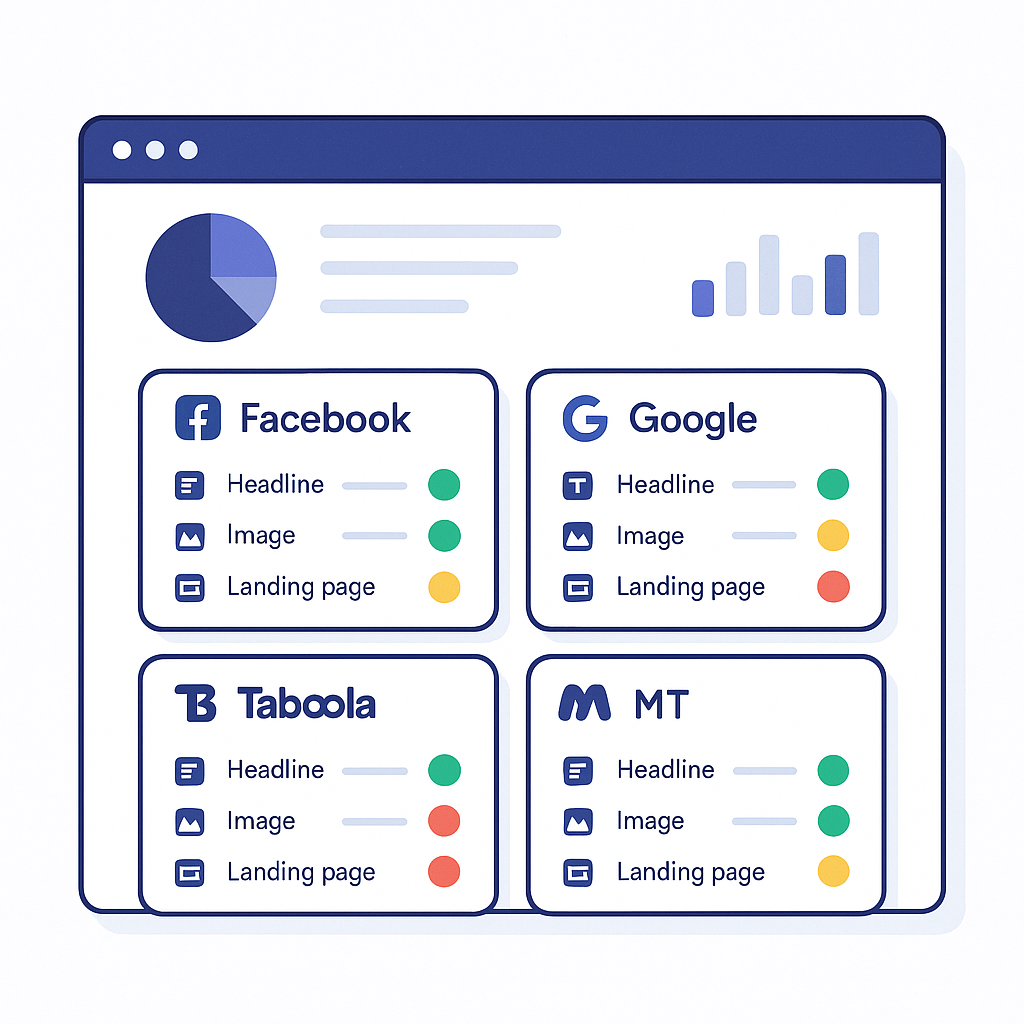
The audit covers legal requirements (FTC disclosures, privacy policies, terms of service), platform-specific policies (ad network guidelines, publisher requirements), and technical compliance (SSL certificates, mobile responsiveness, load speeds that meet platform minimums).
I use a simple scoring system: green light (compliant), yellow (minor issues that should be addressed), red (campaign-killing problems that must be fixed). Yellow issues can often wait until after initial testing proves viability. Red issues stop everything.
Ongoing Monitoring and Updates
Policy changes happen constantly, and they're not always announced clearly. Facebook might update their advertising policies with two weeks' notice buried in a developer blog post. Google could change their landing page requirements and grandfather existing campaigns for 30 days.
Staying current requires systematic monitoring. Set up Google Alerts for policy changes across your major traffic sources. Join affiliate marketing communities where policy updates get discussed quickly. Follow compliance-focused newsletters and legal blogs that track regulatory changes.
The goal isn't to catch every minor policy tweak—it's to spot the major shifts early enough to adapt before they impact your campaigns.
The Future of Landing Page Compliance
Compliance requirements will only get more complex as privacy concerns intensify and regulatory oversight expands. The trends are clear: more disclosure requirements, stricter data handling rules, and platform policies that favor brand advertisers over performance marketers.
Artificial intelligence is changing both sides of the compliance equation. AI-powered content generation makes it easier to create compliant copy at scale—but it also enables regulators and platforms to detect policy violations more efficiently.
The marketers who thrive will be those who treat compliance as a competitive advantage rather than a necessary evil. Clean, compliant campaigns get better platform treatment, higher approval rates, and longer lifespans. In a world where traffic costs keep rising, compliance becomes a form of operational efficiency.
Smart operators are already building compliance expertise as a core competency. They're developing relationships with legal counsel who understand performance marketing. They're creating internal processes that scale with campaign volume. Most importantly, they're viewing compliance as an investment in long-term business sustainability rather than a short-term cost center.
Related reading: ClickFunnels vs GoHighLevel breakdown
Related reading: Affiliate Marketing FAQ: Honest Answers for Beginners
Frequently Asked Questions (Updated 2026)
Do I need to disclose AI-generated content on my affiliate landing pages in 2026?
Yes, and this is one of the fastest-moving compliance requirements of 2026. Google Ads now requires disclosure when AI-generated content appears on landing pages connected to paid campaigns—this includes AI-written copy, AI-generated images, and synthetic testimonials or reviews. The FTC's updated endorsement guidelines, which took full effect in late 2025, also address AI-generated social proof specifically: synthetic reviews, fabricated user testimonials created with AI tools, and AI-generated before/after imagery in health or financial contexts are all explicitly flagged as deceptive practices subject to enforcement action.
From a practical standpoint, you should audit every element of your landing page and document what was AI-assisted versus human-created. If AI tools were involved in generating testimonials, product images, or results claims, you need clear disclosure language—not buried in fine print, but prominently placed near the content in question. Native platforms including Taboola and Outbrain have also begun requiring AI content declarations in their editorial submission processes. The safest approach: treat AI disclosure the same way you treat affiliate relationship disclosure—visible, plain-language, and positioned where users will actually see it before engaging with the content.
How does the Texas TDPSA affect affiliate landing pages targeting US audiences in 2026?
The Texas Data Privacy and Security Act (TDPSA) entered meaningful enforcement territory in 2026, and it matters for affiliate marketers more than most realize. If your landing page collects personal data—email addresses, phone numbers, behavioral data via pixels—from Texas residents, and your operation meets the threshold definitions (which are broader than many assume and don't require physical presence in Texas), you have compliance obligations around data processing disclosures, opt-out mechanisms for data sales, and privacy policy requirements.
The practical implications for landing pages: your privacy policy must be current, accessible, and specifically address your data practices in TDPSA-compliant language. If you're passing lead data to third-party buyers or affiliate networks—which is common in pay-per-lead models—that likely constitutes a 'sale' of personal data under the TDPSA definition, requiring a clear opt-out mechanism on your page. Combined with California's CCPA, Florida's expanded provisions, and the growing list of state frameworks, the days of a single generic privacy policy covering your entire US traffic are effectively over. Work with a privacy attorney to implement a geo-aware consent management platform (CMP) that serves appropriate disclosures based on visitor location—this is now table stakes for serious affiliate operations, not optional infrastructure.
What's the fastest way to audit an existing affiliate landing page for 2026 compliance gaps?
A structured audit covering five key areas will catch the most dangerous gaps quickly. First, run your landing page URL through your primary traffic platform's policy checker tools—both Meta's Ad Library transparency tools and Google's policy center offer diagnostic signals. Second, review every claim on the page against the FTC's updated substantiation standards: income claims, health outcome claims, and results testimonials all require documented substantiation that you should be able to produce on demand. Third, check your disclosure placement—affiliate relationship disclosures must appear before the user engages with affiliate content, not at the bottom of a long-scroll page. Fourth, audit your data collection touchpoints: every form field, pixel, and tracking script should be reflected accurately in your privacy policy, and your consent mechanisms should meet the requirements of any state privacy law applicable to your traffic sources. Fifth, test your page against current platform creative policies manually—load it fresh and read it as an enforcement reviewer would, flagging superlative claims, urgency language, and before/after comparisons that platforms are actively targeting in 2026. Tools like IsItWP's compliance scanner, Termly, and iubenda have updated their rulesets for 2026 state law changes and are worth running as a secondary check after your manual review.
This article contains affiliate links. We may earn a commission at no extra cost to you. Full disclosure.
Editorial Team
Senior Digital Marketing Strategist
The Prophet Visionary editorial team covers affiliate marketing, paid traffic, funnels, and digital product strategy with hands-on practitioner experience.
Learn more about our editorial team →The Right Platform Simplifies Your Entire Stack
Fewer tools means fewer tracking gaps, simpler compliance, and cleaner data. Systeme.io consolidates funnels, email, courses, and affiliates so your analytics actually make sense.
See the Simplified StackThis page contains affiliate links — I may earn a commission at no extra cost to you.
Disclaimer: The information on this site is for educational purposes only and does not constitute financial, legal, or business advice. Results vary based on individual effort, market conditions, and other factors. Always do your own due diligence before making business or investment decisions.