The SEO Blogging Strategy That Actually Converts Traffic in 2026 and Into The Foreseeable Future
Most affiliate marketers treat SEO blogging like throwing spaghetti at the wall. They pump out generic "how-to" content, sprinkle in some keywords, and wonder why their organic traffic converts worse than their paid campaigns.
I've been running SEO-driven affiliate campaigns since Google still showed PageRank scores, and here's what I've learned: the bloggers making real money aren't just ranking—they're building systematic content engines that feed their funnels.
The difference between a hobby blog and a revenue-generating content machine comes down to three things: intent mapping, conversion architecture, and what I call "compliance-first optimization." Most people get at least two of these wrong.
Intent Mapping: Beyond Basic Keyword Research
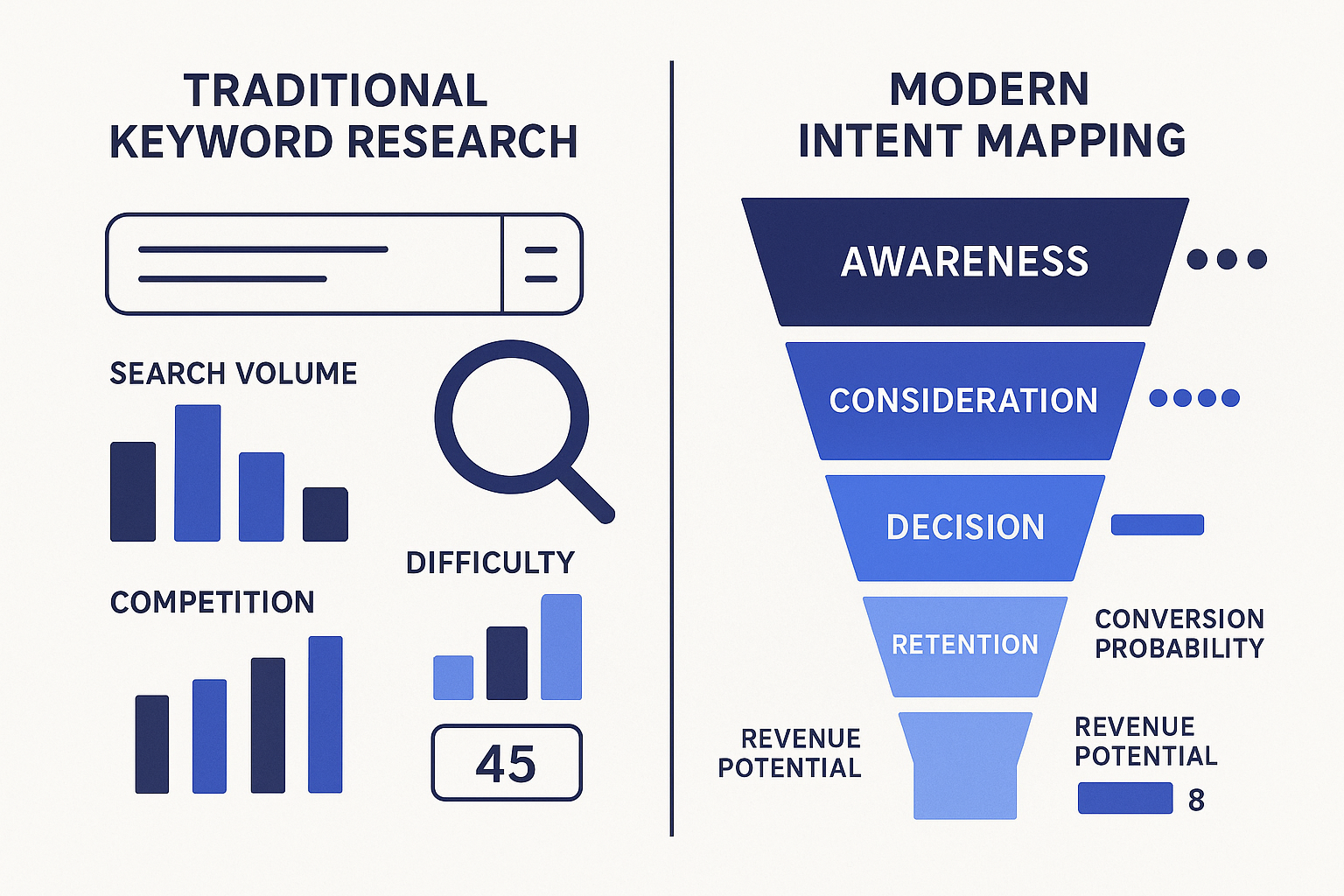
Traditional keyword research is dead. Well, not dead—but if you're still using search volume as your primary metric, you're missing the point entirely.
The real money lives in understanding search intent layers. When someone searches "best CRM for small business," they're not just looking for a listicle. They're 2-3 weeks into a buying cycle, comparing solutions, and probably dealing with a specific pain point that pushed them to finally research alternatives.
Here's how I map intent for affiliate content:
- Problem-aware searches: "why is my email deliverability dropping" (top-of-funnel, educational content)
- Solution-seeking searches: "email marketing automation tools" (comparison content, multiple affiliate angles)
- Vendor-comparison searches: "ConvertKit vs Mailchimp 2026" (bottom-funnel, high-converting)
The counterintuitive part? I spend more time on problem-aware content because it builds the foundation. Someone who reads your deliverability guide today becomes the person searching for email tools next month—and they'll remember your site.
The Revenue-Per-Visitor Framework
I track every piece of content by RPV (revenue per visitor), not just rankings. A post ranking #3 for a 1,000-volume keyword that converts at 0.2% with a $50 commission beats a #1 ranking on a 10,000-volume keyword converting at 0.02% with a $20 commission.
The math is simple, but most bloggers never do it.
Say you're in the project management software space. Your "Asana vs Monday.com" comparison post gets 2,500 monthly visitors. If 3% click through to affiliate offers and 8% of those convert (realistic numbers for good comparison content), you're looking at 6 conversions monthly. At $30-50 commissions, that's one post generating $180-300 per month.
Now multiply that by 50 similar posts. That's the difference between a side hustle and a business.
Content Architecture That Actually Converts
Here's where most SEO bloggers completely fumble the ball. They optimize for rankings but forget about conversions until the very end—usually with a weak "check out this tool" link buried in paragraph seven.
Conversion-focused content architecture starts with the end goal and works backward. Before I write a single word, I know exactly where I want the reader to go and what objections I need to handle.
The Three-Layer Conversion Model
Layer 1: Soft Conversion
Email capture, usually through a content upgrade that's genuinely useful. For that project management post, maybe it's a "Software Selection Checklist" PDF. Nothing salesy—just value that requires an email.
Layer 2: Medium Conversion
This is where most of your affiliate revenue comes from. Direct product recommendations, comparison tables, "best for" scenarios. The key is specificity—don't just say "Asana is great for teams." Say "Asana works best for creative teams under 15 people who need visual project tracking but don't want to pay for advanced reporting features."
Layer 3: Hard Conversion
Direct response elements. Limited-time bonuses, exclusive deals, urgency-driven CTAs. Use these sparingly, but when someone's clearly ready to buy, give them a reason to buy now.
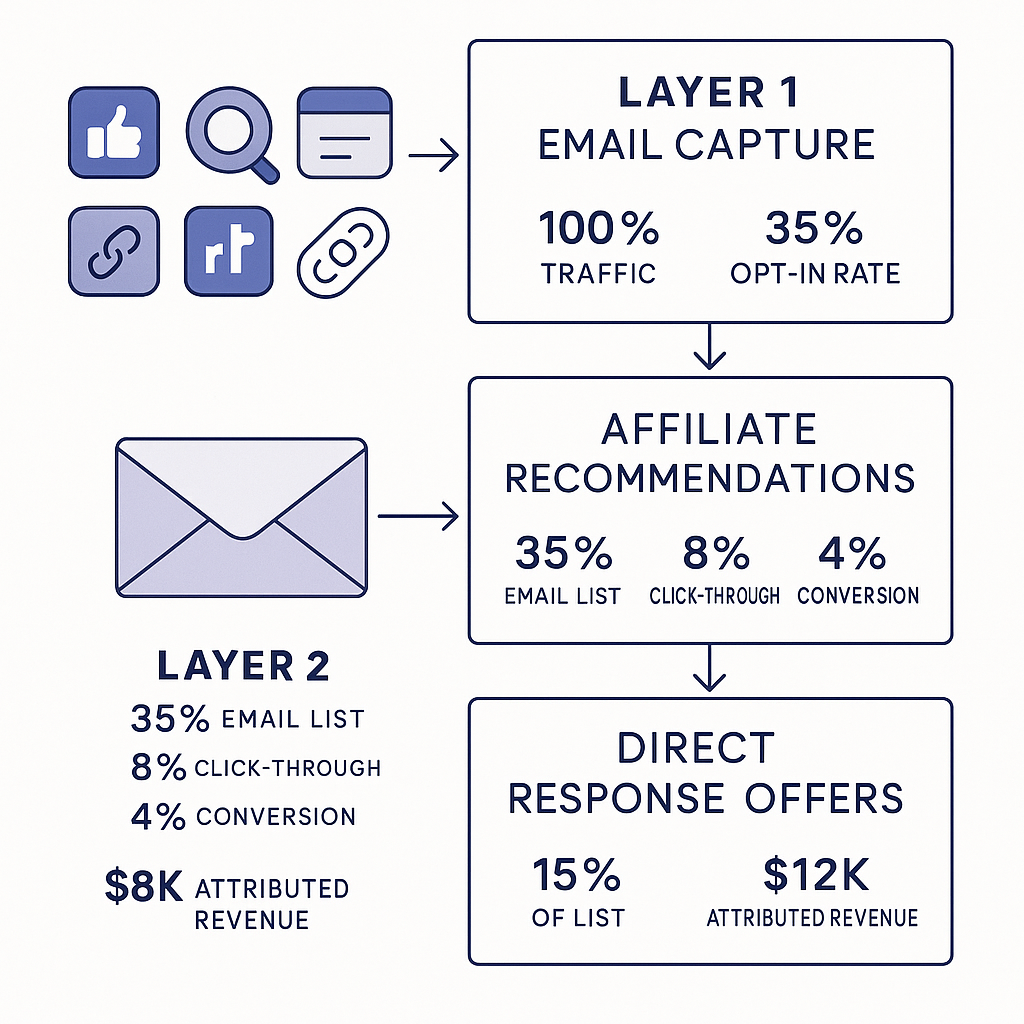
The architecture itself matters too. I structure high-converting posts with what I call "conversion checkpoints"—natural places where someone ready to buy can exit to an affiliate offer without disrupting the experience for people who want to keep reading.
Internal Linking That Builds Authority
Google's algorithm has gotten scary good at understanding topical authority. If you want to rank for competitive affiliate keywords, you need supporting content that proves you know what you're talking about.
I build content clusters around every major affiliate vertical. For email marketing tools, that means posts about deliverability, automation strategies, segmentation tactics, compliance requirements—all linking back to my main comparison and review posts.
But here's what most people miss: the internal links need to make sense for users, not just search engines. Link to related content when it genuinely helps someone understand the topic better. Forced internal linking feels forced, and Google can tell the difference.
Compliance-First SEO in the Privacy Era
The compliance landscape has shifted dramatically since iOS 14.5 and the ongoing death of third-party cookies. What worked for affiliate SEO in 2020 can get you in serious trouble in 2026.
The FTC has gotten much more aggressive about disclosure requirements, and Google's algorithm actively looks for proper affiliate disclosures. I've seen sites lose 40-60% of their organic traffic overnight because of disclosure issues.
Disclosure Strategy That Protects and Converts
Proper disclosure doesn't hurt conversions—it actually improves them when done right. People trust transparent recommendations more than hidden affiliate content.
My disclosure framework:
- Clear, prominent disclosure at the top of every affiliate post
- Contextual disclosures before affiliate links ("This is an affiliate link")
- Honest pros and cons for every recommended product
- Alternative recommendations, including free options when relevant
The last point is crucial. If you only recommend paid tools, readers get suspicious. Include genuinely good free alternatives, and your paid recommendations carry more weight.
Technical SEO for Affiliate Compliance
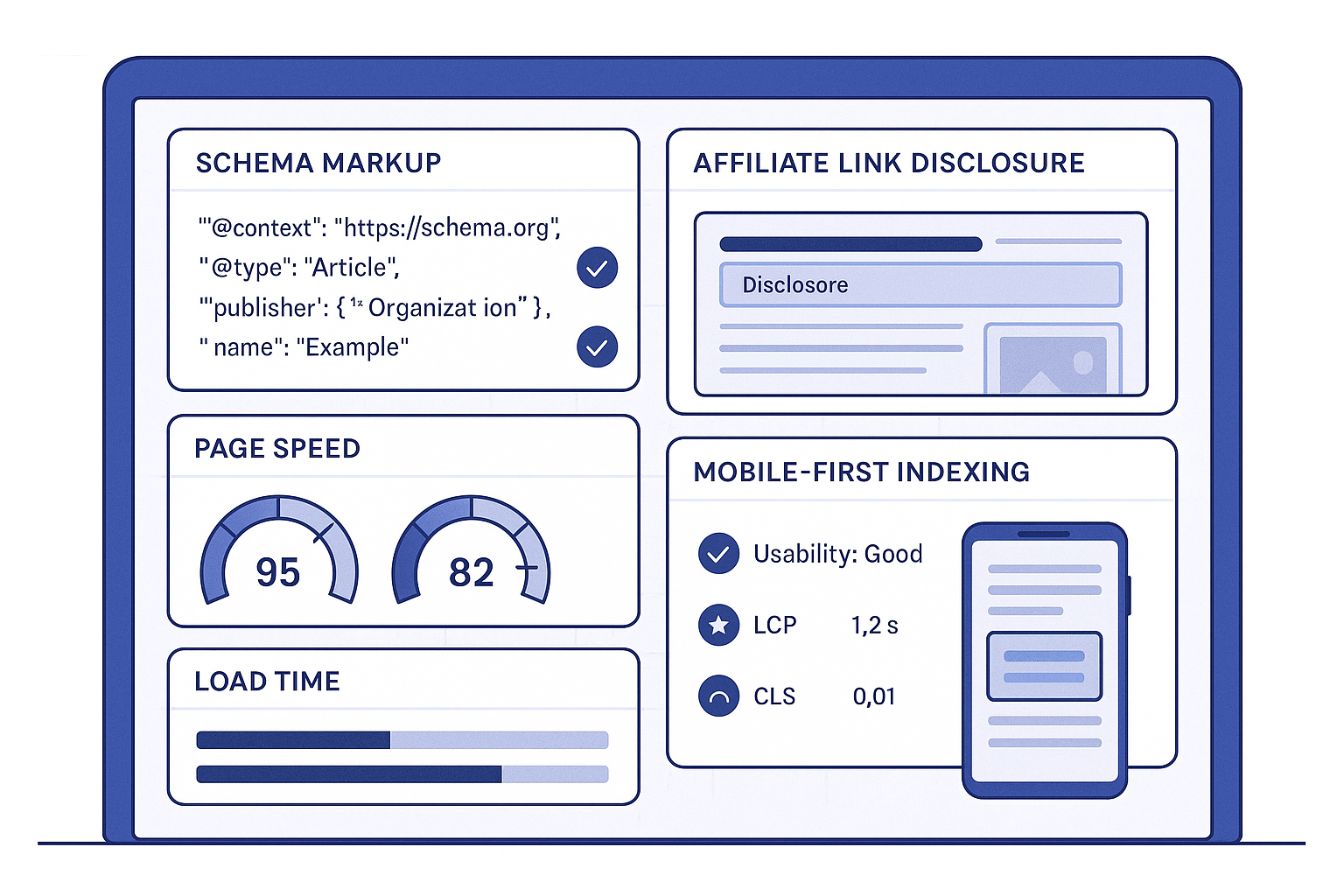
The technical side matters more than ever. Proper schema markup, affiliate link labeling, and page structure all impact both compliance and rankings.
I use structured data markup for all review content—it helps Google understand what you're reviewing and shows rich snippets in search results. The FAQ schema is particularly powerful for affiliate content because it lets you target question-based searches directly in the SERPs.
Content Velocity vs. Content Quality
There's this persistent myth in affiliate SEO that you need to publish daily to compete. It's nonsense.
I'd rather publish one thoroughly researched, properly optimized post per week than seven thin pieces of content. Google rewards expertise and depth, not publishing frequency.
Quality content in the affiliate space means:
- Actually using the products you recommend (or being honest about why you haven't)
- Updating posts regularly as products change
- Including real screenshots, not just stock photos
- Addressing specific use cases and user types
The research phase alone should take 2-3 hours for a comprehensive affiliate post. That includes competitor analysis, product testing (when possible), and understanding the actual customer journey for your target audience.
The Update Strategy That Compounds Results
Here's something most affiliate bloggers never do: they treat content as "publish and forget." The biggest wins come from updating and improving existing content.
I review every post quarterly and update based on:
- Product changes and new features
- Pricing updates
- New competitors entering the market
- Search ranking opportunities (new keywords the post could target)
- Conversion rate improvements
A post that's converting at 1.2% can often be improved to 2%+ with better CTAs, updated product information, or additional conversion checkpoints. That's literally doubling your revenue from existing traffic.
The Attribution and Measurement Reality
Most affiliate bloggers have no idea which content actually drives revenue. They look at affiliate dashboard numbers and Google Analytics separately, never connecting the dots.
Proper attribution tracking requires:
- UTM parameters on all affiliate links
- Google Analytics goals for affiliate clicks
- Regular cohort analysis to understand delayed conversions
- Content performance scoring based on actual revenue, not just clicks
The delayed conversion piece is huge. Someone might read your blog post, click an affiliate link, not convert immediately, then return directly to the vendor site three days later and purchase. Most attribution models miss this completely.
I've found that content-driven affiliate conversions often have a 7-14 day delay, especially for higher-priced software products. Factor this into your performance analysis or you'll make terrible optimization decisions.
What's Coming Next
AI content detection is getting better, but so is AI content generation. The winning strategy isn't to avoid AI tools—it's to use them strategically while maintaining genuine expertise and unique perspectives.
The affiliate bloggers who'll dominate in 2026 and beyond are the ones building real authority through consistent, helpful content that solves actual problems. The technical SEO tactics will keep evolving, but the fundamentals of understanding your audience and providing genuine value never change.
Search behavior is shifting toward more specific, longer queries as people get comfortable with voice search and AI assistants. This actually benefits affiliate bloggers who focus on detailed, specific content over generic keyword stuffing.
The opportunity has never been bigger—but neither has the importance of doing it right from both a revenue and compliance perspective.
Related reading: email platforms built for affiliate marketers
Frequently Asked Questions (Updated 2026)
Does Google's AI Overview (AIO) kill affiliate blog traffic in 2026?
Not entirely — but it does kill lazy affiliate blog traffic. AI Overviews tend to cannibalize broad informational queries ("what is email marketing," "how does affiliate marketing work") where the answer is straightforward enough for an AI to summarize. What AIO cannot replicate is first-person experience, nuanced tool comparisons, and proprietary data like RPV benchmarks or conversion rates from real campaigns.
The affiliate bloggers winning in 2026 have restructured their content around three AIO-resistant formats: (1) original case studies with specific numbers, (2) vendor comparison content that requires human judgment and recent hands-on testing, and (3) community-sourced insights that no AI model has been trained on yet. Bottom-funnel comparison content — like ClickFunnels vs GoHighLevel for affiliate funnel builders — continues to drive strong click-through rates because buyers actively want to read past the AI summary before committing.
The net effect for most affiliate blogs: informational traffic is down 20-40%, but conversion rates on remaining traffic are up because the casual browsers are being filtered out by AIO. Adapt your content strategy accordingly.
What's the best content-to-email funnel structure for affiliate SEO blogs in 2026?
The highest-converting structure in 2026 follows a three-stage handoff: blog content → lead magnet → segmented email sequence. Here's what's changed recently:
- Blog content now needs to do more pre-qualification work. With AI filtering out casual readers, the people landing on your posts are more intent-driven — your content should reflect that by going deeper faster, not easing in with basic definitions.
- Lead magnets are shifting from generic PDFs to tool-specific resources — checklists, swipe files, or calculators tied to the exact problem your post addresses. A deliverability post converts better with a "Deliverability Audit Checklist" than a generic "Email Marketing Guide."
- Email sequences need to be deliberately structured around offer stacking, not single-product pitches. Readers who came from SEO content are researchers — they respond to sequences that educate first and pitch second. See Offer Stacking for High-Ticket Affiliate Email Sequences for a full breakdown of how to structure this.
The biggest mistake affiliate bloggers make is treating the blog and the email list as separate channels. They're one funnel. Your SEO content is the top of it.
How do you do keyword research for affiliate blogs when AI search is changing what ranks?
In 2026, effective affiliate keyword research has shifted from volume-first to intent-depth analysis. Here's the updated framework:
Step 1 — AIO vulnerability check: Before targeting any keyword, search it yourself and check whether Google's AI Overview gives a complete answer. If it does, you need a unique angle (original data, a specific sub-niche, or a comparison element) or the traffic opportunity is marginal.
Step 2 — Commercial intent scoring: Prioritize keywords where the searcher is evaluating options, not just learning. "Best," "vs," "review," "alternative," and "for [specific use case]" modifiers still signal buying intent that AI summaries don't fully satisfy.
Step 3 — Sequence keyword mapping: Map your keywords to where they sit in a buyer's journey, then connect them to your email funnel. A reader who finds you via a problem-aware keyword should enter a different email sequence than one who arrived via a vendor comparison. This is where most affiliate bloggers leave money on the table — the SEO and email sides never talk to each other. If your welcome sequence isn't converting these segmented readers, the problem is often structural: Why Your Welcome Sequence Isn't Selling Affiliate Offers breaks down the most common architecture failures.
Step 4 — AI-citation potential: Increasingly, traffic arrives via AI tools citing your content. Write content that's citation-worthy: specific statistics, clear frameworks with named steps, and direct answers to precise questions. This is the new "featured snippet optimization."
This article contains affiliate links. We may earn a commission at no extra cost to you. Full disclosure.
Editorial Team
Senior Digital Marketing Strategist
The Prophet Visionary editorial team covers affiliate marketing, paid traffic, funnels, and digital product strategy with hands-on practitioner experience.
Learn more about our editorial team →The Right Platform Simplifies Your Entire Stack
Fewer tools means fewer tracking gaps, simpler compliance, and cleaner data. Systeme.io consolidates funnels, email, courses, and affiliates so your analytics actually make sense.
See the Simplified StackThis page contains affiliate links — I may earn a commission at no extra cost to you.
Disclaimer: The information on this site is for educational purposes only and does not constitute financial, legal, or business advice. Results vary based on individual effort, market conditions, and other factors. Always do your own due diligence before making business or investment decisions.