The 48-Hour Affiliate Funnel: Skip the Trial-and-Error Phase
Most beginners waste 3-6 months building their first affiliate funnel from scratch. They agonize over landing page copy, test dozens of email sequences, and burn through ad budgets while "learning the ropes."
That's backwards thinking.
The fastest path to your first profitable affiliate campaign isn't innovation—it's intelligent imitation. I've watched hundreds of beginners shortcut the learning curve by starting with proven funnel frameworks and adapting them to their offers. The difference? They're collecting commissions while others are still tweaking button colors.
Why Template-Based Funnels Beat "Original" Builds
Here's what most people get wrong about affiliate marketing: they think they need to reinvent the wheel. You don't. Every profitable affiliate funnel follows predictable patterns because human psychology doesn't change.
The supplement space uses quiz funnels that segment traffic by health goals. Dating offers rely on "compatibility tests" that build investment before the pitch. Weight loss campaigns use before/after story bridges that create emotional connection.
These patterns work because they've been split-tested across millions of dollars in ad spend.
When you start with a template, you're beginning with a framework that's already survived the market. Your job isn't to create—it's to customize and optimize. Say you're promoting a ClickBank weight loss offer with a $37 commission. Instead of writing landing page copy from scratch, you'd find a high-converting template from the same vertical and adapt the messaging to your specific product.
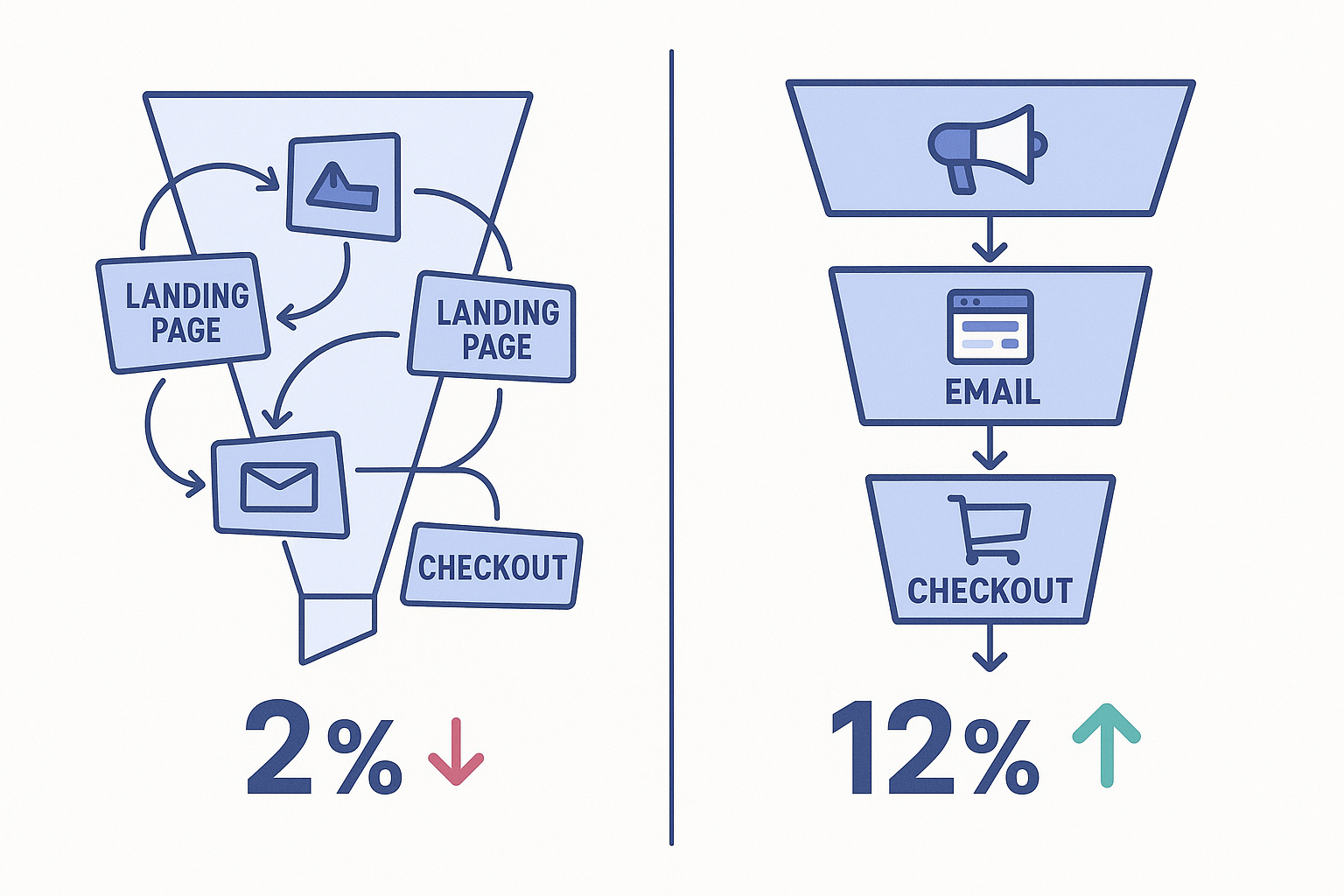
The counterintuitive part? Templates actually perform better than most "custom" funnels because they eliminate the guesswork around funnel psychology.
The 48-Hour Funnel Build Process
I've refined this process with dozens of students. It works because it focuses on execution over perfection.
Day 1: Template Selection and Customization
Start by identifying your offer type. Is it an information product, supplement, software tool, or service? Each category has specific funnel patterns that convert.
For info products, you'll typically want a video sales letter (VSL) bridge page that builds authority before sending to the vendor's sales page. Software offers work better with free trial bridges that demonstrate value. Physical products often convert through comparison pages that position your offer against alternatives.
Once you know your pattern, source your template. Systeme.io offers solid funnel templates for $27/month. ClickFunnels has an extensive template library (though it's pricier at $147/month). If you're budget-conscious, you can find proven templates on sites like FunnelFlux or even reverse-engineer successful funnels using tools like BuiltWith.
Customization is where beginners either win or waste time. Focus on three elements: headline, hero image, and primary call-to-action. Don't rewrite everything—adapt the existing copy to match your offer's specific benefits and your target audience's language.
Day 2: Traffic Integration and Testing
Most beginners obsess over funnel perfection and ignore traffic setup. Wrong priority.
Your funnel is worthless without qualified visitors. Set up your tracking first—use something like Voluum or RedTrack to monitor conversions from source to sale. Then configure your traffic source.
For beginners, I recommend starting with native ads on platforms like Taboola or Outbrain. They're more forgiving than Facebook and often cheaper than Google. You can often get clicks for $0.08-0.15 on NewsBreak or MGID if you're targeting the right demographics.
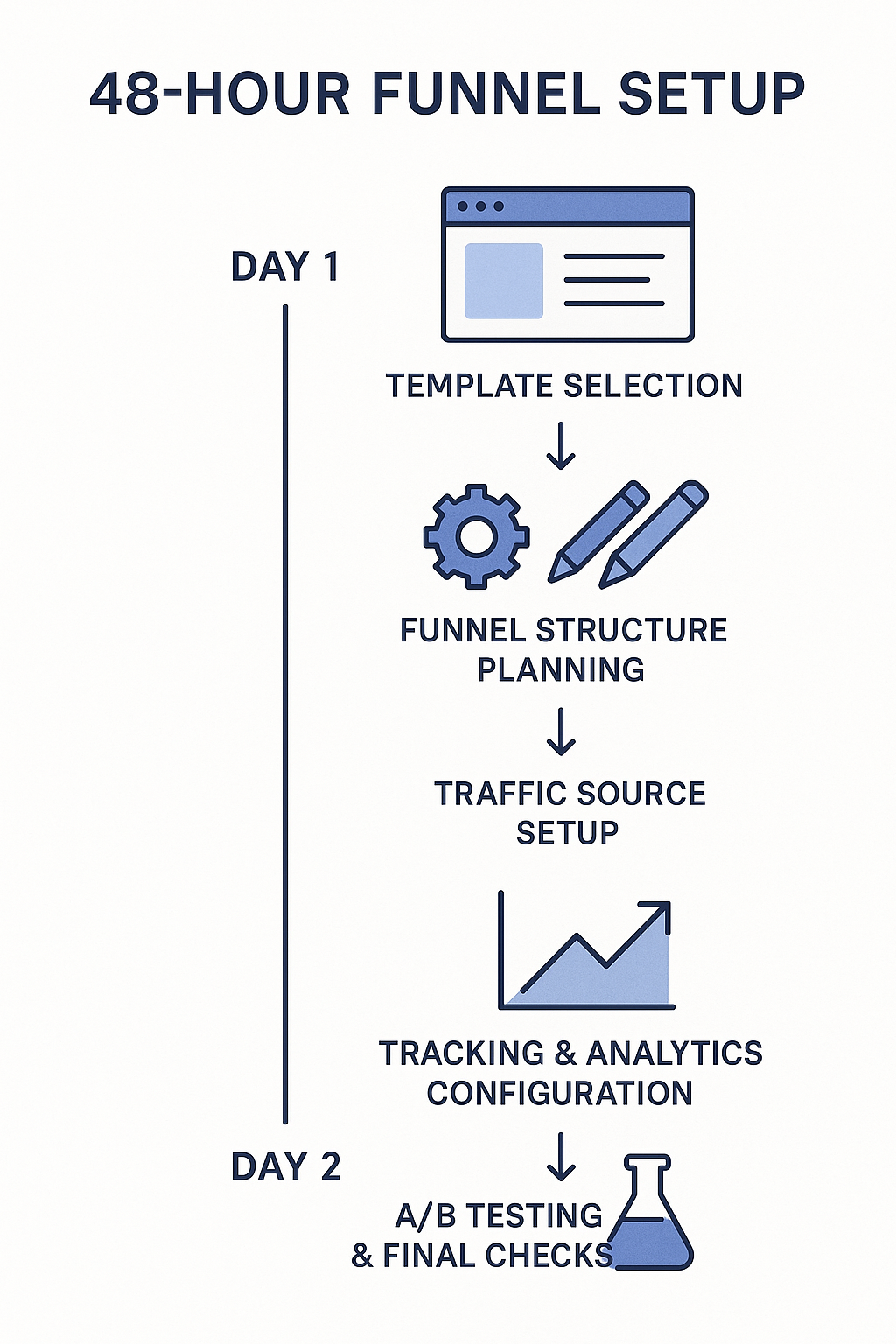
Launch with a small daily budget—$25-50 max—and focus on data collection, not immediate profits. You need at least 100 clicks before you can make meaningful optimization decisions.
Platform Selection: Where Beginners Go Wrong
The platform choice can make or break your speed-to-market. Most beginners either over-complicate or under-invest in their tech stack.
All-in-One vs. Best-of-Breed
All-in-one platforms like Systeme.io or GetResponse handle landing pages, email sequences, and affiliate link management in one dashboard. They're perfect for beginners because there's less integration headache. You can have a complete funnel running in hours, not days.
Best-of-breed approaches—combining ConvertKit for email, Unbounce for landing pages, and Voluum for tracking—offer more flexibility but require technical knowledge most beginners don't have yet.
My recommendation? Start all-in-one, then migrate to specialized tools once you're generating consistent commissions.
But here's the thing about platform choice: it matters less than execution speed. I've seen profitable funnels built on $19/month platforms outperform "premium" setups that took weeks to configure.
Integration Shortcuts
Zapier connections can automate most of the tedious funnel management tasks. Set up zaps to add new leads to your email sequences, trigger follow-up campaigns based on click behavior, and sync conversion data with your tracking platform.
The real shortcut? Use platforms that integrate natively with major affiliate networks. If you're running ClickBank offers, choose funnel builders that have direct ClickBank integration. Same for ShareASale, CJ Affiliate, or Impact.
Email Sequence Templates That Convert
Email is where most affiliate commissions actually happen. Your landing page gets attention—your email sequence gets conversions.
The mistake beginners make is writing "educational" email sequences that never ask for the sale. Your subscribers didn't opt-in for a newsletter—they want the solution your offer provides.
The 5-Email Conversion Sequence
Email 1 (immediate): Deliver the lead magnet and set expectations for what's coming.
Email 2 (day 1): Share a case study or success story related to your offer. Include your affiliate link naturally within the story.
Email 3 (day 3): Address the biggest objection to your offer. If it's price, talk about ROI. If it's skepticism, provide social proof.
Email 4 (day 5): Create urgency with a time-sensitive bonus or discount (if your merchant allows it).
Email 5 (day 7): Final pitch with scarcity angle—limited spots, ending soon, etc.
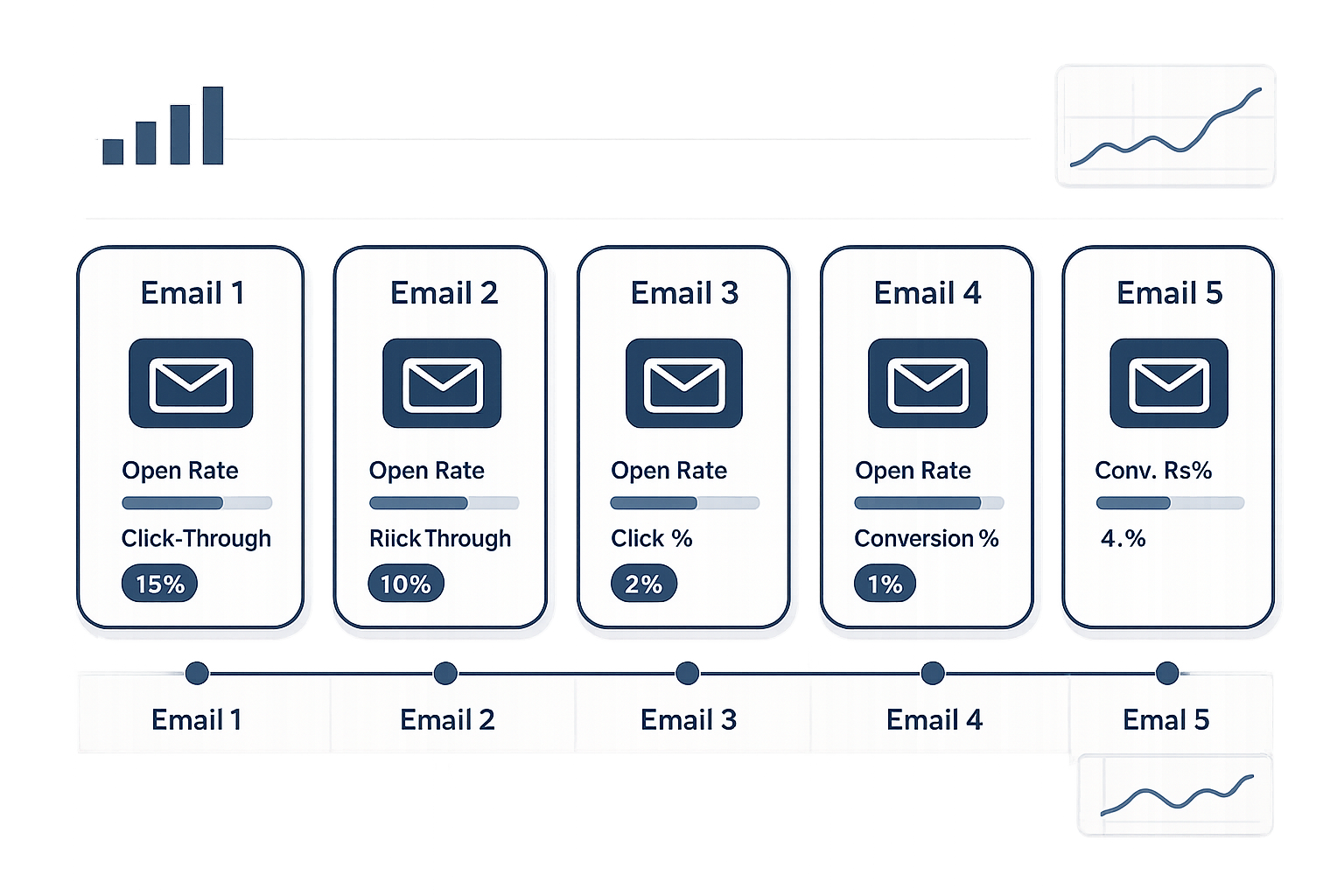
This isn't revolutionary—it's reliable. I've used variations of this sequence across dozens of verticals, from crypto education to fitness supplements. The psychology works because it builds trust while maintaining sales pressure.
Personalization Without Complexity
Advanced marketers use dynamic content and behavioral triggers. Beginners should focus on simple personalization that actually moves the needle.
Use the subscriber's first name (obviously), but also reference their specific pain point from your landing page. If they opted in for "lose 10 pounds in 30 days," your emails should consistently reference that goal.
Tag subscribers based on their traffic source. Someone who came from a Facebook ad about "quick weight loss" has different motivations than someone from a blog post about "sustainable fitness." Adjust your messaging accordingly.
Testing and Optimization: The 80/20 Approach
Beginners either don't test anything or test everything. Both approaches kill profits.
The 80/20 rule applies here: focus on the elements that drive the biggest conversion improvements. That's usually headline, offer presentation, and traffic source—not button colors or font choices.
Start with headline variations. A strong headline can double your opt-in rates, which doubles your email list growth, which doubles your commission potential. Test 3-4 variations using your platform's built-in split testing.
Next, test your traffic sources. The same funnel that converts at 2% from Taboola might convert at 6% from Outbrain, or vice versa. Traffic quality varies dramatically between platforms.
Only after you've optimized those major elements should you test smaller details like email subject lines or call-to-action button text.
The real shortcut here is knowing when to stop testing and start scaling. Once you find a profitable combination—even if it's not perfect—put more budget behind it. You can optimize a profitable campaign, but you can't optimize a campaign that doesn't convert at all.
Scaling Beyond the Template
Templates get you started, but scaling requires customization based on your specific data.
Once you're generating consistent commissions, you'll start seeing patterns in your analytics. Maybe your quiz funnel works better for mobile traffic. Maybe your email sequence converts better when you add a sixth email. Maybe your landing page performs better with video testimonials instead of text.
These insights come from real traffic and real conversions, not theoretical best practices. That's when you start moving beyond templates into true optimization.
The key is treating your initial template as a minimum viable funnel, not a final product. It gets you to market quickly so you can start collecting the data that drives real improvements.
Smart affiliates also use their successful funnels as templates for new offers. Once you've proven a funnel structure works in one vertical, you can often adapt it to related offers with minimal changes. Your weight loss funnel might work for muscle building supplements. Your dating advice funnel might work for relationship coaching programs.
The affiliate marketing landscape is moving toward more sophisticated tracking and personalization, but the fundamentals haven't changed. People still buy solutions to problems, and funnels still need to build trust before asking for action.
What's changing is the speed at which you can test and iterate. AI tools are making copywriting faster, landing page builders are getting more intuitive, and traffic platforms are offering better targeting options.
The opportunity for beginners willing to move fast and test smart has never been better. Just don't confuse innovation with procrastination—your first funnel doesn't need to be perfect, it needs to be profitable.
Related reading: how long your affiliate email follow-up sequence should be
Related reading: offer stacking inside your email sequence to increase revenue per subscriber
Frequently Asked Questions (Updated 2026)
Can I build a 48-hour affiliate funnel using AI tools in 2026?
Yes—and in 2026, AI tools have made the 48-hour timeline more achievable than ever. Both GoHighLevel and ClickFunnels 2.0 now include native AI copy assistants that can generate headline variations, email sequences, and call-to-action copy based on your offer details. Tools like Jasper and Copy.ai integrate directly with most funnel builders via Zapier or native connections.
The practical workflow: use your platform's AI assistant to adapt template copy to your specific offer (takes 20–30 minutes instead of 2–3 hours), then use an AI image generator for any custom graphics you need on the landing page. The structural funnel work—page layout, automation triggers, email sequencing—still requires your hands-on setup, but the content creation bottleneck that used to slow beginners down is largely eliminated. AI is a speed multiplier here, not a replacement for understanding your offer and audience.
Is GoHighLevel or ClickFunnels better for building affiliate funnels fast?
For pure speed on a first affiliate funnel build, ClickFunnels 2.0 has a slight edge because its drag-and-drop editor has a shallower learning curve and its template library is heavily optimized for direct-response affiliate-style pages. You can have a landing page live in under two hours without prior experience.
GoHighLevel becomes the better long-term choice once you're managing multiple funnels or want to consolidate your landing pages, email marketing, SMS follow-up, and CRM into a single platform. Its Snapshot import system lets you pull entire pre-built affiliate funnel systems—pages plus automation—in one click, which is a significant time advantage at scale.
If you're brand new and building your first funnel this week, start with whichever platform your chosen affiliate program or mentor recommends so you have community support. See our full GoHighLevel vs ClickFunnels comparison for affiliate funnel builders for a side-by-side feature breakdown.
What should I do if my affiliate funnel gets traffic but no conversions after 48 hours?
Zero conversions after your first 48 hours with real traffic is normal—but it tells you something specific depending on where the drop-off happens. Use your funnel builder's analytics to identify the leak before changing anything.
If your landing page opt-in rate is below 20% on cold traffic, the problem is your headline or offer hook—swap in a different headline variant and retest. If opt-ins are healthy (25%+) but no one is clicking through to the affiliate offer, your bridge page or email sequence isn't creating enough desire before the pitch. Our guide on why your welcome sequence isn't selling affiliate offers covers the most common sequence mistakes that kill conversions after the opt-in.
If you're seeing clicks to the affiliate offer but no sales, the issue is likely offer-audience mismatch or the offer page itself—which is outside your control. In that case, test a competing offer in the same niche before rebuilding your funnel from scratch.
This article contains affiliate links. We may earn a commission at no extra cost to you. Full disclosure.
Editorial Team
Senior Digital Marketing Strategist
The Prophet Visionary editorial team covers affiliate marketing, paid traffic, funnels, and digital product strategy with hands-on practitioner experience.
Learn more about our editorial team →Build High-Converting Funnels Without 5 Different Tools
Systeme.io gives you a drag-and-drop funnel builder, email automation, upsells, order bumps, and analytics — all in one platform starting at $0/month.
See the Funnel BuilderThis page contains affiliate links — I may earn a commission at no extra cost to you.
Disclaimer: The information on this site is for educational purposes only and does not constitute financial, legal, or business advice. Results vary based on individual effort, market conditions, and other factors. Always do your own due diligence before making business or investment decisions.