Pre-Sell Pages That Pass Policy Reviews While Converting
The affiliate marketing landscape has turned into a policy minefield—and most marketers are stepping on every single explosive device.
I've watched countless campaigns get torched because someone thought they could slip past Facebook's review algorithms with the same pre-sell tactics that worked in 2019. The truth is, the platforms have gotten ruthlessly efficient at spotting non-compliant content, but they haven't gotten any better at explaining what actually works.
Here's what most people get wrong: they think compliance means neutering your copy until it converts about as well as a grocery store flyer. Wrong. The best-performing pre-sell pages I've seen lately are the ones that thread the needle perfectly—they satisfy the policy bots while still hitting every psychological trigger that makes people buy.
The New Reality of Platform Scrutiny
Every major traffic platform now runs your pre-sell pages through multiple review layers. Facebook's got human reviewers backed by AI that can spot misleading claims in your hero images. Google's crawling deeper into your funnel than ever before. Even native platforms like Taboola and Outbrain are cracking down on anything that smells like a hard pitch disguised as editorial content.
The shift happened gradually, then all at once. Privacy changes forced platforms to become more conservative about what they'll promote. Regulatory pressure made them hypersensitive to health claims, income promises, and anything that could trigger an FTC investigation.
But here's the counterintuitive part—this actually creates an opportunity for marketers who know how to adapt.
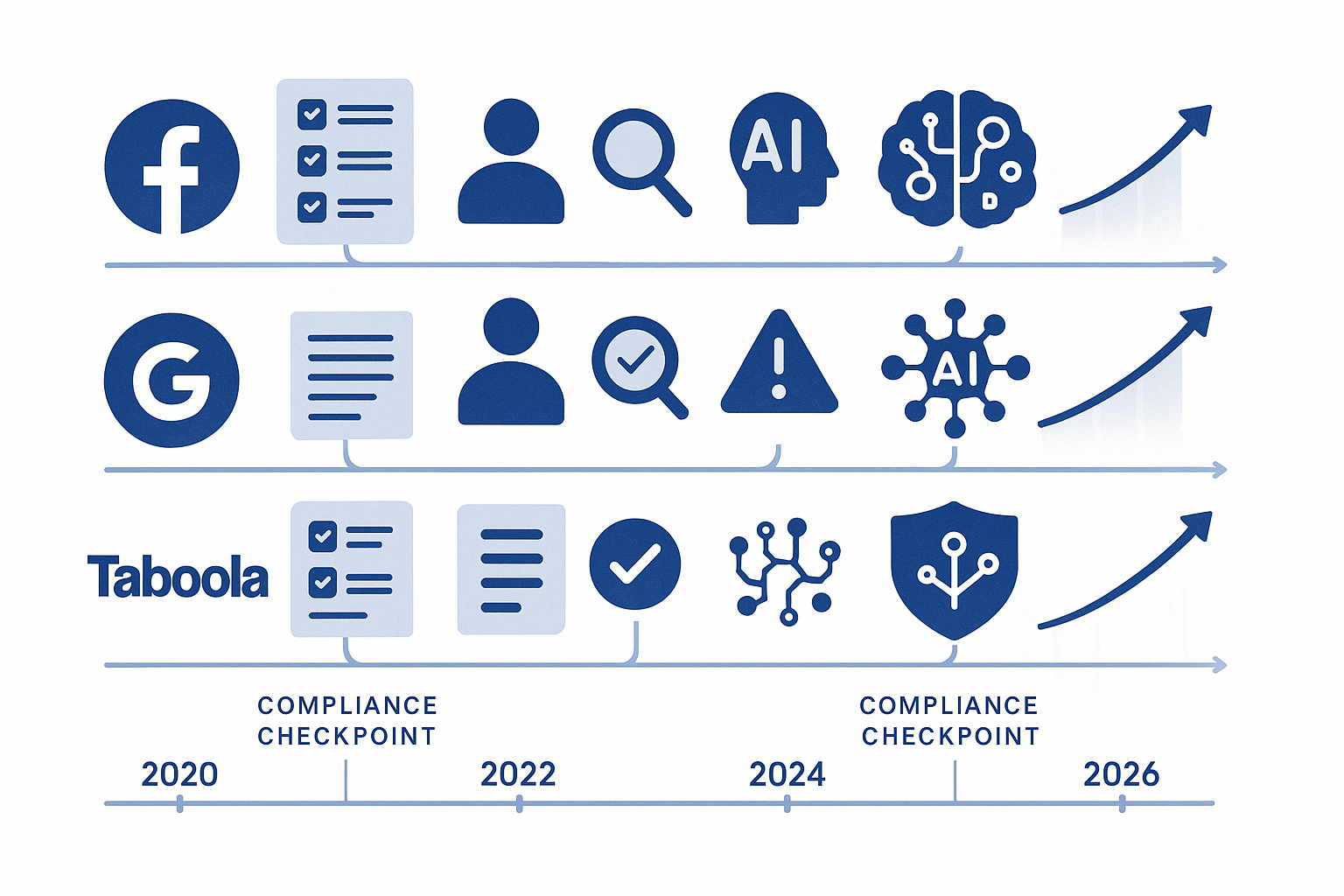
When everyone else is struggling to get their campaigns approved, the ones who master compliant conversion tactics suddenly have less competition and lower CPCs. I've seen advertisers cut their Facebook ad costs by 40% simply because their pre-sell pages sailed through review while competitors got stuck in approval hell.
Building Policy-Proof Page Architecture
The Three-Layer Compliance Framework
Every pre-sell page needs to pass three distinct review processes: automated scanning, human review, and post-approval monitoring. Most marketers optimize for one and ignore the other two.
Layer one is the bot scan. Platforms use OCR to read text in images, sentiment analysis on your copy, and pattern matching against known violative content. This is where obvious red flags get caught—income screenshots, before/after photos, urgent countdown timers.
Layer two involves human reviewers who spend maybe 30 seconds scanning your page. They're looking for the stuff the bots missed: implied claims, testimonials that seem fake, or copy that feels too "salesy" for the traffic source.
Layer three is the ongoing monitoring that happens after your ads go live. Platforms track user behavior signals—if people immediately bounce from your page or file complaints, that triggers additional scrutiny.
The Editorial Camouflage Strategy
The highest-converting compliant pages I've analyzed all use what I call "editorial camouflage." They look and feel like legitimate news articles or educational content, but they're engineered to pre-sell just as effectively as any traditional sales page.
Say you're promoting a joint pain supplement through native ads. Instead of leading with "Discover the Ancient Secret That Eliminates Joint Pain in 7 Days," you go with "Why Doctors Are Recommending This Overlooked Nutrient for Joint Health." Same psychological hook, completely different compliance profile.
The key is structuring your content like genuine editorial pieces. Start with a newsworthy angle. Include quotes from credible sources (even if they're just explaining general concepts, not endorsing your specific product). Use subheadings that sound like article sections, not sales copy bullets.
Conversion Psychology Within Compliance Constraints
Here's where it gets interesting—you can't use traditional scarcity tactics, but you can create urgency through information scarcity. Instead of "Only 24 hours left," try "New research published this month reveals..." People still feel compelled to act, but for compliance-friendly reasons.
Social proof becomes more nuanced too. Rather than showcasing dramatic testimonials, you reference broader trends: "Thousands of people are asking their doctors about this approach" or "The fastest-growing supplement category according to industry data."
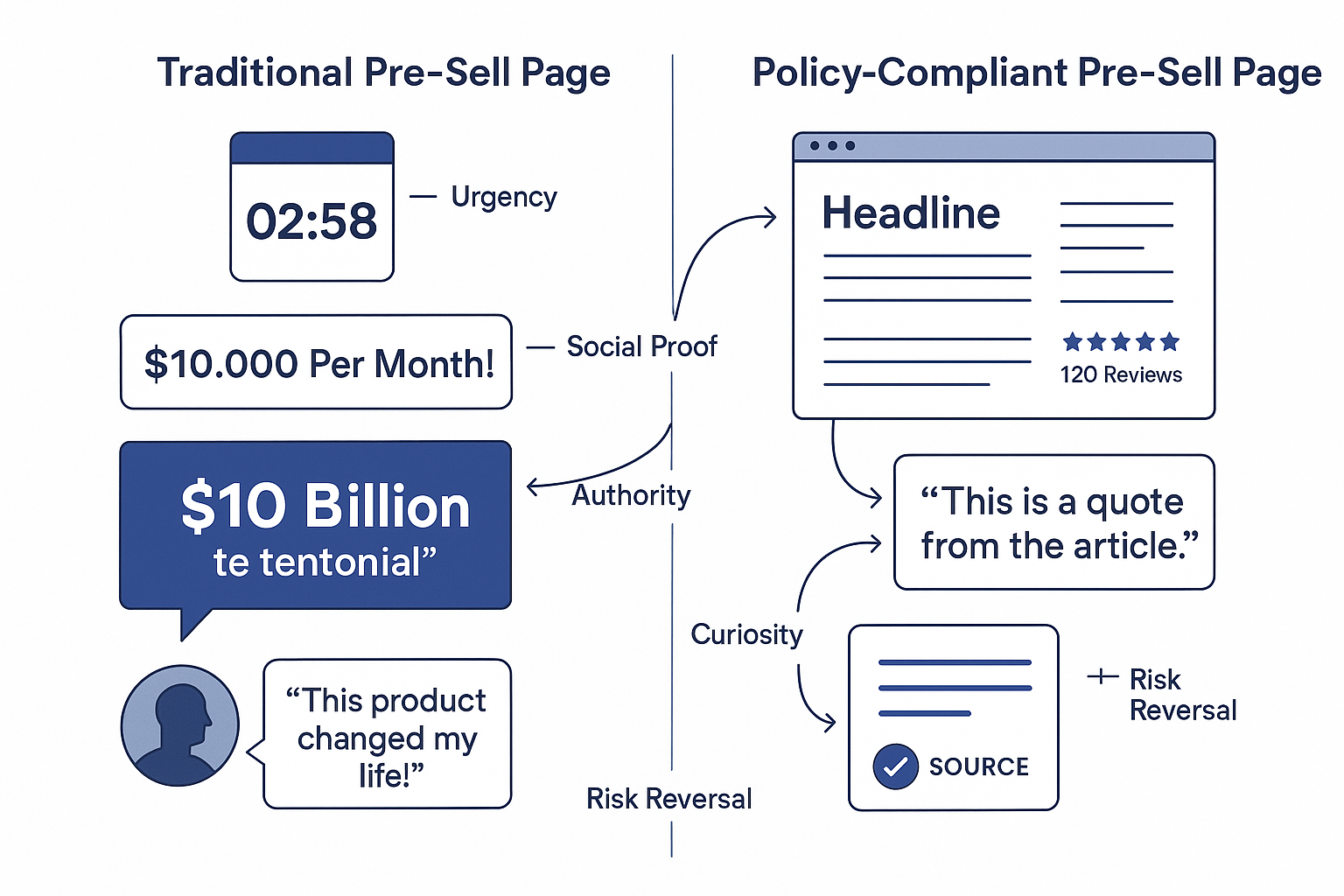
The emotional triggers still work—you just have to be more sophisticated about how you activate them. Fear of missing out transforms into fear of staying uninformed. Social proof shifts from individual success stories to collective behavioral trends.
The Soft-Sell Conversion Sequence
Most affiliate marketers still think in terms of hard transitions: hook the reader, agitate their problem, then slam them with the solution. That approach triggers every policy algorithm on the planet.
The soft-sell sequence feels more like education that naturally leads to a logical next step. You present information, let readers draw their own conclusions, then offer a way to learn more or take action based on what they've discovered.
I've found the most effective structure follows a "discovery narrative." You walk readers through recent findings, explain why this information matters to them personally, then position your offer as the natural way to apply these insights.
Technical Implementation for Policy Survival
Page Speed and User Experience Signals
Platforms are increasingly factoring user experience metrics into their approval decisions. A pre-sell page that loads slowly or feels spammy sends negative signals that can trigger additional review scrutiny.
Your page needs to load in under 3 seconds on mobile. Use tools like GTmetrix or PageSpeed Insights, but don't just chase the score—focus on perceived loading speed. A page that renders the above-the-fold content quickly feels faster even if the total load time is longer.
Mobile optimization isn't optional anymore. Over 70% of native traffic comes from mobile devices, and platforms are testing your pages on mobile-first. If your pre-sell page requires zooming or horizontal scrolling, you're asking for policy troubles.
Tracking and Attribution Compliance
This is where many marketers shoot themselves in the foot. They build compliant pre-sell pages, then blow it with aggressive tracking pixels or retargeting setups that violate platform policies.
iOS privacy changes mean you need to be more strategic about data collection. Use server-side tracking where possible, implement proper consent management, and be transparent about what data you're collecting.
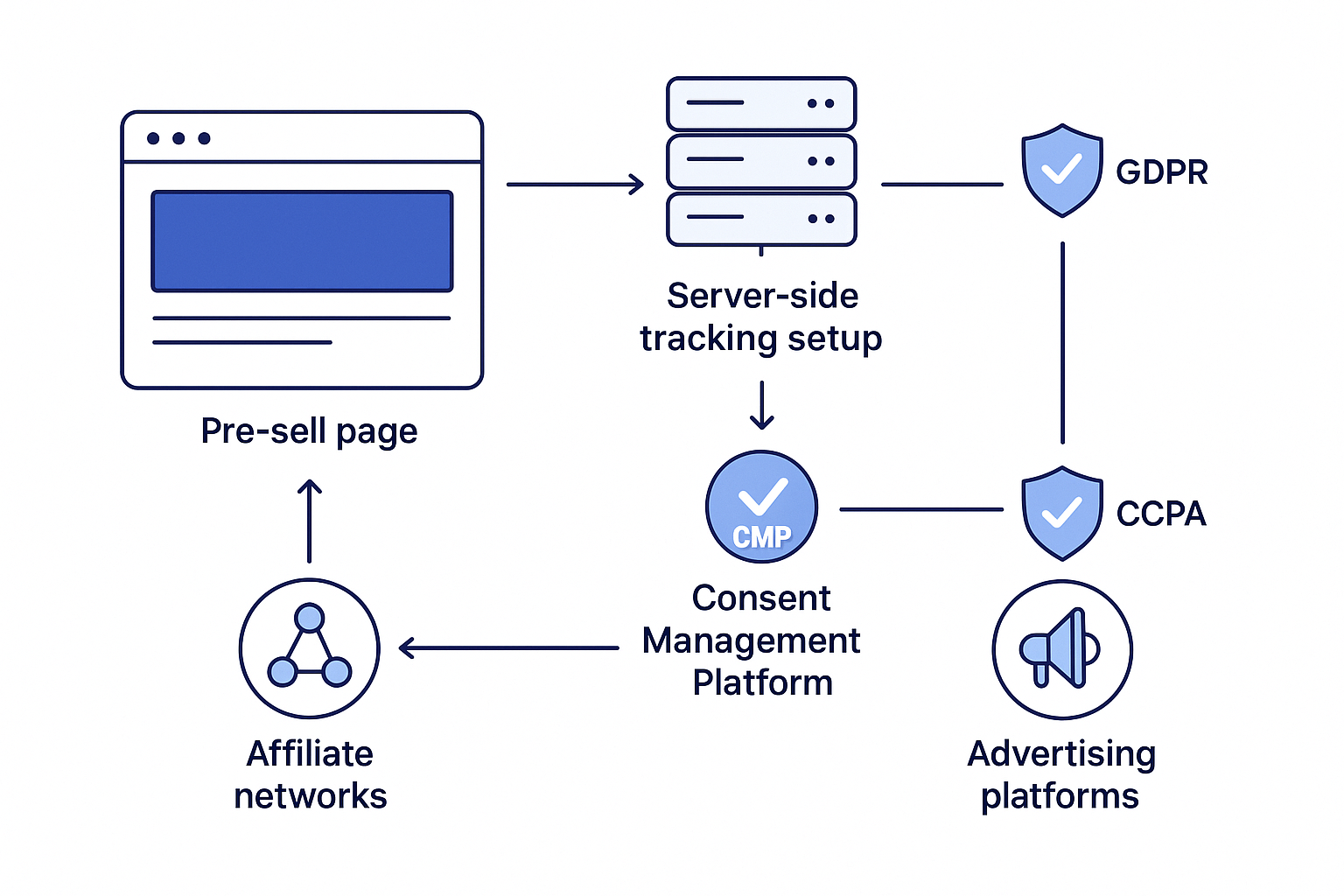
ConvertKit and Systeme.io have both updated their tracking to be more privacy-compliant by default, but you still need to configure things properly. Don't just copy tracking codes from old campaigns—verify that your setup meets current platform requirements.
Testing and Optimization Within Policy Boundaries
A/B testing compliant pre-sell pages requires a different approach than traditional conversion optimization. You can't just test more aggressive headlines against softer ones—you need to test different compliance strategies against each other.
I've found the biggest wins come from testing different editorial angles rather than different levels of sales aggression. For a weight loss offer, test "New Study Reveals Surprising Metabolism Factor" against "Why Nutritionists Are Changing Their Recommendations." Both are compliant, but they appeal to different psychological triggers.
The testing timeline is longer too. You need enough data to see not just conversion differences, but approval rate differences. A variation that converts 10% better but gets rejected 30% more often is actually worse for your overall ROI.
Data-Driven Compliance Optimization
Track your approval rates by traffic source, creative angle, and page variation. I use a simple spreadsheet that logs every campaign submission along with approval status, review time, and any feedback from platform reps.
Patterns emerge quickly. Maybe educational angles get approved faster on Facebook but convert better on native platforms. Maybe certain industries have different tolerance levels for the same compliance strategies.
The real insight comes from correlating approval data with performance data. You want to find the sweet spot where high approval rates meet strong conversion performance.
Future-Proofing Your Pre-Sell Strategy
Platform policies will only get stricter, but the fundamental principles of compliant conversion aren't going anywhere. The marketers who succeed long-term are the ones who view compliance as a competitive advantage, not a creative limitation.
AI-powered policy enforcement is getting more sophisticated, but it's also becoming more predictable. Once you understand the patterns these systems look for, you can design content that naturally avoids triggering them.
The biggest opportunity I see for 2026 is in authentic, value-driven pre-sell content. As platforms crack down on manipulative tactics, genuinely helpful content that happens to pre-sell effectively will stand out even more.
Smart marketers are already building relationships with platform reps, staying ahead of policy changes, and treating compliance as a core business competency rather than an afterthought. That's not just good practice—it's the foundation of sustainable affiliate marketing in an increasingly regulated environment.
Related reading: Why Your Affiliate Bridge Page Isn't Converting (And How to Fix It)
Frequently Asked Questions (Updated 2026)
Do Meta's Advantage+ campaigns have different pre-sell page requirements than standard campaigns in 2026?
Yes, and this distinction matters more than most affiliates realize. Advantage+ Shopping Campaigns (ASC) in 2026 apply an additional layer of automated quality scoring to your destination URL that standard manual campaigns don't trigger in the same way. Because Advantage+ uses Meta's AI to optimize delivery across placements automatically, the system weights landing page quality signals—load speed, content relevance, bounce rate, and policy compliance—more heavily in the auction than it does for manually targeted campaigns.
Practically speaking, this means a pre-sell page that technically passes policy review can still underperform in Advantage+ if its engagement metrics are weak. Meta interprets low engagement as a signal that the page is misleading or mismatched to ad intent, and it throttles delivery accordingly—often without any notification to the advertiser. The fix is to ensure your pre-sell page's content closely mirrors the specific promise made in your ad creative, not just the general topic. Tight message match between ad and page is now both a conversion best practice and a delivery optimization requirement under Advantage+.
Can AI-generated content on pre-sell pages trigger policy violations in 2026?
AI-generated copy itself isn't a policy violation on any major platform as of 2026—but the patterns that AI content tends to produce are increasingly flagged. Platforms have trained their detection systems on large volumes of AI-generated marketing copy, and certain structural patterns—repetitive benefit stacking, generic urgency phrases, and vague social proof statements—now score higher on automated risk assessments regardless of whether a human or an AI wrote them.
The more specific risk is factual accuracy. AI tools can generate confident-sounding claims about health outcomes, earnings potential, or product efficacy that don't have substantiation behind them. In 2026's regulatory environment, unsubstantiated claims are the fastest path to both platform rejection and FTC scrutiny. If you're using AI to draft pre-sell copy, treat the output as a first draft that requires a compliance pass: remove or substantiate any specific claims, add required disclosures, and replace generic urgency with legitimate, verifiable scarcity. Tools like Jasper and Copy.ai now include basic compliance flagging in their interfaces, but these should be treated as a starting point, not a final check.
What disclosures are required on affiliate pre-sell pages in 2026 to stay FTC-compliant?
The FTC's updated guidance, reinforced by several high-profile enforcement actions in 2025, now requires affiliate disclosure to meet a higher standard of clarity and placement than many affiliates are currently following. The key requirements as of 2026:
- Above-the-fold placement: Disclosure must appear before any product recommendation or endorsement, not at the bottom of the page. On mobile, this means it needs to be visible without scrolling.
- Plain language: Phrases like "This page contains affiliate links" or "I earn a commission if you purchase through links on this page" are acceptable. Vague terms like "partnered with" or "supported by" no longer meet the clarity standard.
- No visual burial: Disclosure cannot be in a font smaller than your body copy, in a low-contrast color, or hidden in a footer. It needs to be visually distinct enough that a typical reader would notice it.
- Testimonials require individual disclosure: If you're featuring user testimonials on your pre-sell page, each one needs a disclaimer indicating whether results are typical and whether the person was compensated.
Platform policies largely mirror these FTC requirements, so getting your disclosures right for regulatory compliance also improves your approval rates. For a full walkthrough of how this applies to paid traffic funnels specifically, see Bridge Page Compliance: Compliant vs. Non-Compliant Approaches.
This article contains affiliate links. We may earn a commission at no extra cost to you. Full disclosure.
Editorial Team
Senior Digital Marketing Strategist
The Prophet Visionary editorial team covers affiliate marketing, paid traffic, funnels, and digital product strategy with hands-on practitioner experience.
Learn more about our editorial team →Build High-Converting Funnels Without 5 Different Tools
Systeme.io gives you a drag-and-drop funnel builder, email automation, upsells, order bumps, and analytics — all in one platform starting at $0/month.
See the Funnel BuilderThis page contains affiliate links — I may earn a commission at no extra cost to you.
Disclaimer: The information on this site is for educational purposes only and does not constitute financial, legal, or business advice. Results vary based on individual effort, market conditions, and other factors. Always do your own due diligence before making business or investment decisions.