Pre-Sell Pages That Pass Reviews & Convert: 2026 Playbook
I've watched more pre-sell pages get slammed by compliance teams in the past year than in the previous five combined. Platform policies have tightened to the point where even legitimate offers are getting flagged—and it's not just Facebook anymore.
The game has fundamentally shifted. What worked in 2023 will get your account suspended in 2026. But here's what most affiliates miss: the same psychological triggers that make pages convert can be restructured to pass reviews without losing their punch.
The truth is, building compliant pre-sell pages that still convert isn't about neutering your copy. It's about understanding what reviewers are actually looking for—and what they're not.
The New Compliance Reality: What Changed
Platform reviewers now use AI-assisted scanning that flags specific language patterns, visual elements, and even traffic flow behaviors. I've seen accounts get dinged for things that weren't even on their radar two years ago.
Google's latest policy updates specifically target "bridge pages" that exist solely to circumvent advertiser policies. Facebook's review system now analyzes the entire funnel path, not just the landing page. And don't get me started on TikTok's new compliance algorithms—they're ruthless.
But the counterintuitive part? Some of the most compliant pages I've built are also the highest converting.
The Trigger Words That Kill Campaigns
Forget the obvious ones like "miracle" and "guaranteed." The new blacklist includes seemingly innocent phrases that pattern-match to problematic content. Words like "breakthrough," "secret," and even "discover" are getting flagged in certain contexts.
More importantly, reviewers are looking for combinations of elements. A health supplement page with urgency language plus testimonials plus scarcity elements equals instant rejection—even if each component is technically compliant on its own.
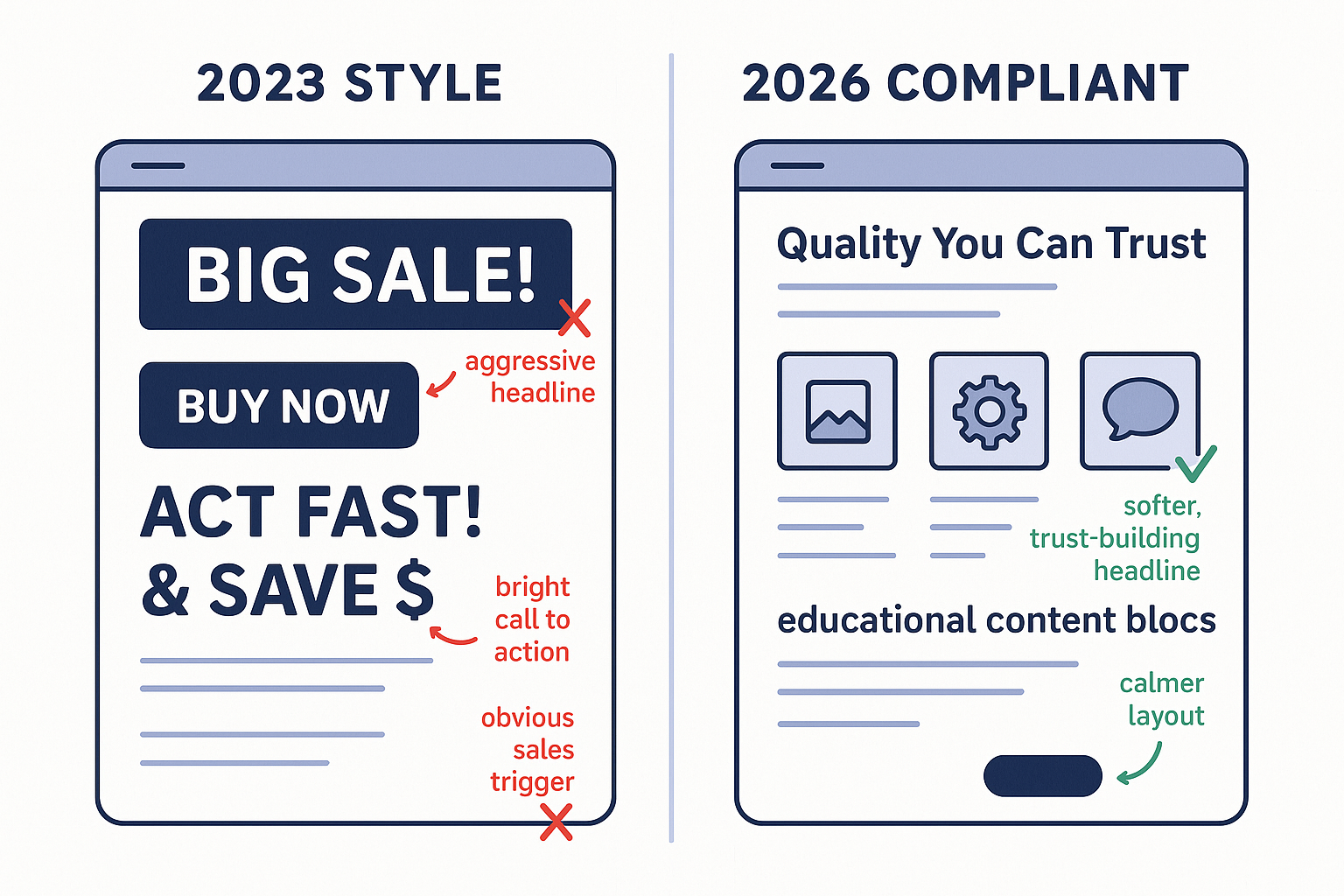
The Editorial Approach: Your Compliance Shield
Here's the framework that's saved my bacon more times than I can count: disguise your pre-sell page as editorial content. Not fake news—that's a death sentence. I'm talking about legitimate educational content that happens to pre-sell your offer.
Say you're promoting a weight loss supplement through ClickBank. Instead of "Lose 30 Pounds in 30 Days," your headline becomes "Why Metabolism Slows After 40 (And What Nutritionists Recommend)." Same audience, same problem awareness, but now you're providing value first.
The key is maintaining what I call "editorial credibility." Real sources. Actual research citations. Multiple perspectives on the problem. This approach doesn't just pass reviews—it builds trust that converts better than hype-heavy copy ever did.
The Information Sandwich Method
Structure your content like a legitimate article: problem identification, educational content, solution introduction, more educational content, then your soft pitch. The educational layers protect your sales message from pattern-matching algorithms while warming up cold traffic.
I've found this works especially well for finance and health offers. Lead with industry statistics, cite credible sources, then introduce your solution as one option among many. The compliance team sees educational content. Your visitors see valuable information that builds trust in your eventual recommendation.
Visual Elements That Pass (And Fail) Review
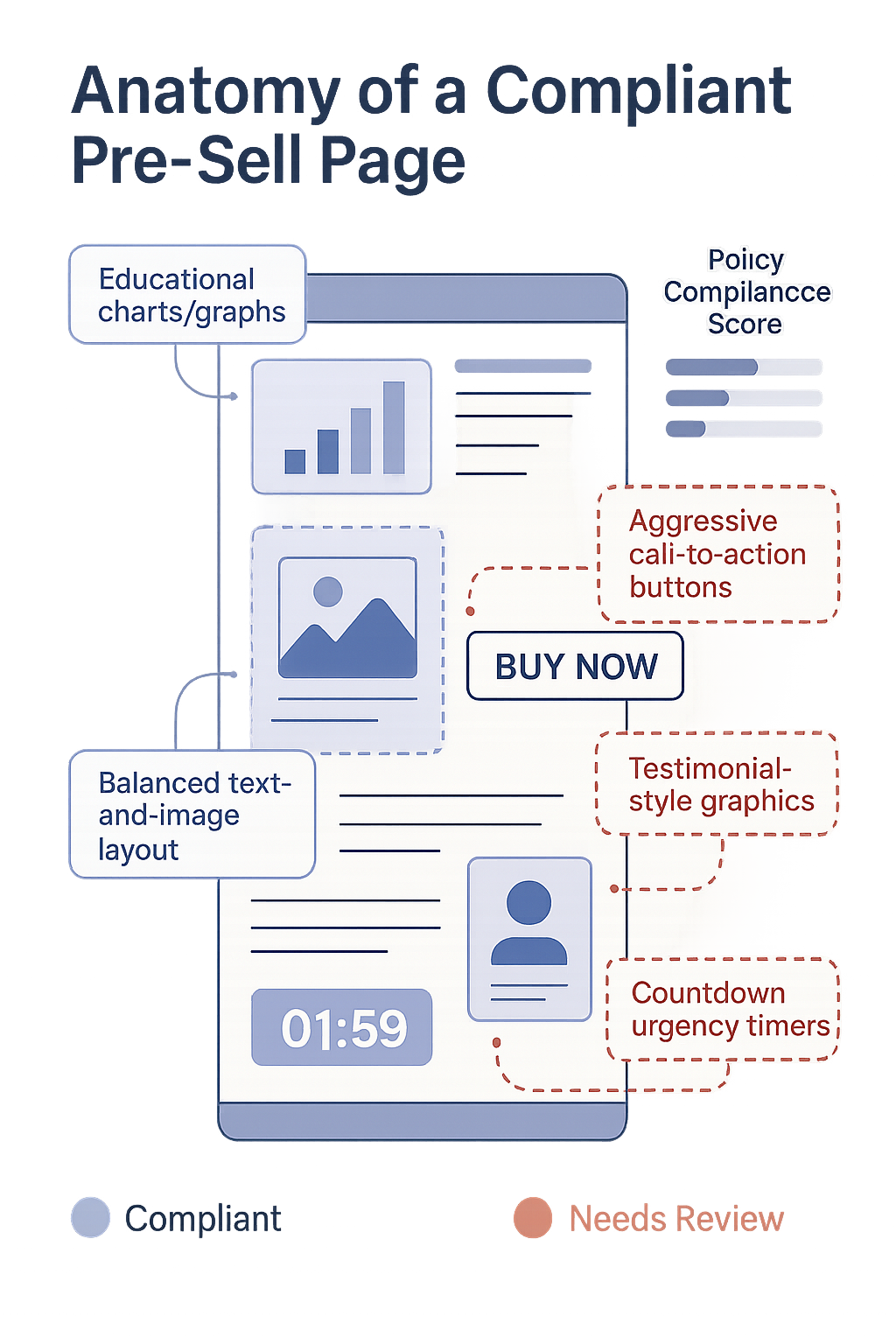
Stock photos of people pointing at their stomachs? Instant red flag. Before/after images? Reviewers assume they're fake until proven otherwise. Charts that look too polished? They scream "marketing material" to compliance teams.
But here's what works: authentic-looking infographics that actually educate, screenshots of legitimate research studies, and simple charts that illustrate concepts rather than results. Think less "marketing creative" and more "Wikipedia illustration."
The visual hierarchy matters too. If your entire page is designed to funnel attention toward one bright CTA button, reviewers know exactly what you're doing. Distribute visual weight more evenly. Make your page look like it has multiple purposes, even if conversion is your primary goal.
The Testimonial Trap
Traditional testimonials are compliance suicide in 2026. But social proof still works—you just need to be smarter about it. Instead of "I lost 50 pounds," use aggregated data: "73% of users in a recent survey reported improved energy levels."
Better yet, cite third-party research that supports your claims. Let the studies do your testimonial work. It's more credible, more compliant, and often more persuasive than individual success stories.
Traffic Source Specific Strategies
Different platforms have different hot buttons. What passes on Google Ads might get flagged on Facebook. What works on native platforms like Taboola might violate TikTok's policies.
For Google traffic, focus on search intent matching. If someone searches "metabolism booster supplements," your pre-sell should read like a comprehensive guide to metabolism boosters—with your offer positioned as one recommended option.
Facebook traffic requires more subtle approaches. Their reviewers are trained to spot affiliate funnels, so your page needs multiple legitimate purposes. Add a newsletter signup, include related articles, make it look like part of a real publication.
Native Platform Nuances
Native platforms like Outbrain and Taboola have their own quirks. They're more tolerant of commercial content but hypersensitive to anything that looks like fake news. Your pre-sell needs to clearly identify itself as promotional content while still providing genuine value.
The sweet spot is educational content with clear commercial intent. Don't try to trick anyone—be upfront about your recommendation while providing enough educational value to justify the click.
Conversion Psychology That Survives Review
The psychological triggers that drive conversions haven't changed—how you implement them has. Scarcity still works, but instead of countdown timers, use supply chain realities: "Due to ingredient sourcing challenges, availability varies monthly."
Urgency gets reframed as timeliness: instead of "Act now," try "Current research suggests..." or "Based on recent studies..." You're creating urgency around information currency rather than artificial deadlines.
Social proof becomes industry consensus. Authority shifts from individual experts to institutional credibility. The underlying psychology remains intact—you're just wrapping it in compliant language.
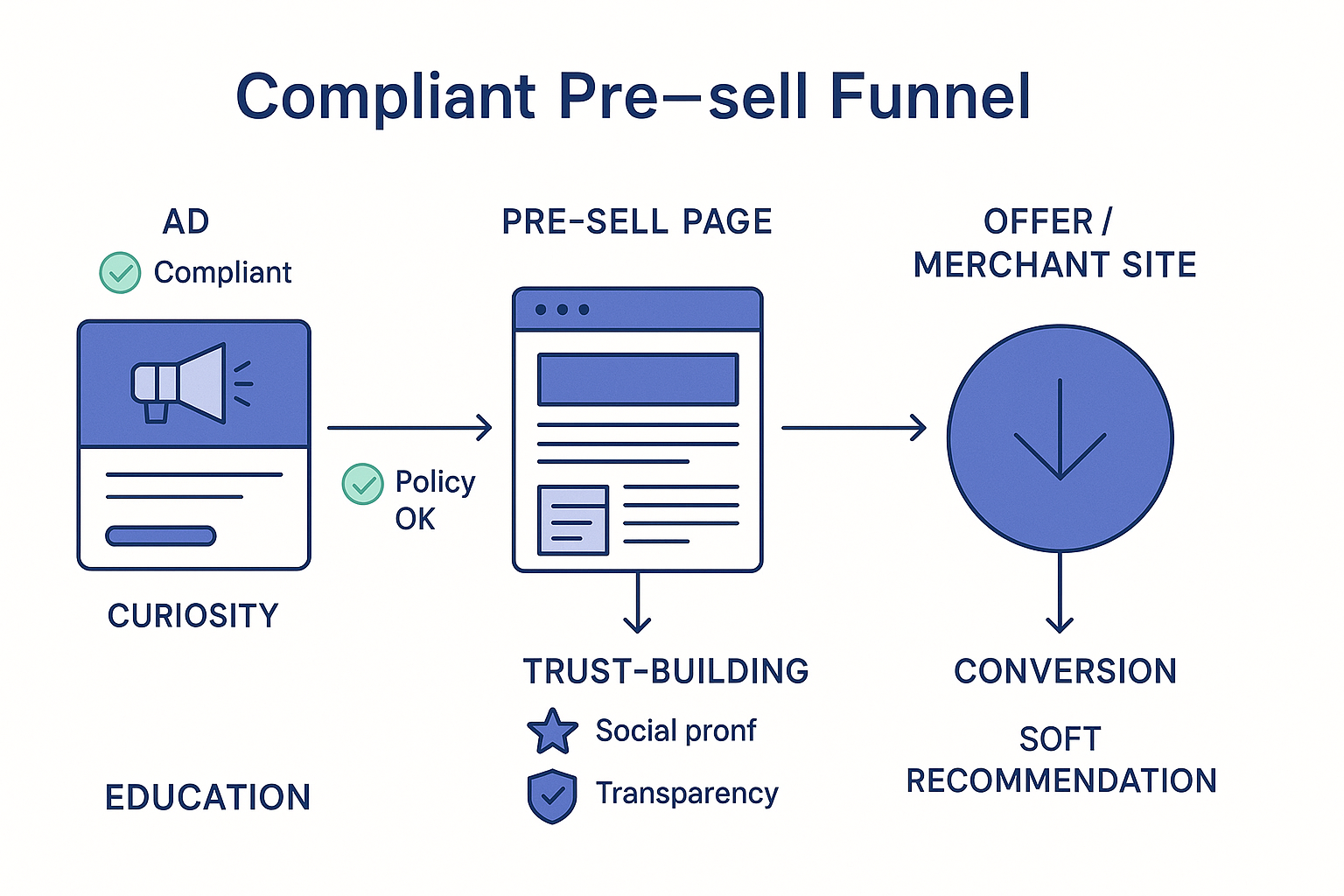
The Trust-First Funnel
Build trust before you build desire. Most pre-sell pages try to create wanting first, then address objections. Flip that script. Address skepticism upfront, provide valuable information freely, then make your recommendation from a position of established credibility.
This approach takes longer to convert, but the conversions are higher quality and the pages survive review. I've seen trust-first funnels outperform traditional pre-sell pages by 40% or more—especially with older, more skeptical demographics.
Testing Within Compliance Boundaries
Split testing compliant pages requires different metrics. Instead of just tracking conversion rates, monitor approval rates, account health scores, and long-term traffic sustainability. A page that converts at 3% but keeps getting flagged is worthless compared to one that converts at 2.5% and runs clean for months.
Test different levels of educational content. Some offers need more trust-building than others. Financial and health products typically require more educational overhead, while business tools can get away with lighter approaches.
The real insight comes from testing compliance elements that don't hurt conversion. Different headline styles, various source citation methods, alternative social proof formats. Find the combination that maximizes both compliance and conversion for your specific offer and traffic source.
Looking ahead, I expect policies to get even tighter as AI detection improves and consumer protection increases. The affiliates who survive and thrive will be those who master the balance between compliance and conversion—not by avoiding the rules, but by understanding them well enough to work within them effectively.
The future belongs to pre-sell pages that don't look like pre-sell pages at all. They'll look like valuable content that happens to include a recommendation. And honestly? That's probably how it should have been all along.
Related reading: GoHighLevel vs ClickFunnels breakdown for affiliate funnel builders
Related reading: high-ticket offer stacking to maximize revenue per subscriber
Frequently Asked Questions (Updated 2026)
Does Meta's AI review system in 2026 look at pages after they've already been approved?
Yes—and this catches a lot of affiliates off guard. Meta Ad Review AI v3.0, rolled out in Q1 2026, introduced continuous post-approval monitoring for active campaigns. A page that passed review on day one can be flagged and paused on day fourteen if behavioral signals (bounce rate, time-on-page, post-click conversion patterns) suggest the landing experience doesn't match the ad creative. This is a significant shift from the old model where approval was essentially permanent unless someone manually reported the ad.
The practical implication: your pre-sell page needs to stay compliant in practice, not just at the moment of submission. Avoid making aggressive copy changes to an approved page mid-campaign, and monitor your ad health scores daily. If you see your relevance score drop suddenly without a change in performance, it may indicate the review system has re-evaluated your page. Tools like AdReview AI can flag potential re-review triggers before they become suspensions.
What's the safest pre-sell page format for affiliate offers in 2026 across multiple platforms?
The format that's holding up best across Google, Meta, and TikTok in 2026 is what compliance teams internally call the "editorial bridge"—a long-form, first-person article format that leads with genuine informational value before transitioning to a product recommendation. Think 600–900 words of real content (problem framing, category education, comparison context) followed by a natural recommendation with a clear, non-deceptive disclosure.
Key structural elements that improve pass rates across all three platforms: (1) a visible "Advertorial" or "Sponsored Content" label above the fold, (2) outbound links to at least one non-affiliated source within the body content, (3) no countdown timers or pop-up overlays, and (4) a footer that includes your affiliate disclosure, privacy policy link, and contact information. Pages missing any of these are increasingly being auto-rejected before human review even occurs.
For funnel builders that make this structure easy to implement, see the ClickFunnels vs GoHighLevel breakdown for affiliate funnel builders—both platforms have added compliance-specific templates in their 2026 updates.
Can AI-generated copy on pre-sell pages cause compliance problems in 2026?
Increasingly, yes. Both Google and Meta have updated their quality reviewer guidelines in 2026 to flag content that exhibits patterns consistent with low-quality AI generation—specifically, generic superlative language, lack of specific attribution, and what reviewers describe as "claim density without substance" (lots of bold assertions with no supporting detail or sourcing). This doesn't mean AI-written copy is automatically rejected, but unedited bulk AI output is a growing risk factor.
The fix isn't to avoid AI tools—it's to use them as a drafting layer and then edit heavily for specificity, personal voice, and verifiable claims. Add real data points with dates and sources. Include first-person observations that reflect actual experience. Reviewers, both human and algorithmic, are increasingly rewarding pages that demonstrate editorial accountability. If your copy could have been written about any product in any niche, it's going to struggle in 2026's review environment.
This article contains affiliate links. We may earn a commission at no extra cost to you. Full disclosure.
Editorial Team
Senior Digital Marketing Strategist
The Prophet Visionary editorial team covers affiliate marketing, paid traffic, funnels, and digital product strategy with hands-on practitioner experience.
Learn more about our editorial team →Build High-Converting Funnels Without 5 Different Tools
Systeme.io gives you a drag-and-drop funnel builder, email automation, upsells, order bumps, and analytics — all in one platform starting at $0/month.
See the Funnel BuilderThis page contains affiliate links — I may earn a commission at no extra cost to you.
Disclaimer: The information on this site is for educational purposes only and does not constitute financial, legal, or business advice. Results vary based on individual effort, market conditions, and other factors. Always do your own due diligence before making business or investment decisions.