Low-Ticket Front-End Offers: Converting Cold Traffic in 2026
Most marketers approach cold traffic like they're trying to sell a Rolex to someone window shopping at Walmart. The disconnect is jarring—and expensive.
I've watched countless campaigns burn through budgets because marketers couldn't resist pitching their $497 course to prospects who've never heard their name. The conversion rates tell the story: 0.2%, maybe 0.5% if you're lucky. That's not marketing; that's hoping.
Low-ticket front-end offers solve this fundamental mismatch. They bridge the chasm between "who are you?" and "take my money" with something more reasonable: a small commitment that proves value.
But here's where most people mess up—they think "low-ticket" means "low-value" or "quick cash grab." Wrong on both counts.
The Psychology Behind Low-Ticket Conversions
Cold traffic operates on a completely different psychological wavelength than your email list or social media followers. These prospects don't know you, don't trust you, and frankly, don't care about your credentials.
What they do care about is solving an immediate problem with minimal risk.
The sweet spot for cold traffic offers sits between $7-$47. Below $7, people question the value ("what's the catch?"). Above $47, the decision-making process shifts from impulse to consideration—and consideration kills conversion rates on cold traffic.
I've found that $19-$27 offers perform exceptionally well across most niches. It's enough money to feel substantial but not enough to trigger buyer's remorse or lengthy deliberation.
The Commitment Threshold
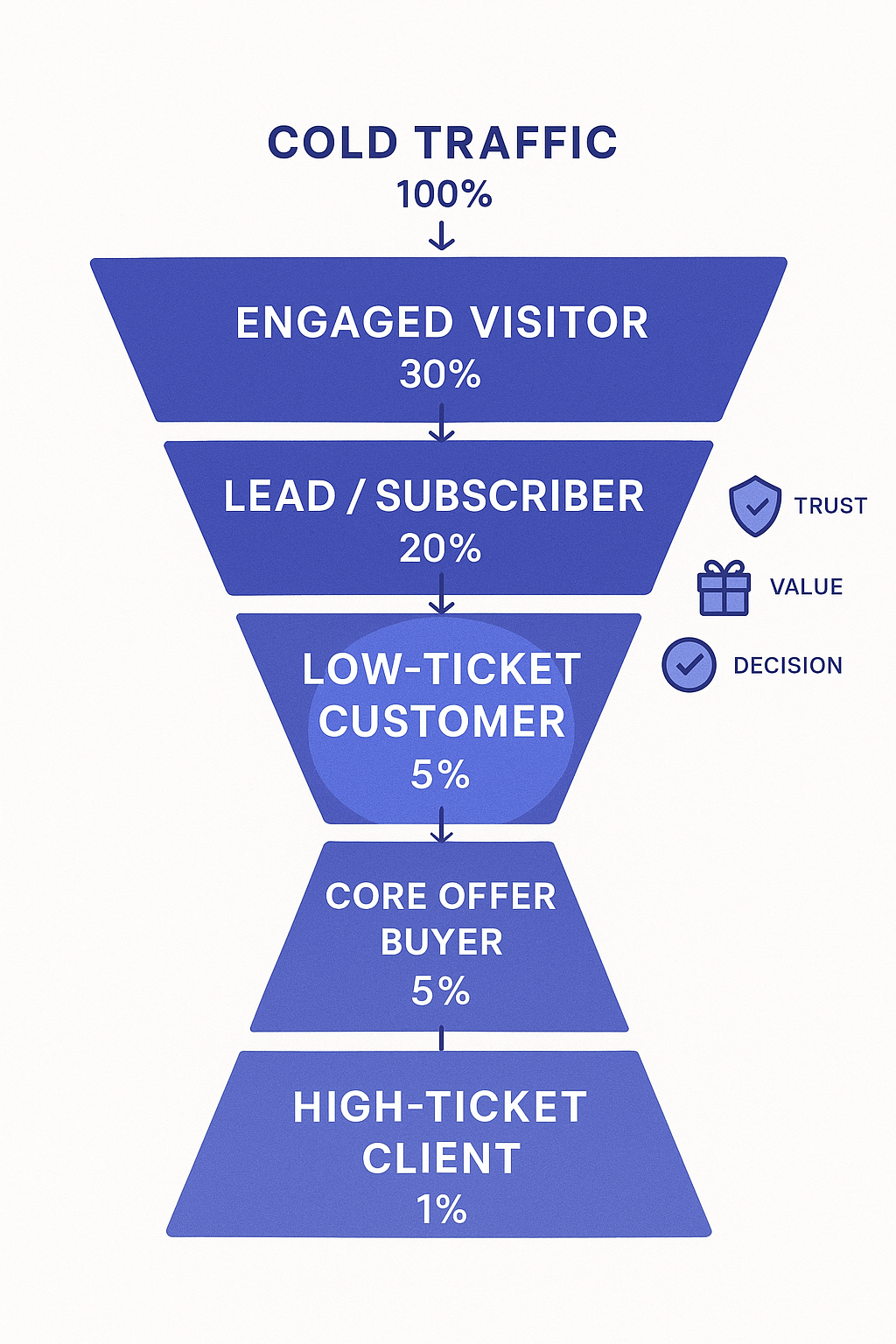
Every purchase, no matter how small, creates psychological ownership. Someone who buys your $19 PDF guide is exponentially more likely to purchase your $297 course than someone who just downloaded a free lead magnet.
The reason? They've already identified as someone who buys solutions to this problem. They've crossed the commitment threshold.
Structuring Offers That Convert Cold Traffic
The anatomy of a high-converting low-ticket offer follows a specific blueprint. Miss any component, and your conversion rates crater.
The Promise-to-Price Ratio
Your offer needs to feel like highway robbery—in the customer's favor. If you're selling a $27 guide on Facebook ads, the perceived value should feel like $200+.
Say you're in the weight loss space targeting busy professionals. A $27 offer titled "21-Day Meal Prep System" needs to deliver what would cost $200+ if they hired a nutritionist for consultation.
The content might include meal plans, shopping lists, prep schedules, and container guides. The time savings alone justifies the price, but the weight loss promise seals the deal.
Instant Gratification Components
Cold traffic has zero patience. Your offer must deliver immediate value—something they can consume and benefit from within 24 hours.
This is where most course creators stumble. They package 6 weeks of content into a low-ticket offer and wonder why people don't finish it. Unfinished customers don't buy again.
Instead, focus on quick wins. A 3-day challenge. A single powerful framework. One transformative technique they can implement immediately.
Platform-Specific Offer Design
Not all traffic sources respond to the same offer structure. What converts on Facebook might flop on Google, and what works on TikTok could bomb on LinkedIn.
Social Media Traffic (Facebook, Instagram, TikTok)
Social traffic is interruption-based. People aren't actively searching for solutions—you're interrupting their scroll with your offer.
This requires a different approach. Your offer needs to hook them with curiosity or controversy, not just benefits.
"The 15-Minute Morning Routine That Replaces Your Need for Coffee" performs better than "Increase Your Energy Naturally" because it's specific and slightly unbelievable.
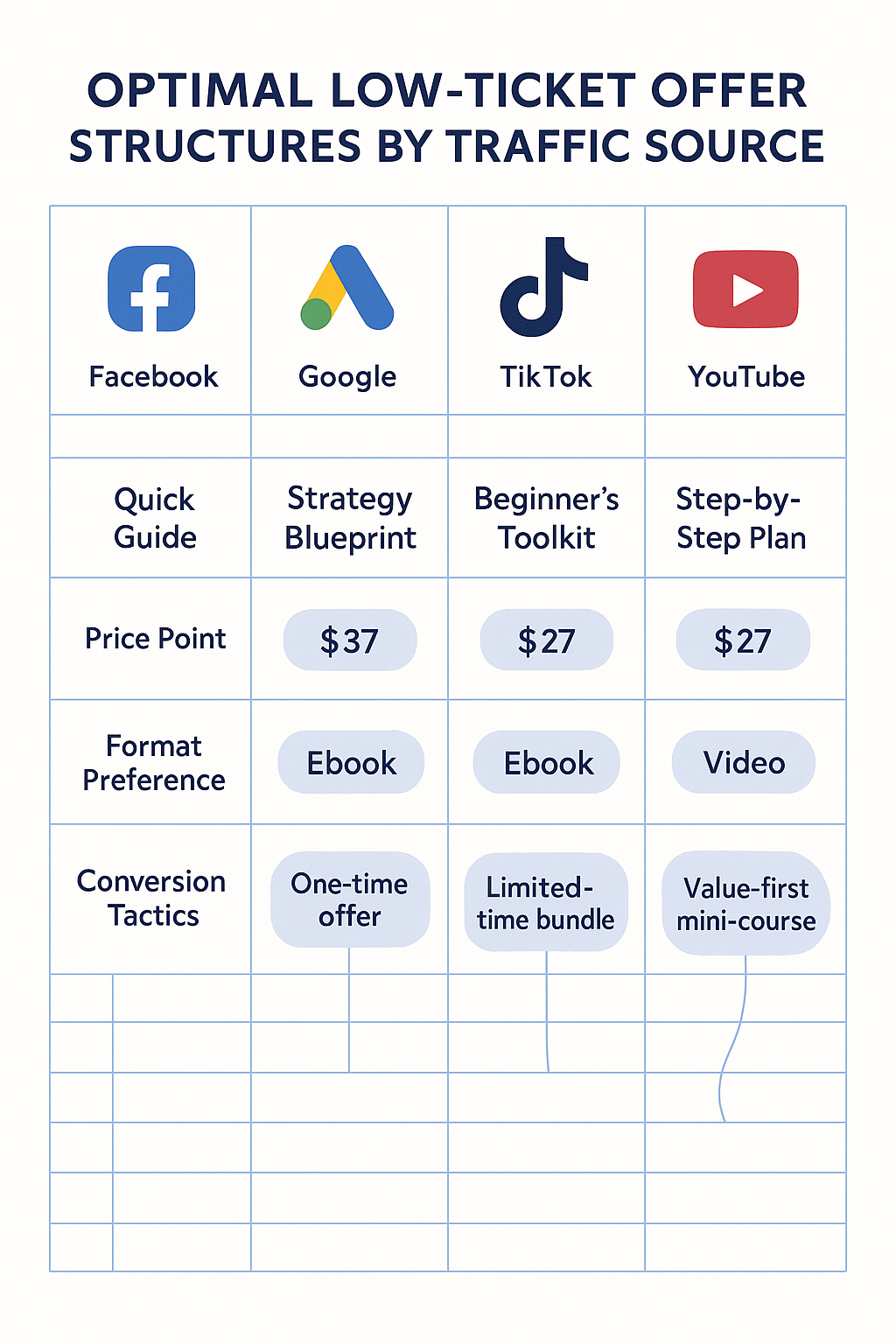
Social media offers should also feel native to the platform. A $19 PDF guide works on Facebook. A $27 video training series works better on Instagram or TikTok.
Search Traffic (Google, YouTube)
Search traffic is intent-based. People are actively looking for solutions, which means you can be more direct with your benefits.
"Complete Guide to Fixing Credit Score Errors" converts well on search traffic because it matches search intent. The same offer might need repositioning for social: "The Credit Score 'Loophole' Banks Don't Want You to Know."
Pricing Psychology and Testing
Price testing on low-ticket offers reveals fascinating psychological triggers that don't apply to higher-priced products.
The counterintuitive truth? Sometimes raising your price from $19 to $27 increases conversions. The reason isn't just positioning—it's cognitive load.
Odd numbers like $19 or $27 convert better than round numbers like $20 or $25 because they feel more calculated, more "real." Round numbers feel arbitrary or promotional.
The Decoy Effect in Action
Smart marketers use decoy pricing even on low-ticket offers. Present three options: a $17 basic version, a $47 "premium" version, and a $27 "popular" version that's clearly the best value.
Most people will choose the $27 option, but here's the kicker—they'll feel smart about it. The $47 option makes $27 feel reasonable, while the $17 option makes it feel substantial.
I've tested this across multiple niches. The three-tier approach typically increases average order value by 23-31% compared to single-option pricing.
Integration with Your Funnel Architecture
A low-ticket front-end offer isn't a standalone product—it's the entry point to your entire customer journey. How you connect it to your backend determines your long-term profitability.
The math is simple: if you break even on your front-end offer, everything else is profit. But breaking even requires strategic backend integration.
The Immediate Upsell
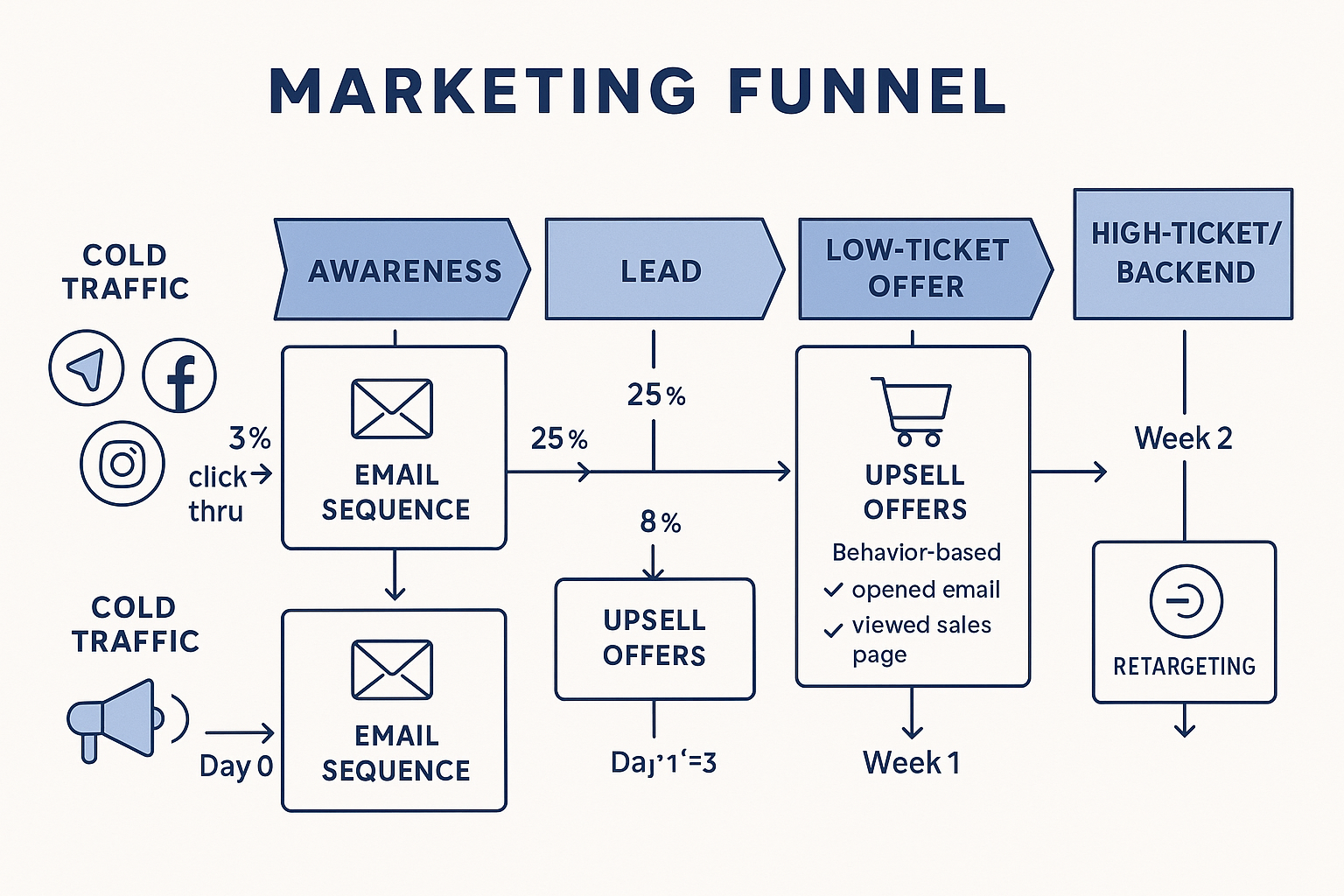
Right after purchase, while buying momentum is peak, present a logical next step. This isn't about cramming another product down their throat—it's about completing the solution.
If they bought your $27 meal prep guide, the immediate upsell might be a $67 workout plan that complements the nutrition system. The offer should feel like "since you're committed to this transformation, here's how to accelerate your results."
Upsell conversion rates of 15-25% are achievable when the offer feels like a natural extension rather than an aggressive pitch.
The Email Sequence Bridge
Your post-purchase email sequence does heavy lifting in customer lifetime value. Most marketers send a download link and call it done. That's leaving money on the table.
A proper sequence includes:
- Immediate delivery email with bonus content
- Implementation tips 2 days later
- Success story and social proof on day 5
- Soft pitch for your core offer on day 7
The key is providing value while gradually introducing higher-priced solutions. By day 7, they've experienced your teaching style and hopefully gotten results from your low-ticket offer.
Common Pitfalls and How to Avoid Them
Even experienced marketers make predictable mistakes with low-ticket offers. Here are the big ones I see repeatedly:
The "Everything but the Kitchen Sink" Trap
Trying to pack too much value into a low-ticket offer creates overwhelm, not excitement. A $27 offer with 47 PDFs, 12 hours of video, and 6 bonus courses sounds impressive but performs poorly.
People buy low-ticket offers for quick wins, not comprehensive education. Save the comprehensive stuff for your core programs.
Weak Follow-Up Sequences
Your low-ticket offer is only as valuable as your follow-up. I've seen marketers spend thousands perfecting their sales page while completely ignoring the post-purchase experience.
The truth is, most people won't implement what they buy immediately. Your email sequence needs to guide them through implementation while building trust for future offers.
The Future of Low-Ticket Offers
Privacy changes, iOS updates, and rising ad costs are reshaping how low-ticket offers need to function in 2026 and beyond.
First-party data collection becomes crucial. Your low-ticket offer isn't just generating revenue—it's building an owned audience in a world where tracking pixels are disappearing.
Interactive content is becoming essential. Static PDFs are losing ground to interactive assessments, calculators, and mini-courses that provide personalized results. These formats naturally collect more first-party data while delivering superior user experiences.
AI integration is also changing the game. Smart marketers are using AI to personalize low-ticket offers based on traffic source, demographic data, or behavior patterns. A Facebook visitor might see a video-based offer while a Google searcher sees a comprehensive guide—same core value, different packaging.
The marketers who adapt their low-ticket strategy to these changes won't just survive the evolving landscape—they'll dominate it while their competitors wonder why their old playbooks stopped working.
Related reading: High-Ticket Offer Stacking: How to Build Email Sequences That Pay
Related reading: ClickFunnels vs GoHighLevel breakdown for affiliate paid traffic
Frequently Asked Questions (Updated 2026)
Are low-ticket offers still profitable in 2026 with rising ad costs?
Yes—but the math requires more intentional funnel architecture than it did two or three years ago. With Meta CPMs averaging $15–$22 in competitive niches in 2026, a $27 front-end offer alone rarely covers acquisition costs. Profitability now lives in the order bump, the one-click upsell, and the back-end email sequence that follows.
The front-end offer's job in 2026 is threefold: (1) qualify buyers from browsers, (2) partially offset ad spend, and (3) initiate the trust relationship that makes the $197–$497 back-end offer a natural next step. Marketers who treat the low-ticket offer as a standalone product struggle. Those who treat it as the entry point to a full monetization stack see strong overall ROAS even when the front end breaks even or runs at a slight loss.
For a detailed look at back-end monetization after the front-end sale, see Backend Email Monetization: What Actually Works for Affiliate Lists.
What types of low-ticket offers convert best on cold traffic in 2026?
Format matters more than it did even 18 months ago. In 2026, the top-performing low-ticket offer formats for cold traffic are:
- Actionable mini-courses (video-based, under 60 minutes): These outperform static PDFs because they signal production effort and create a consumption experience that builds trust quickly.
- Tool-based offers (templates, prompt packs, swipe files with implementation guides): These convert well because they promise immediate usability—the buyer can get value within minutes of purchase.
- Micro-workshops or live-recorded trainings: These carry strong perceived value because of the implicit social proof of a live audience, even when delivered as a replay.
Plain PDF ebooks have seen declining conversion rates on cold traffic as the market has grown more saturated with AI-generated content in that format. If you're using a PDF, pair it with a short video walkthrough or implementation checklist to differentiate. You can also explore how to design a low-ticket front-end offer that actually converts for a full format-selection framework.
How should I structure the email follow-up after someone buys a low-ticket offer?
The post-purchase email sequence is where most low-ticket funnels leave the majority of their revenue on the table. A buyer who just converted from cold traffic is at peak engagement—and most marketers waste that window with a single receipt email.
A high-converting post-purchase sequence for a low-ticket buyer in 2026 typically follows this structure:
- Immediate delivery email: Access to the product plus a single, clear next step (not a pitch—just a "start here" directive).
- Day 1 – Implementation check-in: A short email that anticipates the first obstacle the buyer will hit and addresses it. This builds trust and positions you as someone who understands their journey.
- Day 2–3 – Soft bridge to next offer: Share a result or case study that naturally leads to the problem your mid-ticket offer solves.
- Day 4–5 – Direct offer email: Present your next offer with a clear, time-aware reason to act now.
For a fully mapped sequence template, see Why Your Post-Purchase Emails Aren't Turning Buyers Into Repeat Customers.
This article contains affiliate links. We may earn a commission at no extra cost to you. Full disclosure.
Editorial Team
Senior Digital Marketing Strategist
The Prophet Visionary editorial team covers affiliate marketing, paid traffic, funnels, and digital product strategy with hands-on practitioner experience.
Learn more about our editorial team →Monetize Smarter With Funnels + Email in One Place
Order bumps, upsells, automated email sequences, and your own affiliate program — Systeme.io gives you the full monetization stack without the bloated monthly spend.
See the Monetization StackThis page contains affiliate links — I may earn a commission at no extra cost to you.
Disclaimer: The information on this site is for educational purposes only and does not constitute financial, legal, or business advice. Results vary based on individual effort, market conditions, and other factors. Always do your own due diligence before making business or investment decisions.