Native Ads for Affiliates: The Stealth Traffic Strategy That Works
Most affiliates still think native advertising is just "those weird ads at the bottom of news articles." They're missing the point entirely.
Native ads have evolved into one of the most sophisticated—and profitable—traffic sources for affiliate marketers who know how to use them properly. The key isn't blending in perfectly with editorial content (though that helps). It's understanding that native platforms give you access to audiences in a receptive, discovery mindset.
I've watched affiliates burn through budgets on native platforms because they approach them like Facebook or Google. Wrong move. Native advertising requires a completely different playbook—one that prioritizes curiosity over conversion, story over sale.
Why Native Ads Work Differently for Affiliate Marketing
The fundamental difference between native and other paid traffic sources comes down to user intent. When someone's scrolling through Taboola widgets on CNN or browsing Outbrain recommendations on ESPN, they're not actively searching for solutions. They're in exploration mode.
This creates both an opportunity and a challenge. The opportunity? You can introduce people to problems they didn't know they had—or solutions they never considered. The challenge? You need to earn their attention before you can direct their action.
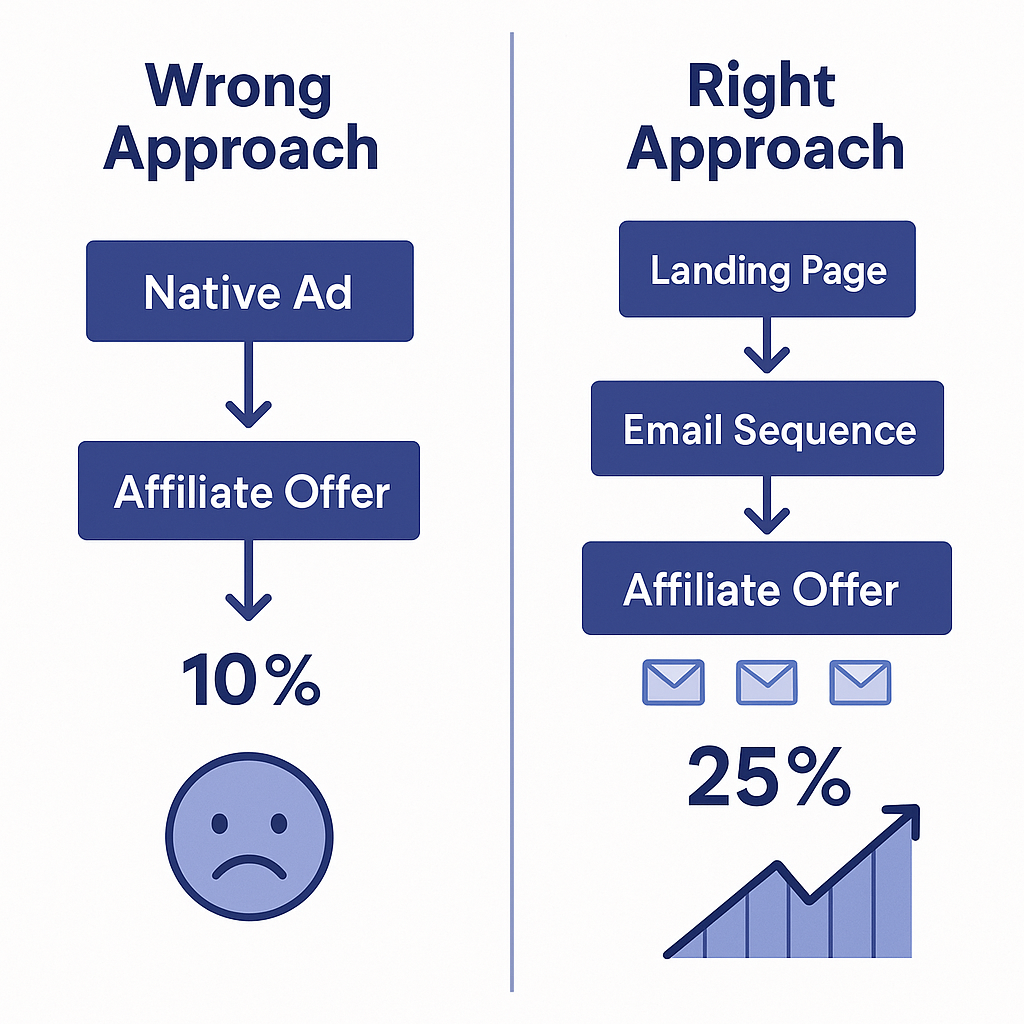
Here's what most people get wrong: they try to drive cold native traffic directly to affiliate offers. That's like trying to propose on a first date. It occasionally works, but the success rate is terrible.
The affiliates making serious money with native ads understand that the platform is just the first step in a longer conversation. They're building audiences, nurturing interest, and creating multiple touchpoints before making the ask.
Platform Selection: Where to Spend Your Native Ad Budget
Not all native platforms are created equal for affiliate marketing. Some have stricter policies around affiliate links, others have audiences that convert better for specific verticals.
Tier 1 Platforms: Premium Inventory, Premium Prices
Taboola remains the gold standard for native advertising, but their affiliate policies have tightened significantly. You'll need approved landing pages, and direct linking to ClickBank offers is basically impossible. Minimum spends start around $10K monthly for serious consideration.
Outbrain follows similar guidelines but tends to be slightly more affiliate-friendly in certain verticals. Their traffic quality is excellent, particularly for finance and business opportunity offers.
Tier 2 Platforms: Better Value, More Flexibility
MGID and RevContent offer more flexibility for affiliate marketers. MGID particularly shines for international traffic, while RevContent has strong US inventory at lower CPCs than the tier 1 platforms.
Content.ad and EngageYa are worth testing for specific verticals. I've seen health and wellness affiliates do particularly well on Content.ad's network.
Emerging Platforms: The Testing Ground
Platforms like Yahoo Gemini (now part of Verizon Media) and Microsoft Audience Network are expanding their native inventory. The competition is lighter, which can mean better CPCs—if you can handle lower volume.
The real opportunity right now is in mobile-first native platforms. NewsBreak has been quietly building a massive US audience, and their native ad units are converting well for certain offers at $0.08-0.15 CPC.
Creative Strategy: The Art of Native Ad Copy
Your creative approach makes or breaks native campaigns. The best native ads don't look like ads—they look like content recommendations you'd actually want to click.
Headlines That Hook Without Overpromising
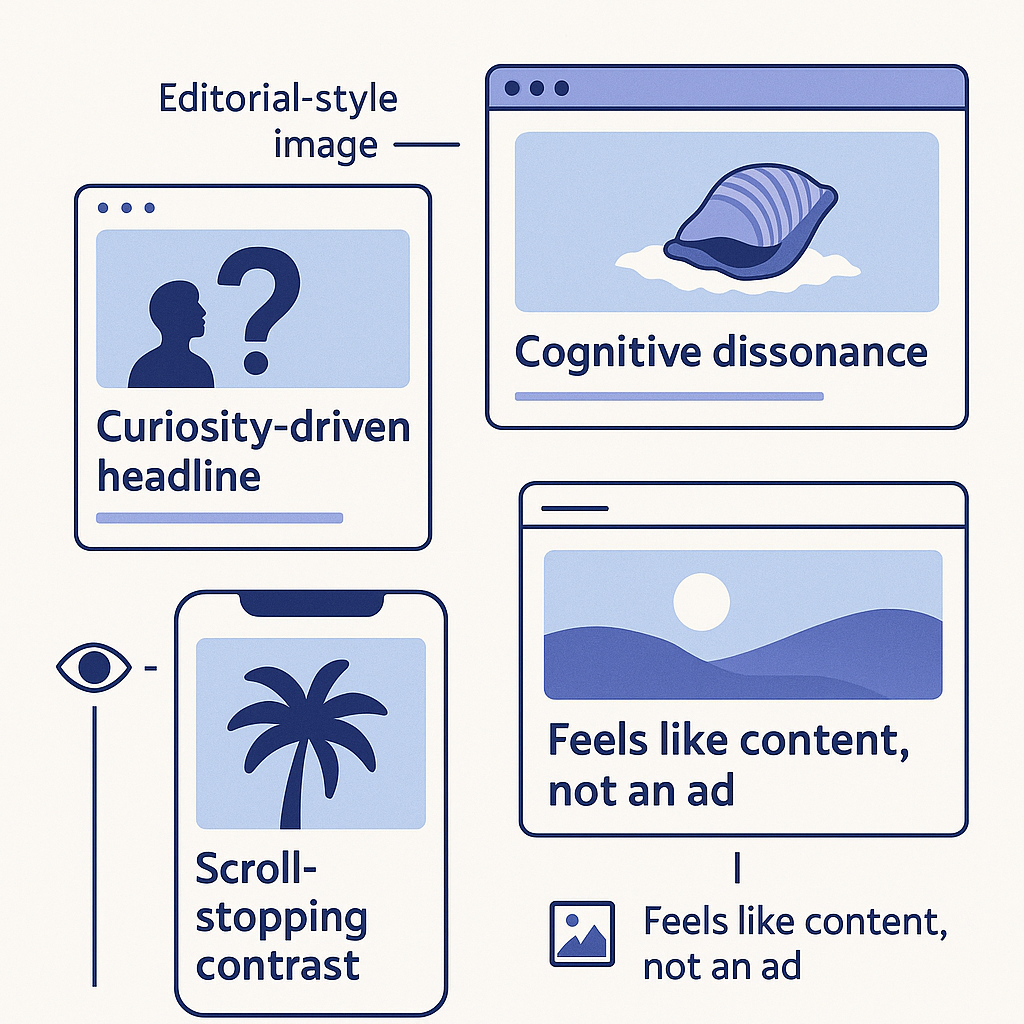
Forget benefit-heavy headlines. Native audiences respond to curiosity and intrigue. Instead of "Lose 30 Pounds in 30 Days," try "The Metabolism Mistake 99% of Dieters Make."
I've found that numbered lists, contrarian takes, and "insider secrets" consistently outperform direct benefit claims. The goal is to create an information gap that only clicking can resolve.
But here's the counterintuitive part—the most effective native headlines often don't mention the end benefit at all. They focus on the problem, the mistake, or the hidden truth.
Images That Stop the Scroll
Native ad images need to blend with editorial content while still standing out. Stock photos of smiling people pointing at things? Terrible. Candid-looking photos, charts, before/after comparisons, or unusual angles work better.
One tactic that's been working well: using images that create cognitive dissonance with the headline. A headline about financial mistakes paired with an image of an expensive car. A weight loss angle with a picture of someone eating pizza. The mismatch creates curiosity.
Landing Page Strategy: The Bridge Between Interest and Action
Your landing page is where native traffic lives or dies. These visitors didn't search for your solution—you interrupted their content consumption. They're skeptical and easily distracted.
The most successful native-to-affiliate funnels I've seen use what I call "editorial landing pages." They look like blog posts or news articles, not sales pages. The goal is to continue the editorial experience while gradually introducing the commercial element.
The Curiosity-to-Conversion Path
Start with story or revelation that matches your ad's promise. If your headline was about a "metabolism mistake," your landing page better deliver that information upfront. Build credibility through specificity and research citations.
Then—and only then—introduce the solution. But don't go straight to the affiliate offer. Use a lead magnet or email capture to continue the conversation. A free report, video series, or quiz works well.
Say you're running a supplement offer on ClickBank with a $45 commission. Your native ad talks about "the vitamin deficiency doctors ignore." Your landing page explains the deficiency, builds urgency around the problem, then offers a "free nutrient assessment" that captures emails. Your follow-up sequence educates about solutions before presenting the affiliate offer.
Technical Considerations for 2026
Privacy regulations have made tracking more complex, but native platforms have adapted. Most now offer server-side conversion tracking and enhanced audience building tools that work within iOS 14+ and similar privacy constraints.
Make sure your landing pages load fast on mobile—native traffic is heavily mobile. Use tools like Systeme.io or ClickFunnels for quick deployment, but don't rely on their default templates. Native traffic converts better on pages that look like genuine editorial content.
Compliance and Approval Strategies
Getting your native campaigns approved requires understanding each platform's interpretation of their policies. The written rules are just the starting point—the real rules are in how they're enforced.
Most platforms now require pre-approval for affiliate marketing campaigns. This means having your landing pages, email sequences, and affiliate offers reviewed before you can start spending. The approval process can take 3-5 business days, so plan accordingly.
Common Rejection Reasons and How to Avoid Them
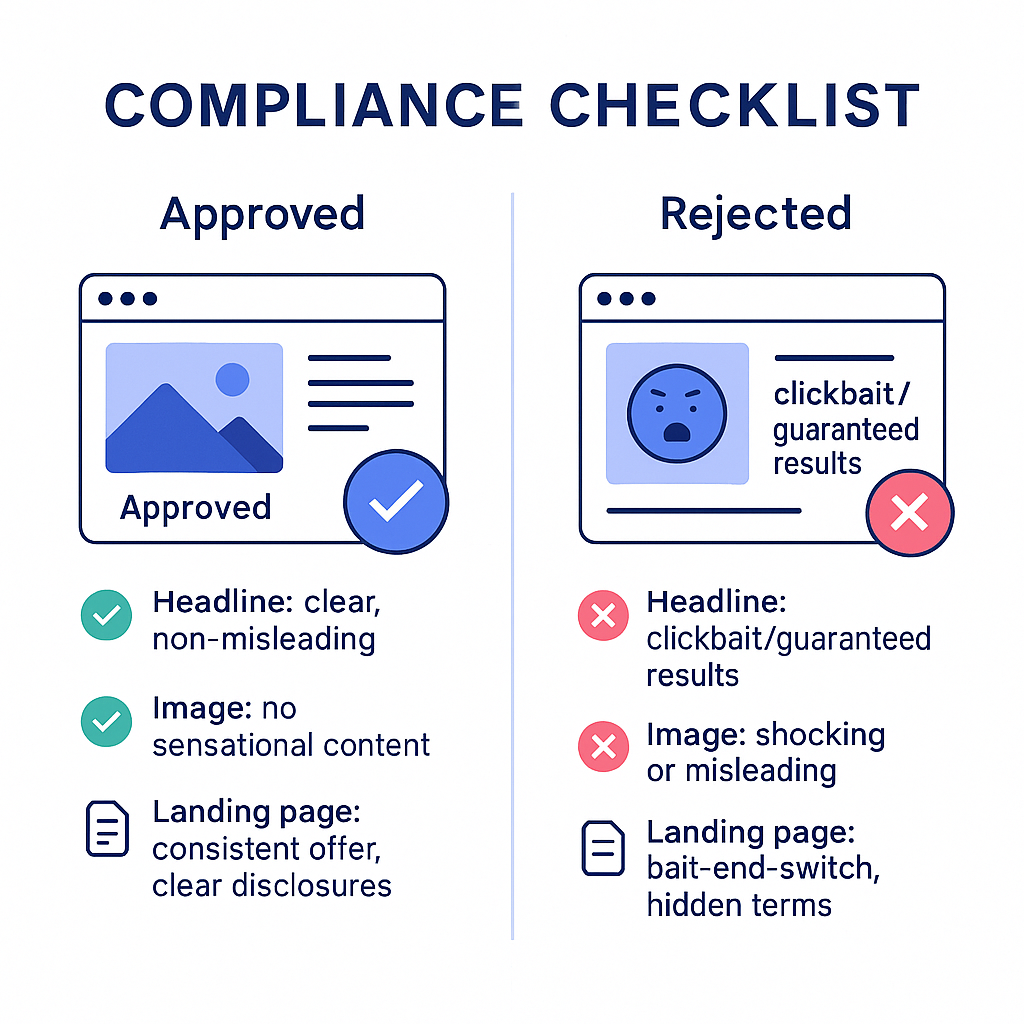
"Misleading content" is the most common rejection reason, and it's often triggered by disconnect between your ad, landing page, and final offer. If your native ad promises "one weird trick" but your landing page talks about "comprehensive lifestyle changes," you'll get flagged.
Health claims are particularly scrutinized. Avoid absolute statements ("cures," "guaranteed," "miracle") and focus on personal stories or research findings instead. "Study shows" performs almost as well as "proven to" but carries much less compliance risk.
Financial opportunity offers need income disclaimers and realistic expectations. The days of "make $500/day from home" headlines are over on quality native platforms.
Attribution and Tracking in the Privacy-First Era
iOS updates and privacy regulations have complicated native ad attribution, but they haven't killed it. The key is building attribution models that don't rely solely on pixel tracking.
First-party data collection becomes crucial. Every native campaign should prioritize email capture or account creation to maintain audience connection beyond platform tracking limitations.
Use UTM parameters aggressively and track them through your entire funnel. Tools like Google Analytics 4 and platform-specific analytics can help bridge attribution gaps, but you'll need to get comfortable with modeled conversions rather than perfect tracking.
The most successful native affiliates I know have shifted toward longer attribution windows and are focusing more on lifetime value metrics than immediate ROAS. It's a more complex approach, but it's also more sustainable.
The Future of Native Advertising for Affiliates
Native advertising is becoming more sophisticated, not less relevant. AI-powered creative optimization is making it easier to test multiple angles quickly, while improved audience segmentation tools help affiliates find their ideal prospects more efficiently.
The platforms are also getting smarter about affiliate marketing. Rather than blanket restrictions, they're developing more nuanced policies that separate quality affiliate marketers from fly-by-night operators.
What this means for affiliates: the bar is rising, but so is the opportunity. The affiliates who invest in proper landing pages, email sequences, and compliance will find less competition and better performance as the platforms clean house.
The real opportunity moving forward isn't in finding the "secret" native platform or the "perfect" headline formula. It's in building sustainable systems that turn native traffic into owned audiences—email lists, social media followers, or app users that you can market to repeatedly.
That's where the real money is in native advertising. Not in the immediate sale, but in the long-term relationship that starts with a curious click on a well-crafted native ad.
Related reading: Why Your Affiliate Bridge Page Isn't Converting (And How to Fix It)
Related reading: Bridge Page Compliance: Compliant vs. Non-Compliant Approaches
Frequently Asked Questions (Updated 2026)
Do native ad platforms allow affiliate marketing in 2026, or have the policies become too restrictive?
Native platforms still allow affiliate marketing in 2026, but the compliance bar has risen substantially. Direct linking to affiliate offers—especially on ClickBank, Digistore24, or similar marketplaces—is effectively banned on Tier 1 platforms like Taboola and Outbrain-Teads. What's required instead is a compliant intermediary: a bridge page or presell page that provides genuine editorial value, includes proper affiliate disclosures, and doesn't use deceptive urgency or fake news formatting.
The good news is that affiliates who build proper funnel infrastructure—a real presell page, an email opt-in, a nurture sequence—are actually at an advantage. They're building assets that compound over time rather than burning ad spend on one-shot direct links. If you're unsure whether your current bridge page setup meets platform and FTC standards, our guide on Bridge Page Compliance: Compliant vs. Non-Compliant Approaches is a practical starting point.
Verticals like health, finance, and weight loss face the strictest scrutiny. Verticals like software tools, online education, and home improvement tend to have more runway—but no vertical is exempt from basic disclosure requirements.
What's the minimum budget needed to test native ads effectively as an affiliate in 2026?
The honest answer is higher than most beginners expect. On Tier 1 platforms like Taboola or Outbrain-Teads, you need enough budget to gather statistically meaningful data across multiple creatives, placements, and audience segments. A realistic minimum test budget is $1,500–$3,000 for a single campaign angle, spread over 2–3 weeks. Anything less and you're optimizing on noise, not signal.
On Tier 2 platforms like Revcontent or MGID, you can run meaningful tests for $500–$1,000, which makes them valuable for proving out angles before scaling. The workflow many experienced affiliates use in 2026: test the angle and creative concept on a Tier 2 platform at lower CPCs, identify what's working, then bring the validated creative to Taboola or Microsoft Native where the volume and traffic quality justify higher spend.
Budget allocation matters as much as total spend. A common framework: 60% to your best-performing creative and placement combinations, 30% to testing new creatives against proven placements, and 10% to testing new placements or audience segments. Don't collapse to a single winner too early—native campaigns tend to fatigue faster than search, and having a creative pipeline is essential for sustained performance.
How do AI creative tools on native platforms change the way affiliates should approach ad testing in 2026?
Every major native platform now offers some form of AI-assisted creative generation—Taboola's Creative Studio, Outbrain-Teads' suite, and Microsoft Advertising's asset automation can all produce headline and image variants at scale from a basic brief. This changes the testing calculus for affiliates in meaningful ways.
The volume problem is largely solved. Where you might have manually written 10 headline variants before, AI tools can generate 40–60 in minutes. The bottleneck has shifted from creative production to creative evaluation—knowing which variants are worth testing, and reading performance data accurately enough to kill losers fast.
Practically, the affiliates getting the most from these tools in 2026 are using them as ideation engines, not autopilots. They'll generate a large batch of AI variants, apply their own knowledge of the offer, the audience psychology, and what's historically worked in the vertical, and select a curated subset for live testing. Human judgment about emotional resonance and compliance risk still outperforms the AI's defaults—especially in sensitive verticals where the AI tends to generate headlines that are technically accurate but would trigger policy flags.
One caution: AI-generated images from these tools can look generic and fail to stop the scroll. Many affiliates are still finding that custom images—real product shots, authentic lifestyle photography, or even well-designed text-overlay graphics—outperform AI image variants in click-through rate, even if the AI wins on production speed.
This article contains affiliate links. We may earn a commission at no extra cost to you. Full disclosure.
Editorial Team
Senior Digital Marketing Strategist
The Prophet Visionary editorial team covers affiliate marketing, paid traffic, funnels, and digital product strategy with hands-on practitioner experience.
Learn more about our editorial team →Your Traffic Is Only as Good as Your Follow-Up
You're paying for clicks — but are you capturing emails and automating sequences? AWeber makes it dead simple to turn paid traffic into a monetized email list.
See How AWeber WorksThis page contains affiliate links — I may earn a commission at no extra cost to you.
Disclaimer: The information on this site is for educational purposes only and does not constitute financial, legal, or business advice. Results vary based on individual effort, market conditions, and other factors. Always do your own due diligence before making business or investment decisions.