AI & Automation in Performance Marketing: What Actually Works
Most performance marketers I know are drowning in AI promises. Every week there's another "revolutionary" tool claiming it'll 10x your ROAS while you sleep. The truth is messier—and more interesting.
After spending the last 18 months testing everything from ChatGPT-powered ad copy generators to machine learning bid optimization platforms, I've found that AI and automation work best when they handle the grunt work, not the strategy. The real wins come from knowing where to apply these tools and where human judgment still reigns supreme.
The Automation Sweet Spots That Actually Matter
Here's what I've learned works consistently: automate the repetitive, data-heavy tasks that eat up your time but don't require creative thinking.
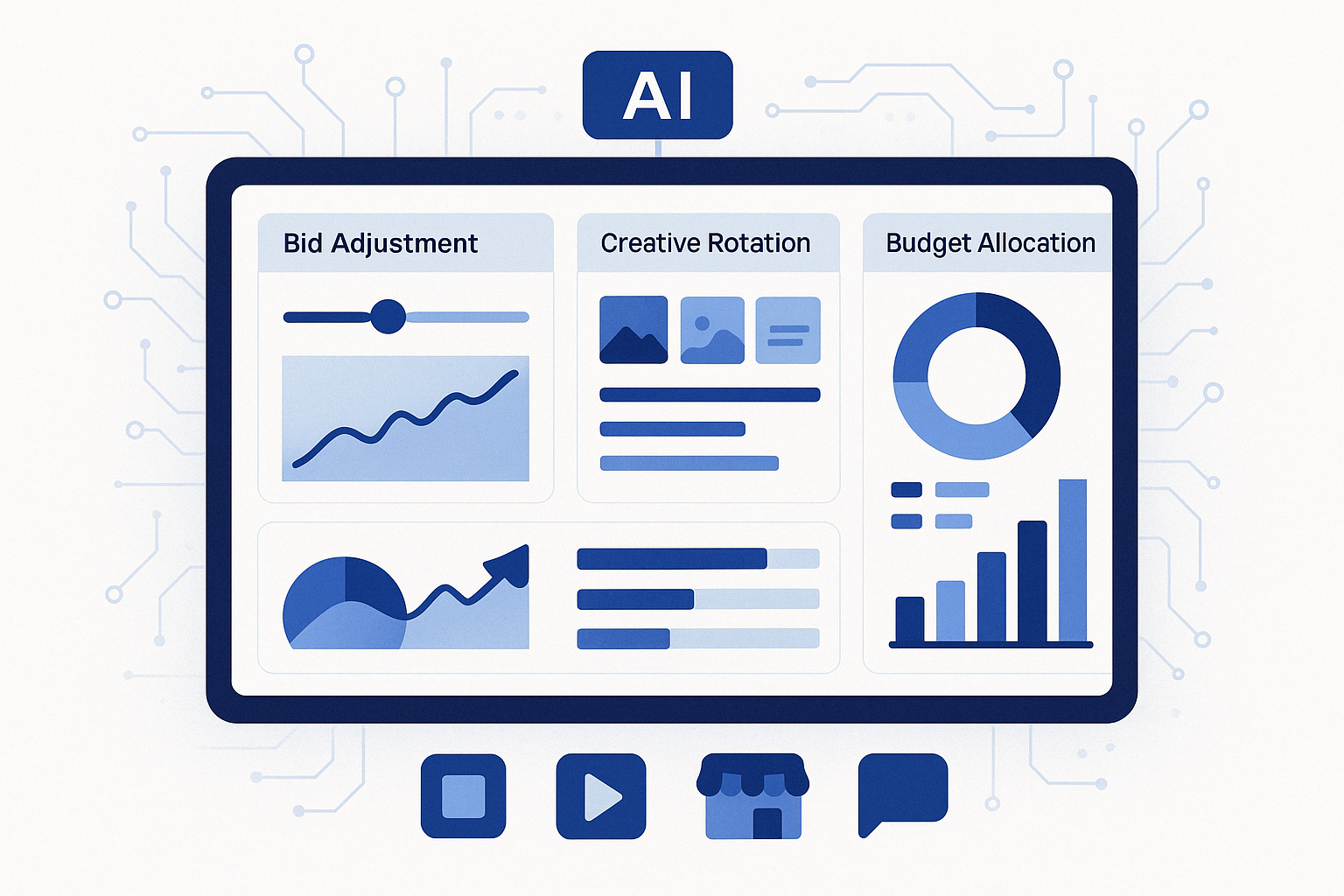
Bid Management and Budget Allocation
Facebook's Campaign Budget Optimization was just the beginning. Now platforms like Google Ads and Microsoft Advertising use machine learning algorithms that can shift budgets between ad sets faster than any human could manually adjust them.
Say you're running a supplement offer across five different audiences on Facebook. Instead of checking performance every few hours and manually reallocating spend, automated bid strategies can react to conversion data within minutes. I've seen CPAs drop 20-30% just by switching from manual bidding to Target CPA strategies—but only when you have enough conversion data to feed the algorithm.
The catch? You need at least 50 conversions per week per campaign for the automation to work reliably. Less than that and you're better off with manual control.
Creative Testing and Rotation
This is where AI shines without the usual overpromising. Tools like Facebook's Dynamic Creative Optimization automatically test different combinations of headlines, images, and ad copy to find winning combinations.
But here's the counterintuitive part—the best results come from giving the AI good raw materials to work with, not letting it create everything from scratch. I'll write 5-6 different headlines and let the platform test combinations, rather than trying to prompt-engineer the "perfect" AI-generated ad.
AI Tools That Move the Needle (And the Ones That Don't)
The AI tool landscape changes faster than Facebook's ad policies, but some categories have proven their worth consistently.
Copy Generation—But Not How You Think
ChatGPT and Claude aren't going to write your next million-dollar VSL. What they excel at is variation generation and angle exploration.
When I'm stuck on ad copy, I'll feed successful ads from the same vertical into GPT-4 and ask it to identify the underlying psychological triggers. Then I'll use those insights to write new angles manually. The AI helps with pattern recognition—I still do the actual copywriting.
For email sequences, AI tools like Copy.ai work well for subject line variations. I'll write the core email, then generate 15-20 subject line options and A/B test the most promising ones. Small wins, but they compound.
Audience Research and Expansion
This is where AI automation delivers serious value. Facebook's Lookalike Audiences have been around for years, but newer tools like Google's Similar Segments and Microsoft's Similar Audiences use more sophisticated algorithms.
The real breakthrough came with AI-powered interest targeting. Instead of manually researching what your ideal customer might be interested in, platforms now analyze conversion patterns across millions of users to suggest new targeting options.
I recently expanded a finance offer from targeting "investment" and "trading" interests to AI-suggested audiences like "business podcast listeners" and "LinkedIn premium users." CPMs dropped 40% while maintaining conversion rates.
The Human Elements That Still Matter Most
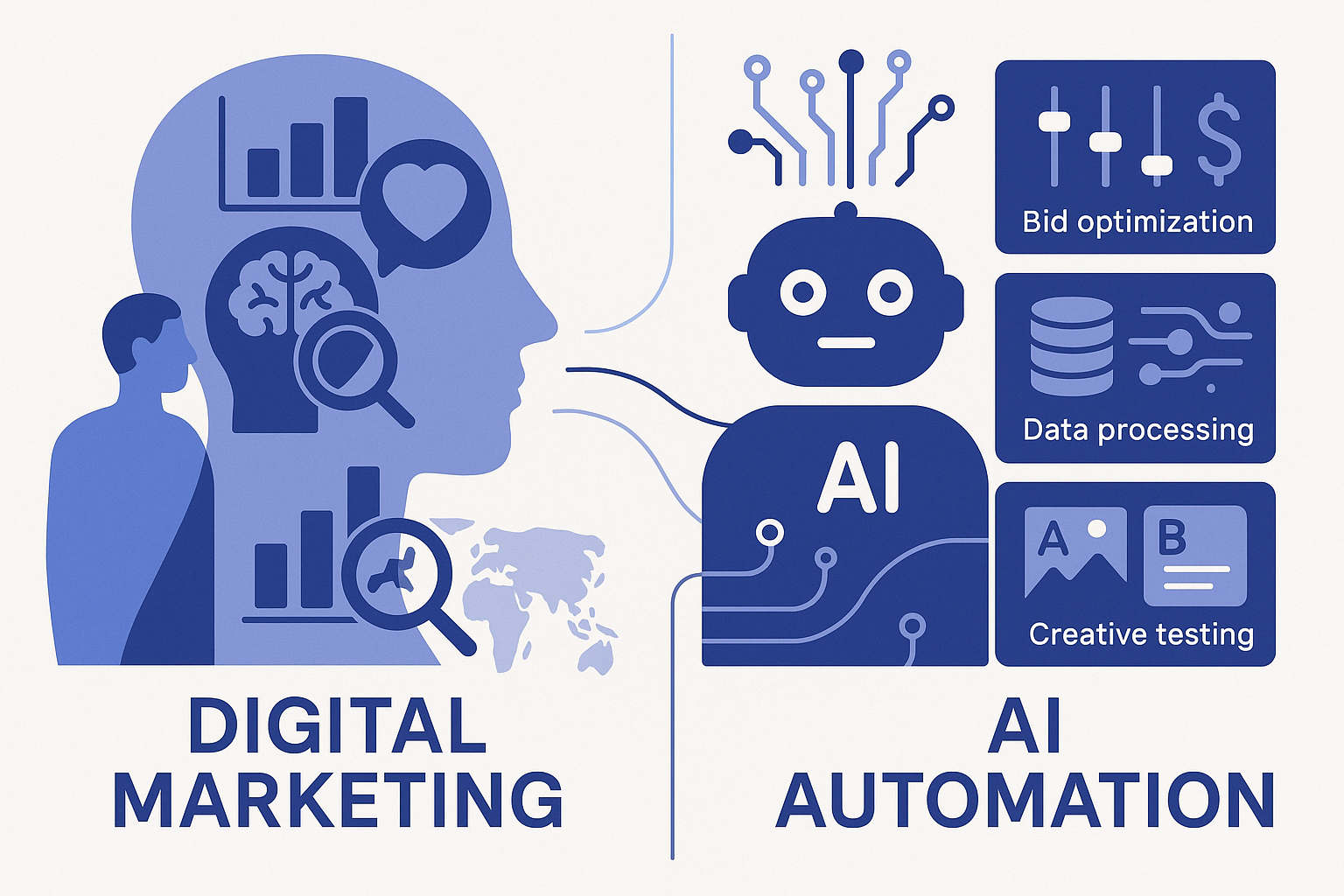
Here's what most people get wrong about AI in performance marketing—they think it's about replacement when it's really about amplification.
Strategy and Offer Development
No AI tool can tell you whether a keto supplement will outperform a testosterone booster in the 45-54 male demographic. That requires market intuition, trend analysis, and understanding customer psychology at a level that current AI can't match.
The same goes for funnel strategy. Should you use a VSL or a webinar? Bridge page or direct linking? These decisions require understanding traffic temperature, offer complexity, and competitive landscape—areas where human judgment remains superior.
Creative Direction and Brand Voice
AI can generate variations of existing creative concepts, but it struggles with breakthrough creative that stops the scroll. The ads that achieve 10x+ engagement rates usually come from human insights about customer pain points, desires, and objections.
Look at the most successful native ads on Taboola or Outbrain. They work because they tap into specific emotional triggers or curiosity gaps that resonate with real people. AI might help you scale that concept once you've proven it, but it won't create the original breakthrough.
Implementation Roadmap: Where to Start
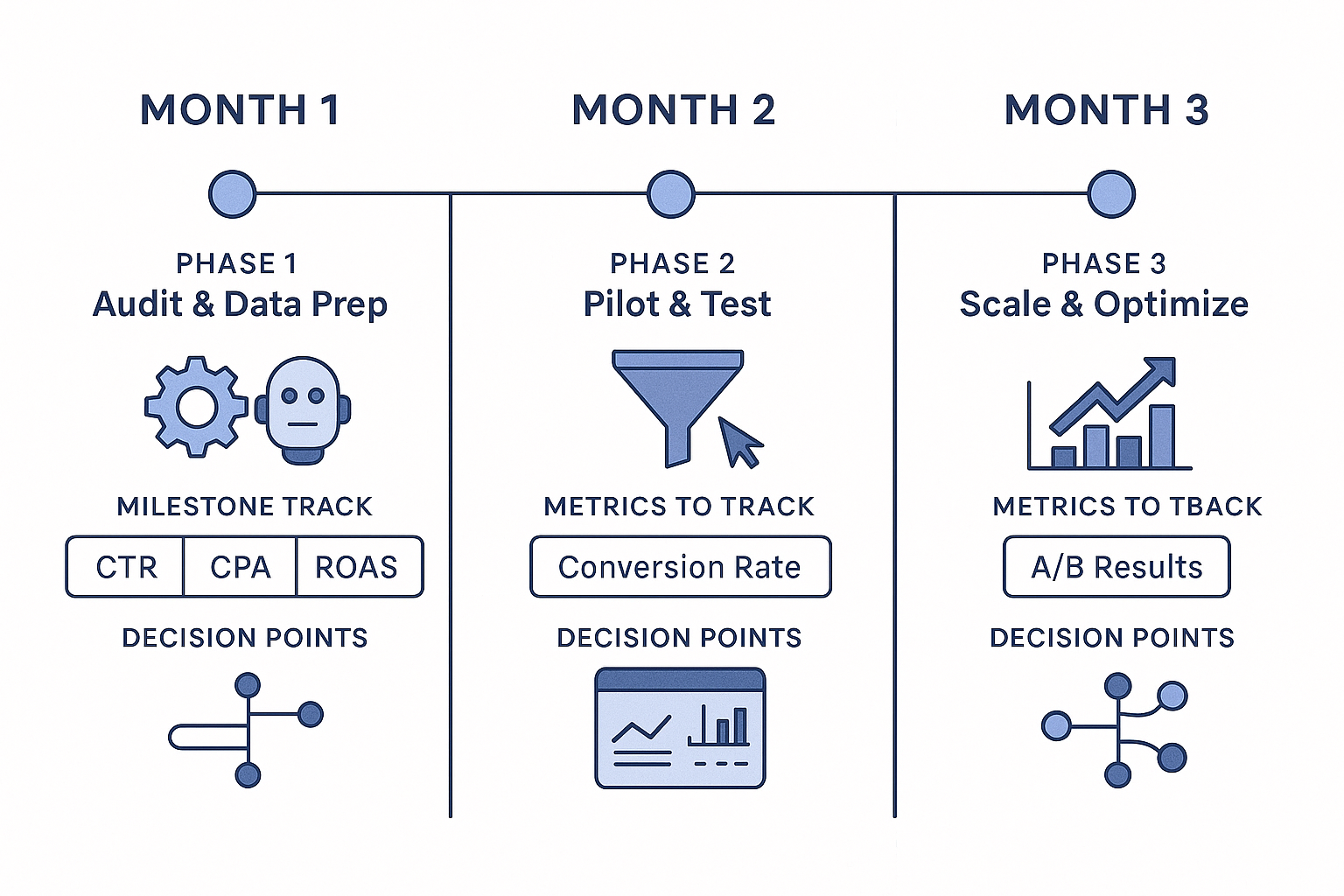
Don't try to automate everything at once. Here's the sequence that's worked best in my experience.
Month 1: Automate Bid Management
Start with Target CPA or Target ROAS bidding on your highest-volume campaigns. You'll need at least 30 conversions in the past 30 days for this to work effectively.
Set your target 20-30% higher than your current average to give the algorithm room to learn. Most people set targets too aggressively and kill performance.
Month 2: Implement Creative Testing Automation
Set up Dynamic Creative Optimization or similar automated testing features. Create multiple variations of your best-performing creative elements and let the platform find optimal combinations.
The key is systematic testing—don't just throw random elements together. Test one variable at a time when possible.
Month 3: Expand Audience Automation
Once your core campaigns are stable, start experimenting with AI-powered audience expansion. Begin with Lookalike Audiences based on your best customers, then gradually test platform-suggested similar audiences.
The 2026 Reality: What's Coming Next
The next wave of AI in performance marketing won't be about better ad copy generators or smarter bidding algorithms. It's about cross-platform optimization and predictive customer lifetime value modeling.
Google's Privacy Sandbox and iOS privacy changes are forcing platforms to get smarter about attribution and conversion prediction with limited data. The marketers who win will be those who understand how to feed these systems the right signals while maintaining creative and strategic control.
We're also seeing early experiments with AI-powered funnel optimization—systems that can automatically adjust landing page elements based on traffic source, device type, and user behavior patterns. The technology isn't quite there yet, but it's closer than most people realize.
The bigger opportunity isn't replacing human marketers with AI—it's using AI to handle the analytical heavy lifting so we can focus on what we do best: understanding customers, crafting compelling offers, and finding new angles that break through the noise.
Smart automation amplifies good strategy. It can't fix a fundamentally flawed approach, but it can turn a solid campaign into a scaling machine. The question isn't whether to use AI and automation in your performance marketing—it's knowing exactly where these tools add the most value while keeping human insight at the center of your strategy.
Related reading: GoHighLevel vs ClickFunnels honest affiliate funnel verdict
Related reading: best email automation sequences for affiliate offer promotions
Frequently Asked Questions (Updated 2026)
Does Meta Advantage+ actually replace manual campaign setup in 2026?
Not entirely—and experienced media buyers are still outperforming full Advantage+ automation in specific scenarios. Meta's Advantage+ Shopping Campaigns (ASC) work exceptionally well for e-commerce brands with large product catalogs and strong pixel history (think 500+ monthly purchases). For affiliate marketers running lead gen or single-offer funnels, results are more mixed.
The practical 2026 answer: use Advantage+ as one campaign type in a portfolio approach rather than a full replacement. Run ASC or Advantage+ Audience campaigns alongside a manual CBO campaign with your proven audience segments, and let the data tell you which outperforms over 2-3 weeks. Most advanced buyers are seeing Advantage+ win on scale but manual campaigns win on efficiency at lower budgets. The "set it and forget it" pitch is still marketing spin—you still need to monitor creative fatigue, frequency, and offer-market fit manually.
What's the best AI tool for generating compliant ad copy in restricted verticals (health, finance, supplements)?
This is one of the most-searched questions in performance marketing circles right now, and the honest answer is: no AI tool generates compliant copy on autopilot in 2026. What the best tools do is accelerate your drafting process while flagging potential policy violations before you upload.
The current workflow that's working well: use ChatGPT-4o or Claude 3.5 Sonnet with a custom system prompt that includes your platform's advertising policies and your compliance checklist. Generate 10-15 variations, run them through a second pass asking the model to flag any claims that could trigger a review, then have a human editor do final review before upload. Tools like Jasper and Copy.ai have added built-in compliance modes for health and finance, but they're not foolproof—Meta and Google's policy enforcement is increasingly AI-driven itself, which means edge cases that passed review six months ago may not today. Always cross-reference current platform policy pages directly, as these updated frequently throughout 2025 and into 2026.
How is AI changing attribution modeling for performance marketers in 2026?
Attribution has been the messiest unsolved problem in performance marketing for years, and AI is finally making meaningful progress on it—though not in the ways most vendors advertise. The big shift in 2026 is the mainstream adoption of data-driven attribution (DDA) across Google, Meta, and increasingly TikTok, replacing older last-click and even linear models.
Google's DDA now uses machine learning to assign fractional credit across touchpoints based on actual conversion path analysis from your account's historical data—it requires a minimum conversion volume to activate (roughly 300 conversions and 3,000 ad interactions in 30 days for Google Ads). Meta's Advantage+ attribution settings have similarly shifted toward 7-day click windows with view-through modeling baked in.
The practical implication: if you're comparing ROAS across platforms using different attribution windows, you're comparing apples to oranges. The marketers winning in 2026 are using a combination of platform-native DDA plus an independent source of truth—whether that's a third-party MTA tool, Northbeam, Triple Whale, or even a simple post-purchase survey asking "how did you hear about us?" Incrementality testing (running geo holdouts or ghost ads) has also become more accessible and is worth adding to your measurement toolkit if you're spending over $50K/month.
This article contains affiliate links. We may earn a commission at no extra cost to you. Full disclosure.
Editorial Team
Senior Digital Marketing Strategist
The Prophet Visionary editorial team covers affiliate marketing, paid traffic, funnels, and digital product strategy with hands-on practitioner experience.
Learn more about our editorial team →Tired of Paying for 5 Tools That Don't Talk to Each Other?
Systeme.io replaces your funnel builder, email tool, course platform, and affiliate manager — one login, one bill, zero integration headaches. Free plan available.
See the All-in-One PlatformThis page contains affiliate links — I may earn a commission at no extra cost to you.
Disclaimer: The information on this site is for educational purposes only and does not constitute financial, legal, or business advice. Results vary based on individual effort, market conditions, and other factors. Always do your own due diligence before making business or investment decisions.