How to Stack High-Ticket Affiliate Offers Inside Email Sequences
The Outcome You're Actually Chasing
Here's what offer stacking, done correctly, looks like in practice: a single subscriber enters your email sequence, buys a $47 front-end product in week one, upgrades to a $297 mid-ticket offer by week three, and converts on a $1,500–$3,000 high-ticket recommendation somewhere between days 30 and 60. Total affiliate commissions from one subscriber: anywhere from $400 to $1,800+, depending on your commission structure and the programs you've chosen.
That's not fantasy math. That's what happens when you architect a sequence around deliberate value escalation—not random broadcast blasts or a 3-email welcome sequence that dead-ends into silence.
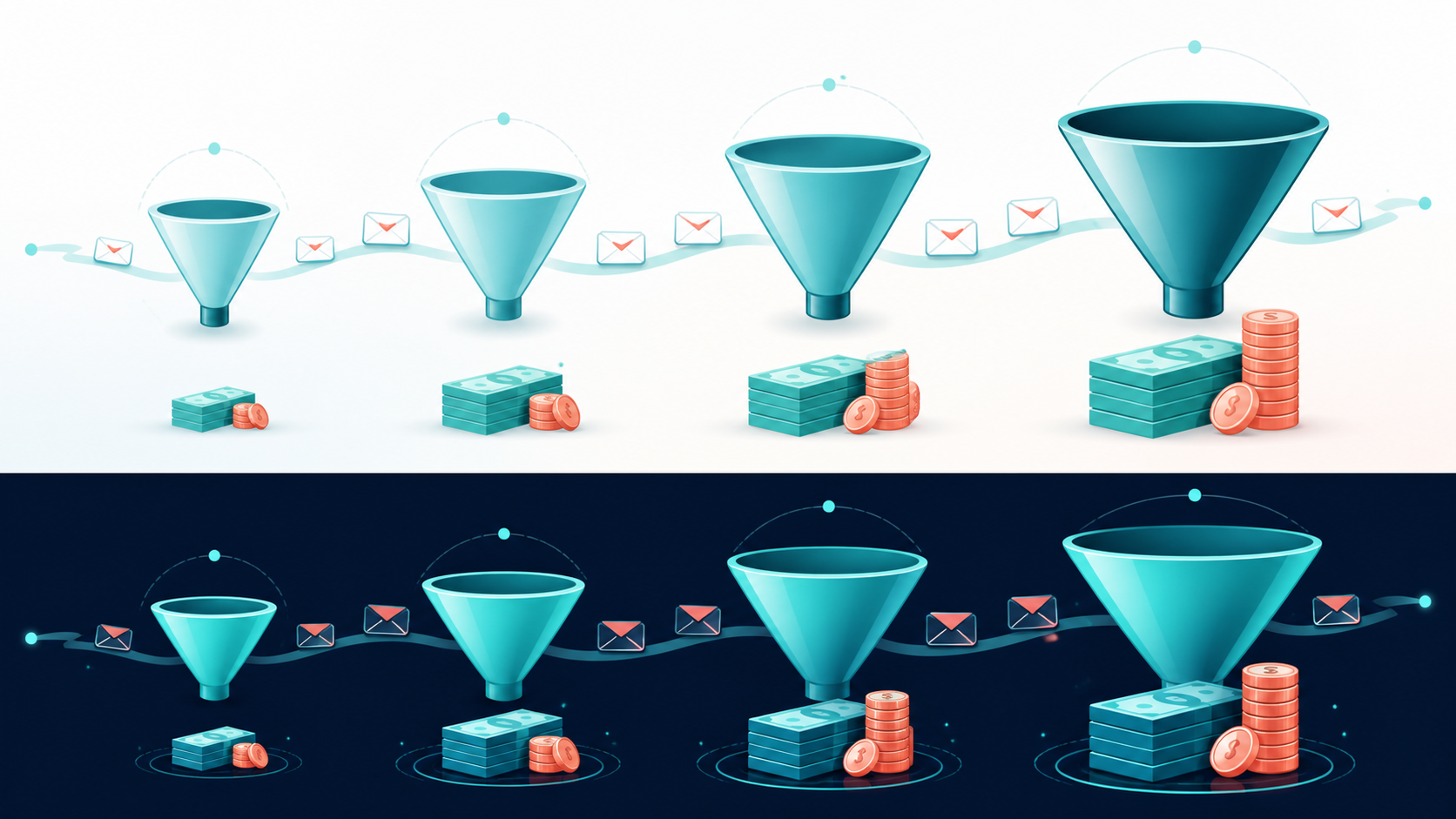
Most affiliates leave 60–70% of their sequence revenue on the table because they treat email like a megaphone instead of a conversation. They pitch one offer, maybe two, then abandon the subscriber to a weekly newsletter. Offer stacking changes the architecture entirely. You're building a revenue ladder inside a single sequence, where each email either deepens trust, resolves an objection, or advances the subscriber one rung closer to a higher-commitment purchase.
This article walks you through the exact framework—the milestones, the sequence structure, the offer selection criteria, and the practical mechanics of running this inside tools like ConvertKit, ActiveCampaign, or gohighlevel.

Milestones and Timeline: What to Expect at Each Stage
Before touching sequence structure, you need a realistic timeline. I've found that affiliates who expect high-ticket conversions inside the first 7 days almost always burn their list. Trust has a minimum viable runway, and skipping it is expensive.
Days 1–7 (The Trust Foundation Phase): No high-ticket pitches. None. Your goal here is deliverability, engagement, and establishing authority. Open rates above 35% in this window tell you your list is healthy. Below 25% and you have a deliverability or audience-fit problem worth fixing before you stack anything.
Days 8–21 (The Front-End Conversion Window): This is where your $27–$97 offers live. These exist not primarily for the commission—though that helps—but to create buyers. A subscriber who spends $47 with you is psychologically different from one who hasn't. They've extended trust. Conversion rates on front-end offers in a well-structured sequence typically run 2–6% of total subscribers, depending on traffic source and offer relevance.
Days 22–45 (The Mid-Ticket Escalation Phase): Now you're introducing $197–$497 offers. These can be standalone affiliate products or upsells within a program you're already promoting. Your mid-ticket conversion rate will be lower—often 0.5–2%—but the commission jump makes it worthwhile. This is also where case studies, proof-of-concept emails, and comparison content earn their keep.
Days 46–90 (The High-Ticket Positioning Phase): This is the $1,000–$5,000 range. Masterminds, done-for-you services, high-end software suites, coaching programs. Conversion rates here are often below 1% of total sequence subscribers—but on a list of 5,000 people, even 0.3% is 15 buyers. At $500 average commission per sale, that's $7,500 from a single sequence without a single new subscriber.
The Offer Stack Architecture: Building the Ladder
The mistake I see constantly is affiliates choosing offers based on commission percentage alone. That's backwards. Your stack needs to be built around a coherent transformation narrative—the subscriber's journey from problem-aware to solution-committed.
Step 1: Define the Core Transformation
Pick one central outcome your audience is working toward. "Make money online" is too broad. "Build a profitable affiliate funnel that generates consistent monthly commissions" is workable. Every offer in your stack should be a stepping stone toward that same outcome. If an offer doesn't fit the narrative, it doesn't go in the sequence—regardless of commission rate.
Step 2: Map Offers to Stages of Commitment
A practical four-tier stack looks like this:
- Tier 1 (Days 8–14): A low-friction, high-relevance front-end offer. Think ClickBank products in the $27–$67 range, or a low-cost tool trial like Systeme.io's free tier leading into a paid plan pitch. Goal: create a buyer.
- Tier 2 (Days 15–25): A course, training, or software upgrade in the $97–$297 range. This should solve the next logical problem the subscriber encounters after the front-end purchase. Sequencing matters here—don't pitch Tier 2 before a meaningful percentage of your list has had time to experience Tier 1.
- Tier 3 (Days 26–45): A mid-to-high ticket program, $297–$997. This is often where affiliate programs with recurring commissions live—think software platforms, membership communities, or hybrid courses with coaching components. The pitch here requires more email real estate: longer-form storytelling, third-party proof, and explicit objection handling.
- Tier 4 (Days 46–90): The flagship high-ticket recommendation. Done-for-you services, masterminds, high-end coaching programs. Commission structures here often range from $500 to $2,000+ per sale. You'll need an application-style email or a direct call-to-action to a VSL/webinar rather than a direct buy link.
Step 3: Engineer the Bridge Emails
Bridge emails are the connective tissue most affiliates forget to write. Between each tier transition, you need 1–2 emails that don't pitch anything—they just deepen the subscriber's awareness of the gap between where they are and where they want to be. These emails carry the sequence's emotional weight. They're also your highest-read emails, because they don't feel like sales.
A bridge email might share a short case study, ask a question that surfaces a pain point, or deliver a genuinely useful tactical tip. The counterintuitive part: the more value you give away in bridge emails, the higher your Tier 3 and Tier 4 conversion rates tend to be. I've tracked this pattern across multiple niches—it holds consistently.
Sequence Structure: Email by Email
Here's a working framework for a 60-day, 18-email high-ticket offer stack sequence. This isn't a template—it's a skeleton you adapt to your niche and offer set.
| Email # | Day | Type | Purpose |
|---|---|---|---|
| 1 | 0 | Welcome | Set expectations, deliver lead magnet if applicable |
| 2 | 1 | Authority | Your story, credibility establishment |
| 3 | 3 | Value | Teach something genuinely useful—no pitch |
| 4 | 5 | Bridge | Surface the core problem your Tier 1 offer solves |
| 5 | 7 | Soft Pitch | Introduce Tier 1 offer with context, not hype |
| 6 | 9 | Objection | Handle the top 2 objections to Tier 1 |
| 7 | 11 | Hard Pitch | Direct Tier 1 CTA with urgency element |
| 8 | 14 | Bridge | Acknowledge Tier 1 buyers, pivot to next problem |
| 9 | 17 | Value | Deeper tactical content—no pitch |
| 10 | 20 | Soft Pitch | Introduce Tier 2 offer |
| 11 | 23 | Case Study | Third-party proof for Tier 2 |
| 12 | 26 | Hard Pitch | Direct Tier 2 CTA |
| 13 | 30 | Bridge | Reframe—shift from tactics to strategy |
| 14 | 35 | Value | High-value content that implies Tier 3 need |
| 15 | 40 | Soft Pitch | Introduce Tier 3 offer with story |
| 16 | 45 | Objection | Handle Tier 3 objections (price, time, trust) |
| 17 | 55 | Invitation | Tier 4 high-ticket—webinar or application CTA |
| 18 | 60 | Follow-Up | Last chance / re-engagement before evergreen broadcast |
Notice what's not in this sequence: daily pitches, fake scarcity, or five consecutive promotional emails. The ratio of value emails to pitch emails runs roughly 2:1. That's not an accident.
For a deeper look at how sequence length affects conversion rates across different offer types, this breakdown on affiliate email sequence length covers the data behind optimal send cadences.
Offer Selection Criteria for High-Ticket Stacking
Not every high-ticket affiliate program belongs in a stack. Here's how I evaluate offers before they earn a slot:
- Commission structure: Flat commissions above $300 per sale, or recurring commissions above $50/month, justify the email real estate. Anything below that needs a volume argument to make sense.
- Vendor support quality: High-ticket offers require trust. If the vendor has poor onboarding, no affiliate resources, or a refund rate above 10%, that reputation attaches to you. Check ClickBank's gravity scores and refund indicators, or ask vendors directly for their chargeback rates.
- Narrative fit: Does this offer logically follow the previous one? If you're stacking a funnel-building course into a paid traffic masterclass into a done-for-you funnel service, that's coherent. Dropping a health supplement into the same sequence because it pays well is incoherent—and your subscribers will feel it.
- Sales page quality: You're sending warm traffic to someone else's sales page. If that page is weak, your conversion rate suffers regardless of how good your email is. Review the page before you commit.
Segmentation: The Multiplier Most People Skip
Here's where offer stacking gets genuinely powerful—and where most affiliates leave real money behind. Running the same sequence to buyers and non-buyers is a structural mistake.
The moment someone purchases Tier 1, they should be tagged and moved into a modified sequence that skips the remaining Tier 1 pitch emails and advances them directly toward Tier 2. In ConvertKit, this is a simple tag-based automation rule. In ActiveCampaign, you'd use a goal step. In GoHighLevel, it's a workflow condition.
Non-buyers of Tier 1 after your hard pitch email? They get a re-engagement email at day 14 that surfaces a different angle—maybe a different offer entirely, or a free resource that rebuilds engagement before you try again.
This kind of behavioral segmentation can increase overall sequence revenue by 20–40% without adding a single new subscriber. I've seen it happen consistently when affiliates move from broadcast-style sequences to properly conditional automations. If you're not sure which platforms handle this best, this comparison of email autoresponders for affiliate marketers covers deliverability and automation depth side by side.
Practical Implementation Notes
A few things I've observed that don't show up in most frameworks:
Subject line fatigue is real at day 30+. By the time you're in the Tier 3 and Tier 4 portion of your sequence, your open rates will have dropped—sometimes significantly. This is normal. What isn't normal is ignoring it. I've found that switching to plain-text emails (no HTML formatting, no images, no branded header) in the Tier 3–4 window often lifts open rates 8–15% compared to designed emails. The plain-text format reads more like a personal message, which is exactly the tone you want when pitching high-ticket.
The "soft no" problem. A lot of subscribers will click your Tier 3 link, land on the sales page, and leave. Most affiliates never follow up on this. If you're using a platform that tracks link clicks (ActiveCampaign and ConvertKit both do this natively), build a separate short sequence—3 emails max—that fires when someone clicks but doesn't buy. These emails should be pure objection handling. No new pitches. Just addressing the specific hesitations that typically kill high-ticket conversions: price, timing, skepticism about results.
Deliverability degrades over long sequences. A 60-day sequence with 18 emails is a lot of sending. If your domain isn't warmed properly, or if your list has significant cold segments from paid traffic, you'll see inbox placement drop by email 10–12. Run a deliverability check via GlockApps or Mail-Tester before launching, and consider suppressing subscribers who haven't opened in 21+ days before they drag down your sender score.
Front-end offer selection affects everything downstream. I can't stress this enough. If your Tier 1 offer attracts freebie-seekers or low-intent buyers, your Tier 3 and Tier 4 conversion rates will reflect that. The quality of your front-end buyer determines the quality of your high-ticket pipeline. Sometimes a higher-priced front-end ($67 vs $17) actually improves downstream conversion rates because it self-selects for more committed buyers from the start.
And if your post-purchase sequence isn't pulling its weight on upsells, this breakdown on post-purchase email sequences for affiliate upsells is worth a close read—it covers the mechanics of converting buyers into repeat buyers, which is the natural extension of what we're discussing here.

Revenue Model Analysis: Realistic Ranges
Let's be direct about what this strategy can and can't do.
A list of 3,000 subscribers running through a properly structured 60-day stack sequence, with reasonable front-end offer fit and mid-quality traffic (think Facebook lead ads or a native traffic campaign from Taboola at $0.45–0.75 CPC), might generate:
- Tier 1 conversions: 90–180 buyers (3–6% rate) at $20–40 average commission = $1,800–$7,200
- Tier 2 conversions: 15–60 buyers (0.5–2% rate) at $80–150 average commission = $1,200–$9,000
- Tier 3 conversions: 6–30 buyers (0.2–1% rate) at $150–300 average commission = $900–$9,000
- Tier 4 conversions: 1–9 buyers (0.03–0.3% rate) at $500–1,500 average commission = $500–$13,500
Total sequence revenue from 3,000 subscribers: roughly $4,400–$38,700, depending heavily on traffic quality, offer selection, and sequence execution. That's a wide range—intentionally so. Anyone giving you a tight number without knowing your niche, your list, and your offers is selling you something.
The point isn't the specific number. The point is the architecture: multiple revenue events from the same subscriber, at increasing commission values, over a 60-day window. That's fundamentally more efficient than a single-offer approach, and it's why affiliates who build stacks tend to outperform those who don't—even when their list sizes are smaller.
How You'll Know It's Working
Concrete signals that your offer stack is functioning as intended:
- Your Tier 1 conversion rate is above 2% by day 14. Below that, something is wrong—either the offer doesn't fit the audience, or your trust-building emails aren't doing their job.
- Your open rate holds above 25% through day 30. A sharp drop before that suggests deliverability issues, not just list fatigue.
- At least one Tier 3 or Tier 4 sale appears within your first full sequence run. Even one. That's validation that the architecture works—optimization comes after.
- Buyers from Tier 1 are converting to Tier 2 at a higher rate than non-buyers. If this isn't happening, your segmentation or your bridge emails need work.
- Your click-to-open rate (CTOR) on pitch emails is above 8%. Below that, your subject lines and preview text are failing to pull the right readers into the email body.
The sequence won't be perfect on the first run. Nothing is. But if you see those signals trending in the right direction across your first 200–300 subscribers, you have something worth scaling.
Offer stacking isn't a shortcut—it's a structure. Build it right, segment it properly, and give it enough volume to produce statistically meaningful data. That's the path from a single-offer email list to a multi-tier affiliate revenue engine that actually compounds over time.
This article contains affiliate links. We may earn a commission at no extra cost to you. Full disclosure.
Editorial Team
Senior Digital Marketing Strategist
The Prophet Visionary editorial team covers affiliate marketing, paid traffic, funnels, and digital product strategy with hands-on practitioner experience.
Learn more about our editorial team →Monetize Smarter With Funnels + Email in One Place
Order bumps, upsells, automated email sequences, and your own affiliate program — Systeme.io gives you the full monetization stack without the bloated monthly spend.
See the Monetization StackThis page contains affiliate links — I may earn a commission at no extra cost to you.
Disclaimer: The information on this site is for educational purposes only and does not constitute financial, legal, or business advice. Results vary based on individual effort, market conditions, and other factors. Always do your own due diligence before making business or investment decisions.