Why Your Welcome Sequence Isn't Selling Affiliate Offers
You spent three weeks building out your welcome sequence. You picked a platform, wrote the emails, set up the triggers, tested the opt-in. And now? Crickets. Maybe a handful of clicks. Maybe one or two sales if you're lucky. Mostly just a growing list of subscribers who opened the first email and then... nothing.
That's a genuinely frustrating place to be. You did the work. You followed the advice. And the results don't match what you were promised by every "7-figure marketer" tutorial you watched at 11pm.
Here's what I've found after years of building and auditing affiliate email funnels: the problem almost never lives where people think it does. It's not your subject lines. It's not your ESP. It's almost always a structural problem—the sequence is built wrong from the ground up, and no amount of tweaking copy on email three is going to fix a broken foundation.
So let's actually diagnose this. Not with vague advice, but with the specific, fixable reasons affiliate welcome sequences fail—and what to do about each one.
The Real Bottleneck Nobody Talks About
Most welcome sequences are built as if subscribers already trust you. They don't. A new subscriber is skeptical by default, especially if they came in through paid traffic (Facebook ads, native ads, solo buys). They gave you their email for a lead magnet. That doesn't mean they're ready to buy anything.
The mistake I see constantly—and I mean constantly—is affiliates pushing an offer in email one or two without doing any trust-building first. They treat the welcome sequence like a sales funnel when it's actually a relationship funnel. The selling comes after the relationship. Try to shortcut that, and you'll get ignored.
The other thing that kills welcome sequences is misalignment between what the subscriber opted in for and what you're trying to sell them. If someone downloaded your "free keto meal plan" and your welcome sequence pivots immediately into promoting a $97 affiliate supplement stack, that's a jarring non-sequitur. Even if the products are related, the transition feels like bait-and-switch. Subscribers feel that, even if they can't articulate it, and they disengage.

Step 1: Fix Your Trigger Logic Before Anything Else
Your automation trigger is the first place to look when a sequence isn't performing. Most people set up a single trigger—"subscribed to list"—and call it done. That's fine for a basic newsletter. It's not fine for affiliate product launches, where timing and segmentation actually matter.
What you want is behavioral triggers layered on top of list entry. On ConvertKit, this means using tag-based automation. On ActiveCampaign, you're building conditional paths. On systeme.io (which is surprisingly capable for the price), you can set up funnel-specific sequences that fire differently based on which opt-in page triggered the subscription.
Here's a concrete example. Say you're promoting a ClickBank offer in the weight loss niche. You have two lead magnets: a recipe guide and a workout plan. If both feed into the same generic welcome sequence, you're treating two very different subscriber intents identically. The person who downloaded the workout plan may be less receptive to a nutrition-focused affiliate offer in email two. Splitting those into separate sequences—even if 80% of the content is the same—lets you tailor the bridge to the offer.
Pro tip: Before you touch a single email, map your trigger logic on paper. Which opt-in page? Which lead magnet? What's the implied intent? Build a sequence for each distinct entry point, not one sequence for everyone.
Step 2: Email One Is Not a Sales Email. Stop Making It One.
Email one has one job: deliver what you promised and make the subscriber glad they opted in. That's it. No affiliate link. No soft pitch. No "by the way, check out this amazing program." Nothing.
I know that feels like leaving money on the table. It's not. Email one sets the tone for the entire relationship. If you open with a pitch, you've signaled to the subscriber that this is a commercial list, not a value-first one. Open rates on every subsequent email will suffer for it.
What email one should do:
- Deliver the lead magnet immediately and clearly
- Introduce yourself briefly—who you are, why you're qualified to help them
- Set expectations for what's coming ("Over the next few days, I'm going to share...")
- Include one genuine, useful tip that has nothing to do with selling anything
That last point is underrated. One actionable insight in email one—something they can use right now—does more for your long-term conversion rate than any subject line hack.
Step 3: The Bridge Email Is Where Most Affiliates Lose the Sale
The bridge email is typically email three or four in a welcome sequence. It's where you transition from pure value delivery into introducing the affiliate offer. And it's where most sequences completely fall apart.
What usually happens: affiliates write something like "I've been sharing tips with you, and I also want to let you know about this amazing program that changed my life..." That's weak. It doesn't connect the problem the subscriber came to you with to the solution you're recommending. It feels like a pivot, not a natural progression.
A strong bridge email does three things in order:
- Amplifies the problem. Remind the subscriber of the pain they're trying to solve. Make them feel it again.
- Introduces the mechanism. Explain why the usual approaches fail, and tease that there's a different way.
- Positions the offer as the logical next step. Not a pitch—a recommendation. "This is what I use / what I've seen work / what addresses exactly what we've been talking about."
The counterintuitive part: the bridge email often shouldn't have a hard call-to-action. A curiosity-driven soft link—"Here's what I'm talking about"—often outperforms "Click here to buy now" in a warm-up sequence. You're still building trust. Let the offer page do the selling.
For deeper thinking on how many emails you actually need before the hard pitch, this breakdown on affiliate email sequence length is worth reading before you finalize your structure.
Step 4: Automate the Behavioral Branches, Not Just the Timeline
A linear welcome sequence—email one on day one, email two on day two, and so on—is better than nothing. But it's leaving serious conversion potential untouched.
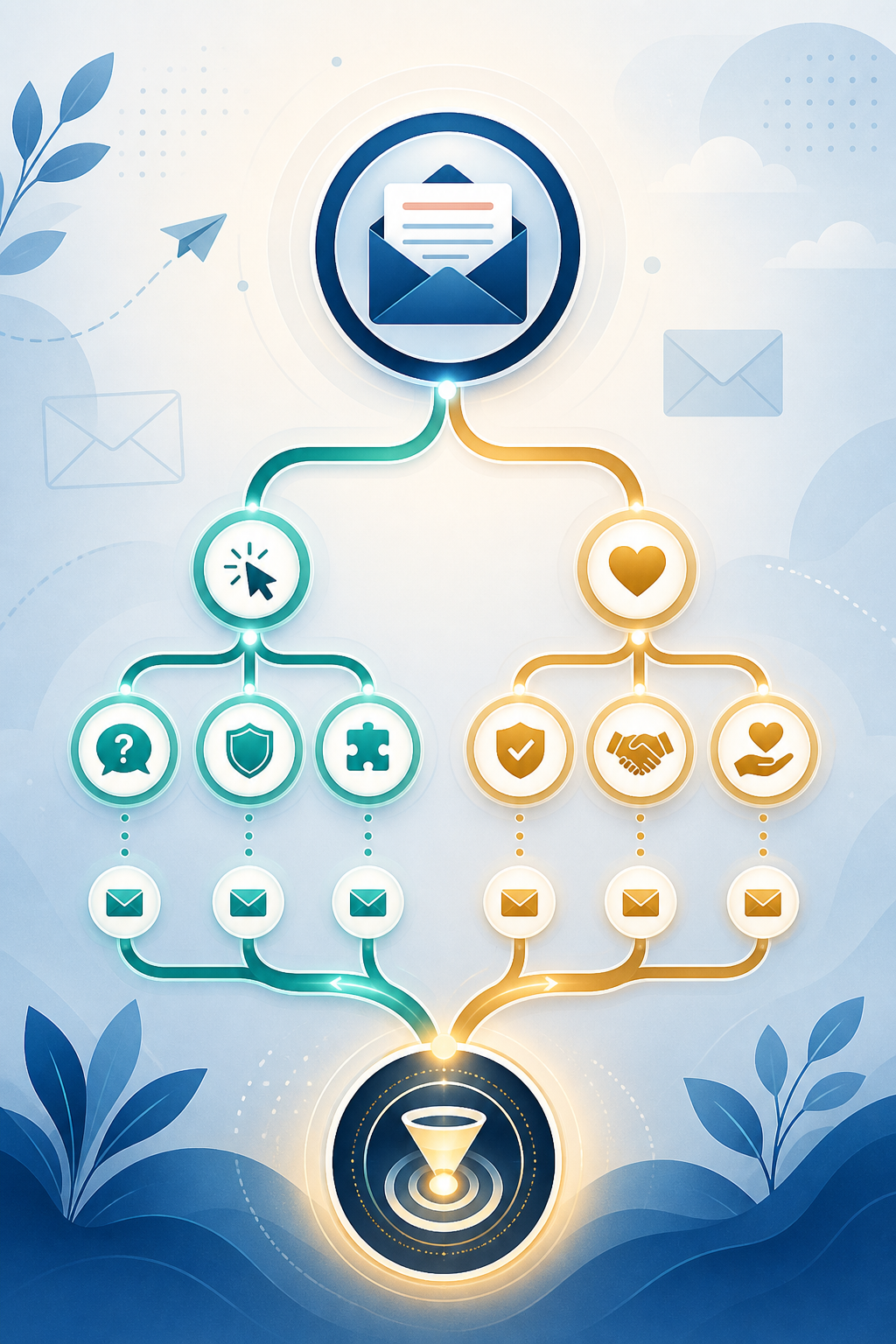
The subscribers who click your affiliate link in email three but don't buy are a completely different segment than the subscribers who didn't click at all. They need different follow-up. The clickers need objection-handling and urgency. The non-clickers need more trust-building and a different angle on the offer.
This is where behavioral automation earns its keep. In ActiveCampaign or ConvertKit, you can tag subscribers based on link clicks and branch the sequence accordingly. The clicker gets a "did you get a chance to check this out?" email with a FAQ or testimonial angle. The non-clicker gets a different email entirely—maybe a case study, maybe a different lead-in to the same offer.
Systeme.io can handle basic conditional branching too, though its logic is less granular than ActiveCampaign. If you're on a budget and just starting out, Systeme.io is fine. If you're scaling a launch with real traffic volume, you want a platform with proper conditional automation. For a clear comparison of what the major platforms actually support, this ranked breakdown of email autoresponders for affiliate marketers covers deliverability and automation depth side by side.
Step 5: Your Subject Lines Are Probably Fine. Your Preview Text Isn't.
Everyone obsesses over subject lines. And yes, they matter. But in my experience, the single most underoptimized element in affiliate welcome sequences is preview text—the snippet that appears next to or below the subject line in most email clients.
Most platforms auto-populate preview text from the first line of the email body. Which means your subscribers are seeing something like "View this email in your browser" or the first generic sentence of your opener before they even decide to open. That's a wasted opportunity.
Set your preview text manually on every single email. Make it work with the subject line, not just repeat it. If your subject line is "The reason most diets fail in week two," your preview text might be "(and it has nothing to do with willpower)." That combination creates a curiosity loop that pulls opens.
Small change. Measurable impact. Do it.
Step 6: The Launch Timing Mismatch Problem
Here's something specific to affiliate product launches as opposed to evergreen offers: timing your welcome sequence to a launch window is harder than it sounds, and most people get it wrong.
If you're promoting a ClickBank launch with a hard open and close date, your welcome sequence needs to account for when subscribers actually join your list relative to the launch window. Someone who opts in six days before launch needs a different sequence than someone who opts in the day before. Both can't receive the same seven-day welcome sequence and have it make sense.
The fix is to build your welcome sequence around the launch countdown, not a fixed day-by-day schedule. Use your ESP's date-based conditions or a launch-specific automation that checks how many days remain until the cart opens. This is more complex to build, but it means every subscriber gets emails that are relevant to where they are in the launch timeline—not a generic drip that may be pitching them on a product that's already closed.
For high-ticket launches specifically, offer stacking within email sequences is a technique worth layering in once your core sequence is solid.
From the Field: What I've Actually Seen Work
A few observations from building and reviewing these sequences in practice—not case studies with made-up numbers, just honest notes:
Three-email welcome sequences outperform five-email ones more often than not when the traffic source is cold paid traffic. Longer sequences work better with warmer audiences (organic search, referral traffic). Cold traffic subscribers have shorter patience windows. Get to the point faster.
Plain text emails consistently outperform HTML templates in affiliate welcome sequences. I know that sounds wrong. Branded templates look professional. But plain text reads like a personal email, and personal emails get read. The open rate difference isn't dramatic, but the click-through difference often is.
Sending cadence matters more than most people admit. Sending emails one per day for the first five days keeps you top of mind during the window when subscribers are most engaged. Spacing them out to every other day feels more "respectful" but usually kills momentum. Compress the sequence. You can always slow down after the welcome window closes.
Deliverability is upstream of everything. If your emails are landing in promotions or spam, no amount of copywriting optimization will save you. Authenticate your domain (SPF, DKIM, DMARC), warm up new sending domains properly, and avoid spam-trigger phrases in your affiliate emails. This is non-negotiable.
Troubleshooting: When the Sequence Still Isn't Working
If you've fixed the structure and you're still not seeing results, run through this checklist:
- Open rates below 20%? Deliverability or subject line problem. Check your spam score and sender reputation first.
- Opens are fine but clicks are low? The bridge email isn't connecting the problem to the offer. Rewrite the transition, not the CTA.
- Clicks are decent but no conversions? The offer page is the problem, not your sequence. Check the offer's EPC data on ClickBank or wherever you sourced it. Some offers just convert poorly regardless of how good your sequence is.
- High unsubscribes in emails one or two? Expectation mismatch. What you promised at opt-in doesn't match what you're delivering. Align them.
- Sequence fires but emails arrive out of order? Automation logic error. Go back and manually trace the trigger path in your ESP.
Your 10-Minute Action Plan
Stop overthinking it. Here's what to do right now:
- Minutes 1-2: Open your current welcome sequence and count how many emails contain an affiliate link. If email one has one, remove it. If more than 60% of your emails are pitching, you've found your problem.
- Minutes 3-4: Check your trigger logic. Is every opt-in source feeding the same sequence? Identify the one opt-in with the most traffic and confirm the sequence is actually firing for it. (You'd be surprised how often it isn't.)
- Minutes 5-6: Open your bridge email. Read it out loud. Does it clearly connect the subscriber's pain to the offer? If it sounds like a pivot rather than a natural progression, flag it for a rewrite.
- Minutes 7-8: Check your preview text on every email. If any of them say "View this email in your browser" or start with a generic opener, fix them manually right now.
- Minutes 9-10: Look at your sending schedule. If your sequence is spread out over two weeks with gaps of three or four days, compress it. Aim for emails on days one, two, three, five, and seven at minimum.
That's it. Ten minutes of honest audit will tell you more about what's broken than another hour of reading about email marketing theory.
The truth is, welcome sequence automation for affiliate launches isn't rocket science—but it does require getting the fundamentals right in the right order. Trust before pitch. Behavioral logic over linear timelines. Alignment between what subscribers expected and what you deliver. Fix those, and the conversions follow.
This article contains affiliate links. We may earn a commission at no extra cost to you. Full disclosure.
Editorial Team
Senior Digital Marketing Strategist
The Prophet Visionary editorial team covers affiliate marketing, paid traffic, funnels, and digital product strategy with hands-on practitioner experience.
Learn more about our editorial team →Your List Is Only as Good as Your Email Platform
AWeber has 25+ years of inbox deliverability, drag-and-drop automation, and AI-powered copywriting built in. Free plan for up to 500 subscribers.
See Why Affiliates Use AWeberThis page contains affiliate links — I may earn a commission at no extra cost to you.
Disclaimer: The information on this site is for educational purposes only and does not constitute financial, legal, or business advice. Results vary based on individual effort, market conditions, and other factors. Always do your own due diligence before making business or investment decisions.