Why Your Welcome Sequence Fails at Upsells (And How to Fix It)
You built the funnel. You wrote the emails. You connected your ConvertKit automations, triple-checked the triggers, and sat back expecting the upsell revenue to flow in.
It didn't.
Maybe you're getting opens—decent ones, even—but nobody's clicking through to the upsell offer. Or they click, but they don't buy. Or worse, they buy the front-end product and immediately unsubscribe, like they were never interested in hearing from you again. You've watched the analytics, tweaked subject lines, maybe even swapped out the offer entirely. Still nothing.
Here's the uncomfortable truth: the problem almost certainly isn't your subject lines. It's the architecture of your welcome sequence itself—specifically, how (or whether) it's designed to move someone from "new subscriber" to "ready to spend more money with you." Most welcome sequences are built to onboard, not to sell. That's the fundamental mismatch nobody talks about.
I've audited dozens of these sequences over the years, and the same structural failures show up again and again. This guide is going to walk you through exactly what's broken and give you a concrete path to fixing it—including a 10-minute action plan at the end if you want to start today.
The Real Bottleneck: Your Sequence Has an Identity Crisis
Most welcome sequences try to do too many things at once. They want to deliver the lead magnet, introduce the brand, build trust, establish authority, and pitch an upsell—all in 3-5 emails. That's asking a lot from someone who signed up 48 hours ago and still isn't sure they trust you.
The result is a sequence that feels scattered. Email 1 delivers the freebie. Email 2 tells your story. Email 3 pitches something. The subscriber has no idea what's happening or why, and they disengage.
What actually works—and I've seen this play out across niches from online courses to software tools to ClickBank health offers—is a sequence with a single, clear psychological arc. Every email should move the subscriber one step closer to a specific belief that makes the upsell feel obvious, not pushy. If you can't articulate what belief your sequence is building toward, that's your bottleneck.

Step 1: Define the One Belief Your Upsell Requires
Before you write a single email, ask yourself: what does a subscriber need to believe before they'll buy the upsell?
Not "they need to trust me" (too vague). Something specific. If you're selling a $197 course on Pinterest traffic after a free "5-day traffic plan" opt-in, the belief might be: "Organic Pinterest traffic is real, it's faster than I thought, and I'm leaving money on the table by not doing it systematically." Every email in your welcome sequence should chip away at skepticism around that specific belief.
This sounds obvious. Almost nobody does it. Most people reverse-engineer from "what can I say in each email?" instead of "what does this person need to believe before they'll buy?"
Write that belief down. Pin it somewhere. It becomes the filter for every email in the sequence.
Step 2: Map Your Email Slots to Belief-Building Jobs
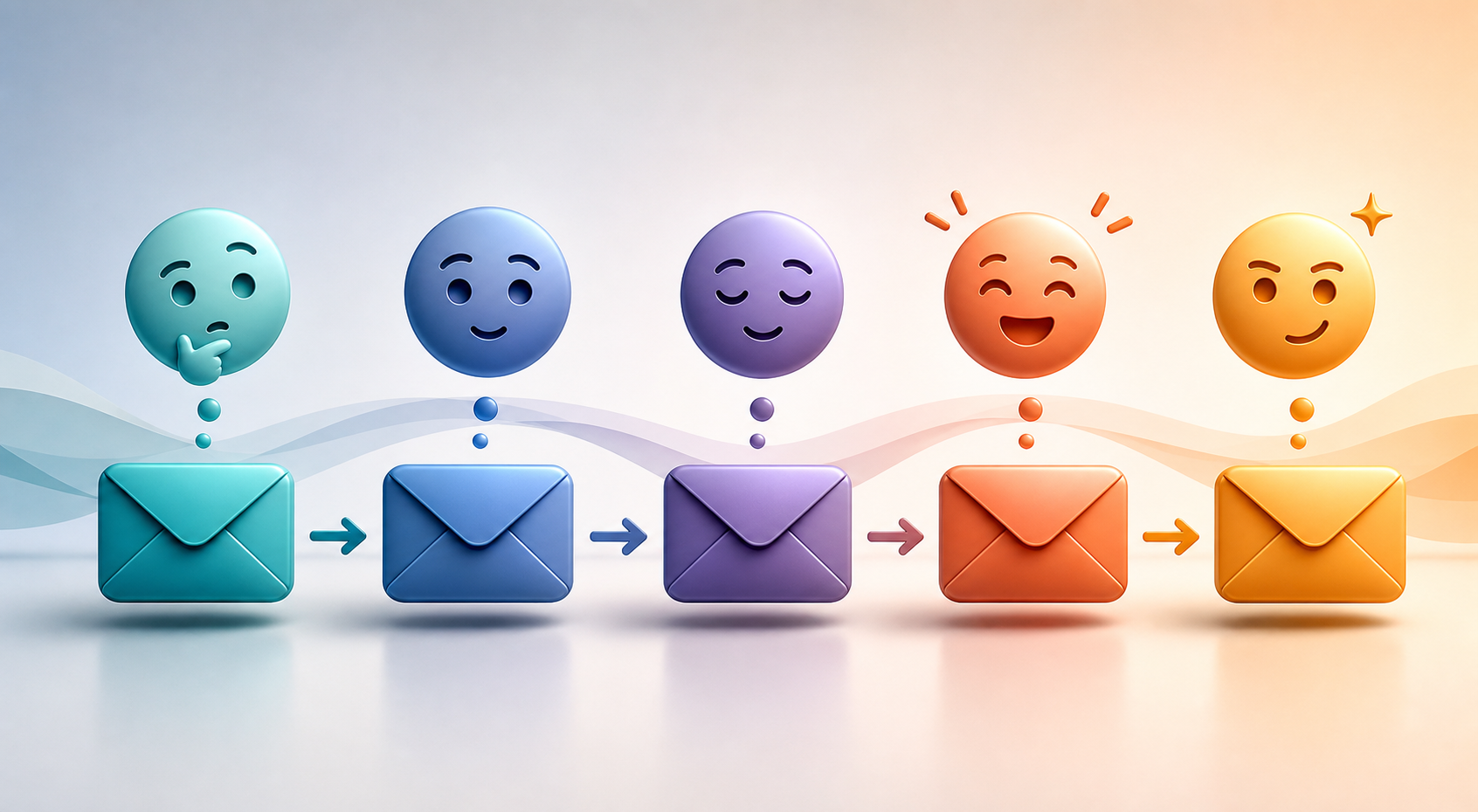
A 5-email welcome sequence isn't five opportunities to pitch. It's four opportunities to build belief and one opportunity to sell. Here's a framework I keep coming back to:
- Email 1 — Deliver + Orient: Give them what they signed up for. Set expectations for what's coming. One line about the upsell is fine here—no more.
- Email 2 — Identify the Core Problem: Name the exact frustration they're experiencing. Make them feel seen. No pitch.
- Email 3 — Shift the Blame: Explain why the usual approaches fail. This reframes their past failures as not their fault—and positions your solution as different.
- Email 4 — Social Proof + Mechanism: Show the path that actually works. Use a case study, a before/after scenario, or a clear explanation of your method. This is where you can introduce the upsell naturally.
- Email 5 — The Offer: Direct pitch. Clear CTA. Urgency if you have it (real urgency, not fake countdown timers).
The counterintuitive part? Email 2 and 3 do the heaviest selling, even though they contain no pitch. They're doing the psychological groundwork that makes Email 5 feel like a natural conclusion rather than an interruption.
If you want to go deeper on sequence length decisions, this breakdown on how long your affiliate email sequence should actually be covers the data behind 5-email vs. 7-email vs. 10-email flows.
Step 3: Fix Your Timing and Frequency
Here's where a lot of automated sequences quietly die: the gaps between emails are wrong.
Send Email 1 immediately—everyone agrees on that. But then what? I've seen people wait 3-4 days between each email in a welcome sequence, thinking they're being "respectful of the subscriber's inbox." What they're actually doing is letting the subscriber go cold.
The first 72 hours after opt-in are when engagement is highest. Open rates drop dramatically after that window. My general rule: Email 1 immediately, Email 2 within 24 hours, Email 3 at the 48-hour mark, Email 4 at day 4, Email 5 at day 6 or 7. That's a 7-day welcome sequence that maintains momentum without overwhelming people.
In ConvertKit, you'd set this up as a sequence with time delays between each email. In systeme.io, it's the same concept inside their automation builder. The platform matters less than the timing logic.
Step 4: Stop Writing for Everyone
One of the most common reasons welcome sequences don't convert upsells is that they're written for a hypothetical average subscriber—which means they resonate deeply with nobody.
Look at where your subscribers are actually coming from. If they opted in from a Facebook ad targeting women over 40 who are frustrated with their metabolism, your welcome sequence should speak directly to that person's specific frustration—not generic "health and wellness" language. If they came from a YouTube video about passive income, the sequence should acknowledge that context.
Segmentation helps here, but even if you're running a single opt-in, you can write with enough specificity that the right person feels like you're reading their mind. Vague copy is the enemy of upsells.
Step 5: The Upsell Email Itself — What Most People Get Wrong
Assuming your first four emails have done their job, Email 5 should almost feel anticlimactic. The subscriber should be thinking "okay, how do I get this?" before you even make the offer.
But the upsell email itself still needs to be structured correctly. Here's what kills conversions in that final email:
- Too many options. One offer. One CTA. That's it. If you're linking to three different products or offering a "choose your path" moment, you're introducing decision paralysis.
- Price shock without context. If you haven't mentioned price range in earlier emails, a $197 offer in Email 5 feels jarring. Seed the price perception earlier—even a subtle "most people spend hundreds on courses that cover half of what we're going to show you" works.
- Weak specificity on the offer. Don't just say "my course helps you get more traffic." Say "inside, you'll find the exact pinning schedule I used to go from 800 to 47,000 monthly views in 90 days—and the template I use to batch 30 days of content in a single afternoon." Specificity converts.
And for the love of everything—test your automation before it goes live. I can't count how many times I've seen broken sequences where the upsell email fires before the lead magnet delivery email, or the wrong tag triggers the wrong sequence. Check the full flow in a test account.
Step 6: Build the Post-Purchase Bridge
Here's something that gets overlooked almost entirely: what happens to the subscribers who do buy the upsell?
Most automations just drop them into a generic "thank you" email and then... nothing. Or they continue receiving the welcome sequence emails that are now completely irrelevant to them. That's a fast way to get unsubscribes from your best customers.
Your automation needs a post-purchase branch. In ConvertKit, this means removing the "welcome sequence" tag and adding a "customer" tag when someone purchases—then triggering a separate onboarding sequence for buyers. In gohighlevel, you'd handle this through workflow branching based on purchase triggers.
The post-purchase sequence has a different job: it needs to reinforce the buying decision, deliver value fast to reduce buyer's remorse, and prime them for the next offer up your value ladder. Post-purchase emails that actually convert affiliate upsells covers that next phase in detail—worth reading once you've got the welcome sequence working.
Practical Implementation Notes
I want to be direct about what this looks like in the real world, because the gap between theory and implementation is where most people get stuck.
When I'm setting up a welcome sequence for a digital product, the first thing I do is write the upsell email first. Not last—first. Writing the pitch email first forces clarity on what belief I'm actually selling, and then I reverse-engineer the preceding four emails to build toward that moment. It sounds backwards. It works.
On the platform side: ConvertKit handles simple linear sequences well, but if you need behavior-based branching (like sending a different Email 3 to people who clicked a specific link in Email 2), you'll hit its limits quickly. Systeme.io's automation builder handles conditional logic better at a lower price point. For more complex funnels with SMS follow-up and CRM integration, GoHighLevel is what I'd reach for—though it comes with a learning curve.
One practical observation: welcome sequences for lower-ticket upsells ($27-$97) can afford to be more direct and move faster. Higher-ticket offers ($297+) generally need more trust-building time—sometimes a 7-10 email sequence before the pitch, or a phone/call component built into the automation. Don't assume the same sequence structure works across all price points.
Also: deliverability matters more than most people realize at this stage. If your welcome emails are landing in Gmail's Promotions tab, your open rates are artificially suppressed and no amount of copywriting will fix it. Check your sender reputation and authentication (SPF, DKIM, DMARC) before you blame the sequence itself. This comparison of email autoresponders ranked by deliverability is a good starting point if you suspect that's the issue.
Why It's Still Not Working: Troubleshooting the Stubborn Cases
Sometimes you implement all of this and the sequence still underperforms. A few specific scenarios worth diagnosing:
High opens, low clicks: Your subject lines are working but your email body isn't creating enough desire to act. Rewrite Email 4 and 5 with more specific outcome language and stronger CTAs. Single link per email—remove any competing links.
Low opens across the board: Deliverability or subject line issue. Run a deliverability test through Mail-Tester.com. If your score is below 8/10, fix technical issues first. If deliverability is fine, A/B test subject lines—specifically, test curiosity-gap subject lines against direct benefit subject lines.
Clicks but no purchases: The sales page is doing the heavy lifting wrong, or there's a disconnect between what the email promises and what the page delivers. Check that the messaging match is tight. Also check page load speed—a sales page that takes 4+ seconds to load on mobile will kill conversions regardless of how good your email sequence is.
Sequence not triggering properly: Tag/trigger logic issue in your automation. Go back to basics—manually test the opt-in flow, confirm tags are being applied, confirm sequence enrollment rules are correct. This is tedious but necessary.
If you're dealing with a sequence that was working and then stopped, check if you recently changed your sending domain or IP, updated your opt-in form, or if the offer itself changed. Any of those can break the chain.
For a deeper look at the post-opt-in failure points specifically, this piece on why your post-opt-in sequence isn't converting covers some additional angles worth checking.
Your 10-Minute Action Plan
Stop reading and do these things right now—or schedule 10 minutes tomorrow morning and actually do them:
- Minutes 1-2: Write down the single belief your subscriber needs to hold before they'll buy your upsell. One sentence. Be specific.
- Minutes 3-4: Open your current welcome sequence. Read every email and ask: "Does this email move the subscriber closer to that belief?" Note which emails don't pass that test.
- Minute 5: Check your email timing. Are you sending Email 2 within 24 hours of Email 1? If not, adjust the delay in your automation tool.
- Minutes 6-7: Look at your upsell email specifically. Does it have one offer and one CTA? If there are multiple links or multiple offers, cut them down to one.
- Minute 8: Confirm your automation has a post-purchase branch. If someone buys the upsell, are they removed from the welcome sequence? If not, add that logic today.
- Minutes 9-10: Run a quick deliverability check at Mail-Tester.com. Send a test email to the address they provide, check your score. If it's below 8, that's your first priority before anything else.
That's it. Ten minutes. You won't fix everything in one session, but you'll know exactly what needs fixing—and that clarity is more valuable than another hour of reading about email strategy.
The sequences that actually generate consistent upsell revenue aren't magic. They're just built with intentionality at every step: the right belief, the right timing, the right offer, and the right automation logic to make sure the right people get the right message. Get those four things aligned and the results follow.
This article contains affiliate links. We may earn a commission at no extra cost to you. Full disclosure.
Editorial Team
Senior Digital Marketing Strategist
The Prophet Visionary editorial team covers affiliate marketing, paid traffic, funnels, and digital product strategy with hands-on practitioner experience.
Learn more about our editorial team →Your List Is Only as Good as Your Email Platform
AWeber has 25+ years of inbox deliverability, drag-and-drop automation, and AI-powered copywriting built in. Free plan for up to 500 subscribers.
See Why Affiliates Use AWeberThis page contains affiliate links — I may earn a commission at no extra cost to you.
Disclaimer: The information on this site is for educational purposes only and does not constitute financial, legal, or business advice. Results vary based on individual effort, market conditions, and other factors. Always do your own due diligence before making business or investment decisions.