Commission Structure & Payout Strategy for Affiliate Programs
Most affiliate programs fail before they even launch. Not because of bad products or weak marketing—but because they get the commission structure completely wrong from day one.
I've seen brilliant businesses with amazing offers struggle to recruit quality affiliates because their payout structure was either too complicated, too stingy, or structured in a way that attracted the wrong type of promoters. The truth is, your commission framework isn't just about percentages—it's about psychology, economics, and strategic positioning all rolled into one.
Here's what most people get wrong: they think affiliate commissions are just another expense line item. But the smartest program managers understand that commission structure is actually a recruitment and retention tool that can make or break your entire affiliate channel.
The Foundation: Understanding Commission Psychology
Before diving into specific structures, you need to understand what drives affiliate behavior. I've found that affiliates make promotion decisions based on three core factors: immediate payout potential, long-term relationship value, and effort-to-reward ratio.
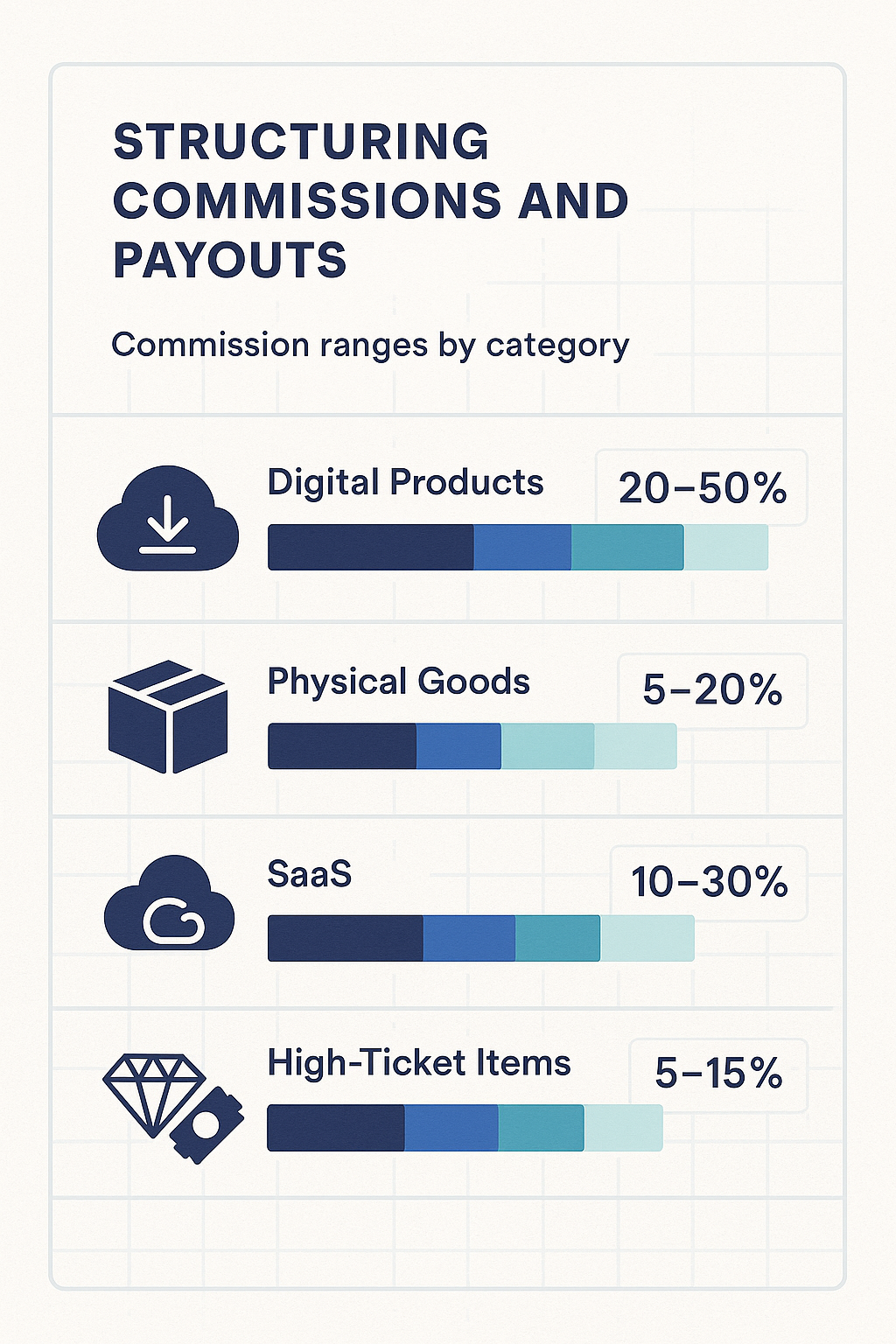
Most affiliates won't even consider promoting offers with commissions below 30% unless there's exceptional conversion data or massive traffic volume potential. But here's the counterintuitive part—increasing your commission from 30% to 50% won't necessarily double your affiliate applications. There are diminishing returns.
The sweet spot for most digital products sits between 40-60%. Physical products can work with 8-15% if the average order values are substantial. But these are just starting points.
Commission Structure Models That Actually Work
Flat Rate Commissions
The simplest approach, and often the most effective for testing. You pay the same percentage or dollar amount for every conversion, regardless of volume or affiliate tier.
I typically recommend starting here for new programs. A 45% commission on a $97 digital product gives affiliates $43.65 per sale—enough to make paid traffic work while leaving you with healthy margins.
The downside? No built-in incentive for affiliates to scale or maintain long-term relationships. But the upside is clarity and simplicity, which removes friction from the recruitment process.
Tiered Performance Structures
This is where things get interesting. Performance tiers reward affiliates for hitting specific volume thresholds within defined timeframes—usually monthly or quarterly.
Here's a structure I've seen work well for a $197 course:
- 1-10 sales: 40% commission ($78.80 per sale)
- 11-25 sales: 50% commission ($98.50 per sale)
- 26+ sales: 60% commission ($118.20 per sale)
But here's the key—you apply the higher commission rate to ALL sales in that period once they hit the threshold, not just the excess sales. This creates a powerful psychological incentive to push for that next tier.
Hybrid Models for Different Affiliate Types
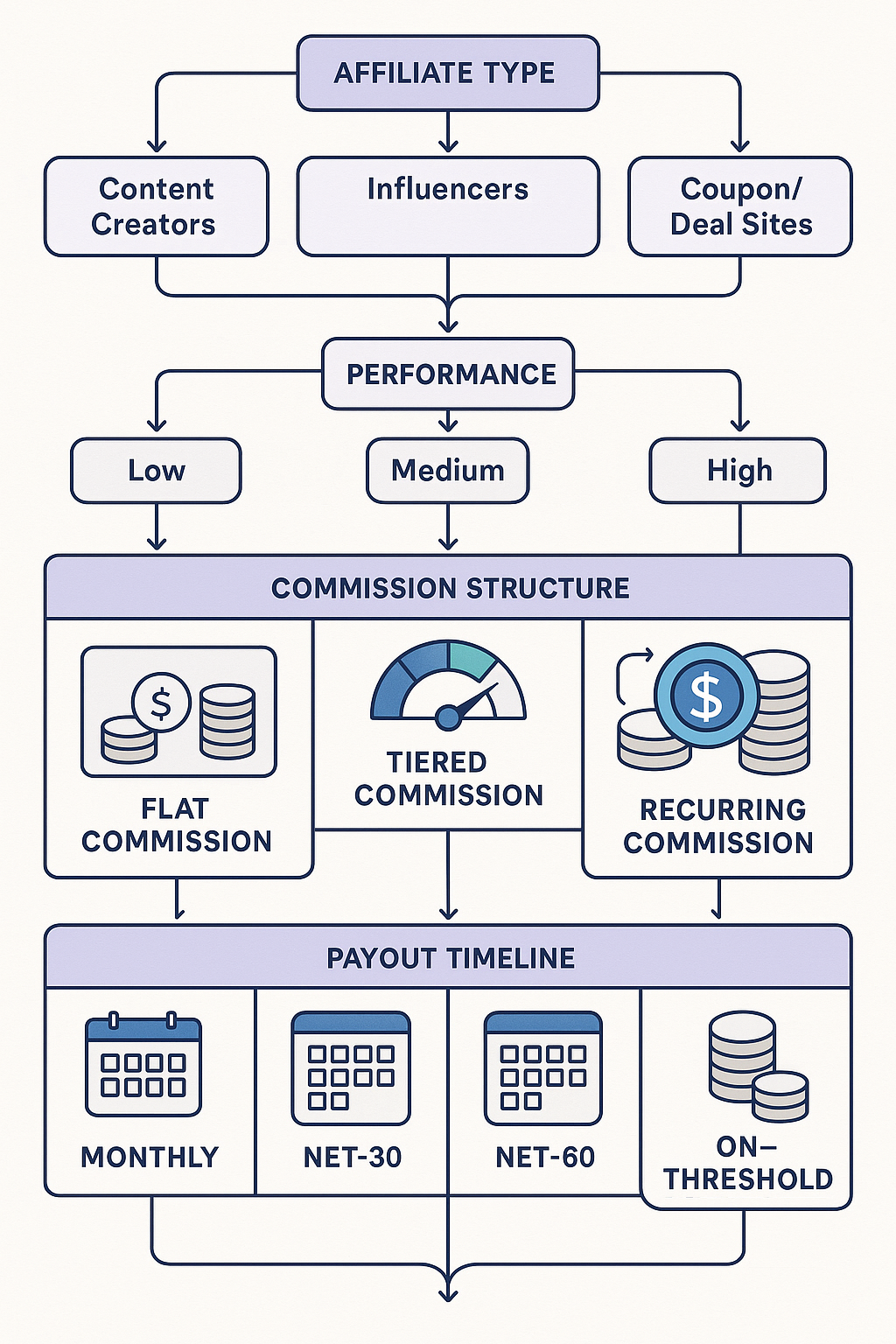
Not all affiliates are created equal. Your email list affiliates have different economics than your paid traffic affiliates, who have different needs than your content creators.
I've found success with multiple tracks:
- Influencer Track: Higher upfront commissions (50-70%) but no recurring payouts
- Paid Traffic Track: Lower initial commission (35-45%) but with performance bonuses
- Content Creator Track: Moderate commission (40-50%) with longer cookie windows
The application process determines which track affiliates enter, and you can always migrate high performers to better terms later.
Advanced Payout Mechanics
Recurring Commission Strategies
For subscription products or programs with natural upsell sequences, recurring commissions can be your secret weapon for affiliate retention.
A structure I've seen work exceptionally well: 50% on the initial sale, then 30% on all recurring payments for the first 12 months, dropping to 15% thereafter. This gives affiliates strong incentive to promote quality customers while protecting your long-term unit economics.
But here's what nobody tells you about recurring commissions—they require sophisticated tracking and can create cash flow challenges if you're not careful. Make sure your tracking infrastructure can handle the complexity.
Bonus Structures and Incentives
Beyond base commissions, strategic bonuses can drive specific behaviors:
- Volume bonuses: $500 bonus for 50+ sales in a month
- Quality bonuses: Extra 10% commission for customers with 90%+ satisfaction scores
- Launch bonuses: Double commissions for the first 72 hours of a new product
- Exclusive bonuses: Additional rewards for affiliates who promote only your products in a category
I typically budget 3-5% of total affiliate payouts for bonus structures. They're incredibly effective for driving short-term behavior but shouldn't be your primary retention strategy.
Payout Timing and Methods
Cash flow kills more affiliate relationships than low commissions. I've seen affiliates abandon profitable partnerships simply because payment terms were too long or unreliable.
The standard 30-day hold period makes sense for digital products with refund policies, but consider these alternatives:
- Weekly payments for proven affiliates (minimum $100 threshold)
- Instant payments for small amounts under $50
- Net-15 terms for affiliates who maintain low refund rates
Payment methods matter too. PayPal works for most affiliates, but international partners often prefer Wise (formerly TransferWise) or direct bank transfers. Having multiple options removes friction.
Minimum Payout Thresholds
Set these too high and you'll frustrate small affiliates. Too low and you'll hemorrhage money on processing fees.
I recommend:
- $50 minimum for PayPal payments
- $100 minimum for bank transfers
- $25 minimum for digital wallets or instant payment platforms
But always offer the option to accumulate commissions rather than forcing monthly payouts that don't meet minimums.
Platform Integration and Technical Considerations
Your commission structure is only as good as your ability to execute it reliably. I've worked with programs using everything from simple spreadsheets to enterprise-level affiliate management platforms.
For most businesses starting out, platforms like Post Affiliate Pro or AffiliateWP provide enough sophistication to handle tiered commissions and multiple payout schedules. If you're already using Systeme.io or similar all-in-one platforms, their built-in affiliate modules can work for basic structures.
But here's what you need to plan for from day one: commission adjustments, refund handling, and dispute resolution. Your platform needs to track these scenarios automatically, or you'll spend hours each month manually reconciling payments.
Common Pitfalls and How to Avoid Them
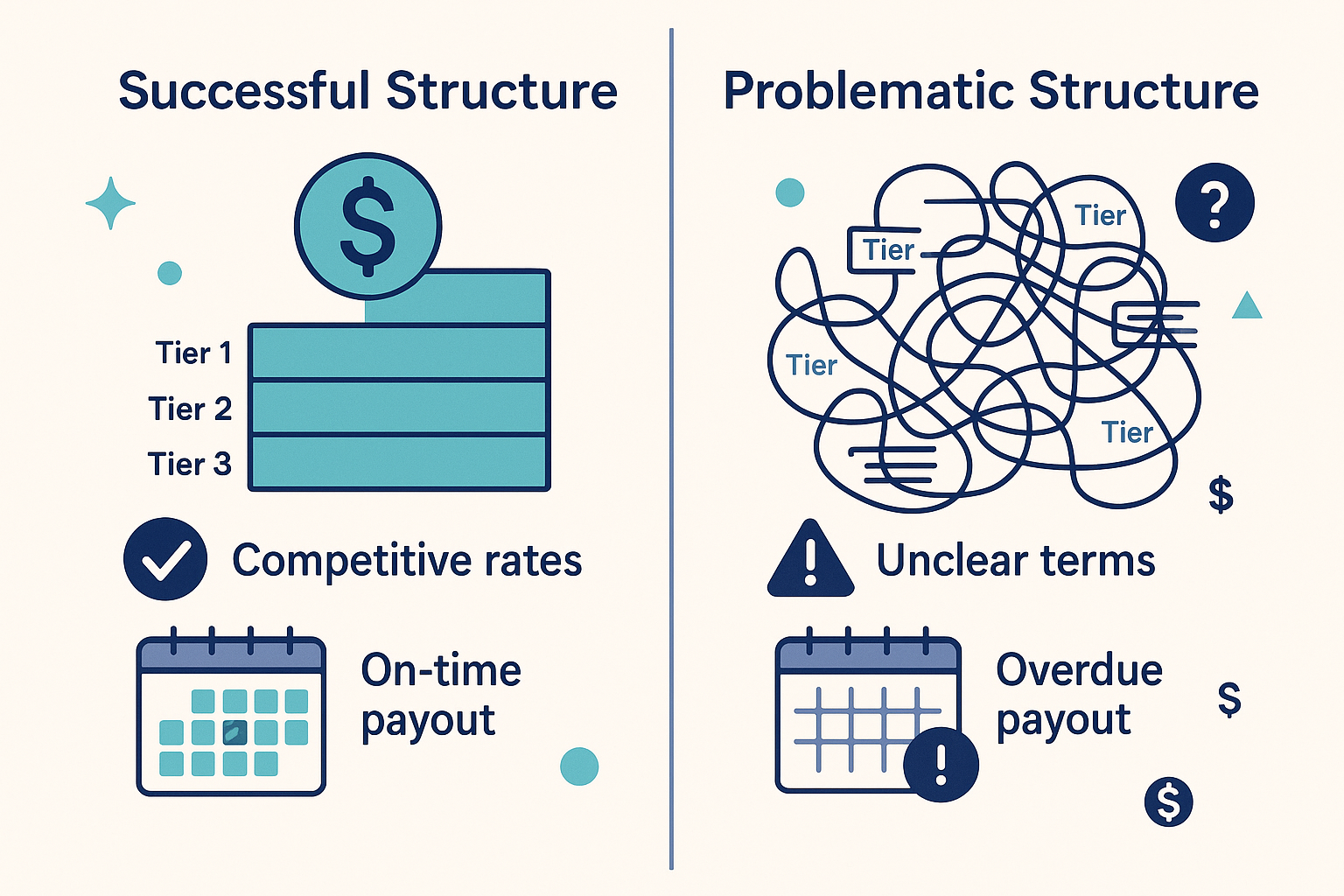
The biggest mistake I see is launching with an overly complex commission structure that requires constant explanation. If you can't explain your commission model in two sentences, it's too complicated.
Another trap: setting commissions based on what you think you can afford rather than what the market demands. I've found it's better to start with market-rate commissions and adjust your product pricing accordingly than to launch with below-market payouts and struggle to recruit quality affiliates.
Geographic considerations often get overlooked too. A 50% commission might be attractive to a US affiliate but meaningless to someone in a country where your payment processor charges 8% fees plus currency conversion costs.
Practical Implementation Notes
Here's the workflow I use when setting up commission structures for new programs:
Week 1: Research competitor commission rates and affiliate application requirements. Check at least 10 programs in your niche.
Week 2: Calculate your unit economics backwards from desired profit margins. Factor in refunds, chargebacks, and processing fees.
Week 3: Set up tracking and payment systems. Test the entire flow from click to commission payout.
Week 4: Launch with a simple flat-rate structure to 5-10 hand-picked affiliates.
The key insight I've gained from managing multiple programs: start simple and evolve based on actual affiliate feedback, not theoretical optimization.
Most successful programs I've worked with made 2-3 major commission structure changes in their first year. That's normal and healthy—it means you're responding to market feedback rather than stubbornly sticking to your initial assumptions.
Document everything. Keep detailed records of commission changes, payout schedules, and affiliate performance by structure type. This data becomes invaluable when you're ready to optimize or when you're explaining ROI to stakeholders.
Revenue Model Integration
Your commission structure shouldn't exist in isolation—it needs to align with your broader monetization strategy. If you're planning to scale quickly, you might accept lower margins initially to attract high-volume affiliates.
For businesses with strong organic traffic and email lists, affiliate commissions can be more conservative since you're not entirely dependent on partner-driven sales. But if affiliates represent your primary customer acquisition channel, commission rates become a competitive advantage rather than just a cost center.
I've seen programs successfully operate on 70%+ commission rates because their lifetime customer value supported it through backend offers and recurring revenue streams. The math works when you're thinking beyond the initial transaction.
Monitoring and Optimization
Set up quarterly reviews of your commission structure performance. Track metrics like affiliate application rates, average affiliate lifespan, and commission-to-revenue ratios across different affiliate tiers.
But don't optimize in a vacuum. Survey your top-performing affiliates about what commission changes would increase their promotional activity. Often, the insights about payout timing or bonus structures are more valuable than pure percentage adjustments.
The most successful affiliate programs I've worked with treat commission optimization as an ongoing conversation with their partner network rather than a set-it-and-forget-it decision.
Remember—your commission structure is a marketing tool as much as it is a financial framework. The right structure attracts better affiliates, who bring higher-quality traffic, which improves your overall business metrics beyond just the affiliate channel.
Start with market rates, test with real partners, and iterate based on performance data. That's the formula for building commission structures that actually drive business growth rather than just moving money around.
This article contains affiliate links. We may earn a commission at no extra cost to you. Full disclosure.
Editorial Team
Senior Digital Marketing Strategist
The Prophet Visionary editorial team covers affiliate marketing, paid traffic, funnels, and digital product strategy with hands-on practitioner experience.
Learn more about our editorial team →Monetize Smarter With Funnels + Email in One Place
Order bumps, upsells, automated email sequences, and your own affiliate program — Systeme.io gives you the full monetization stack without the bloated monthly spend.
See the Monetization StackThis page contains affiliate links — I may earn a commission at no extra cost to you.
Disclaimer: The information on this site is for educational purposes only and does not constitute financial, legal, or business advice. Results vary based on individual effort, market conditions, and other factors. Always do your own due diligence before making business or investment decisions.