Recurring Commission Affiliate Programs Worth Your Time
The Outcome You're Actually After
Let's be honest about what you want: not just a list of programs, but a clear path to predictable monthly recurring revenue from affiliate commissions—income that doesn't require you to keep hunting for new buyers every single month. That's the promise of recurring affiliate programs. But most affiliates either pick the wrong ones or promote them the wrong way and end up with a trickle instead of a stream.
So here's the specific outcome this article is built around: $2,000–$5,000/month in recurring affiliate commissions within 9–12 months, sourced from 3–5 carefully chosen programs, promoted through a combination of content, email, and targeted paid traffic. Not a guarantee—results depend on effort, niche, and execution—but a realistic target for someone who approaches this methodically.
The milestones look like this:
- Month 1–2: Program selection, funnel setup, first 100 email subscribers from lead content
- Month 3–4: First recurring commissions hitting, typically $200–$600/month from early adopters
- Month 5–7: Content compounds, email list grows to 500–1,000, MRR climbs toward $1,000+
- Month 8–12: Optimization, churn mitigation, scaling to $2,000–$5,000+ MRR from affiliate recurring alone
The counterintuitive part? The programs that pay the highest percentage upfront are almost never the ones that produce the most reliable recurring income. What matters more is retention rate of the underlying product—because your commission disappears the moment a customer cancels.

What Makes a Recurring Program Actually Worth Promoting
I've found that most affiliate marketers evaluate programs on commission percentage alone. That's a mistake. The real variables are:
- Product retention rate: A SaaS tool with 85%+ monthly retention is worth far more than one with 60%, even if the latter pays 40% vs. 30%.
- Average customer lifetime: If the average subscriber stays 14 months, your commission math looks very different than a 4-month average.
- Cookie duration and attribution: Some programs (especially in software) use account-based attribution rather than cookies, which is much more affiliate-friendly.
- Payment reliability: Programs run through established networks like ShareASale, Impact, or PartnerStack tend to pay more reliably than standalone affiliate portals.
What most people get wrong is treating recurring affiliate programs like a set-it-and-forget-it machine. It's not. Churn is real. Customers cancel. If you're not consistently bringing in new referrals, your recurring income slowly erodes—typically at 8–15% monthly churn for mid-tier SaaS tools. You need to be feeding the funnel continuously, even if lightly.
The Programs I'd Actually Promote in 2026
These aren't random picks from a curated list. These are programs I'd build a funnel around based on product stickiness, commission structure, and audience fit.
1. ConvertKit (now Kit) — Email Marketing
30% recurring commission, paid monthly, for the lifetime of the referred customer. The product has strong retention because email lists are sticky—people don't migrate their subscriber bases casually. The affiliate program runs through their own portal and pays reliably. Typical customer LTV for a creator with 1,000+ subscribers is 18–24 months. That math works out very well.
The audience fit is critical here. This converts best when promoted to bloggers, creators, and course sellers—not general small business owners who'd be better served by something like Mailchimp. Targeting matters.
2. Systeme.io — All-in-One Funnel Platform
Systeme.io runs a generous 40% lifetime recurring commission. The free plan creates massive top-of-funnel adoption, which means lower friction to refer—you're often sending people to a free tool, not asking them to pull out a credit card immediately. Upgrades happen organically as users hit limits. The affiliate program is managed in-house and has been consistently reliable.
I'd pair this with content targeting people searching for clickfunnels alternatives or all-in-one funnel tools—there's real search volume there and conversion intent is high. If you're building a lead magnet funnel to drive sign-ups, Systeme.io is also a natural tool to recommend because your audience is already in the funnel-building mindset.
3. SEMrush / Semrush — SEO & Research Tools
The Semrush affiliate program (managed through Impact) pays $200 per new subscription sale—technically not a pure recurring commission structure, but the trial-to-paid conversion funnel is well-optimized and the brand is sticky enough that once people are in, they stay. For SEO-focused content publishers, this is one of the highest-EPC programs available.
Honestly, this belongs in any serious affiliate's portfolio if their audience does any kind of content marketing or SEO work.
4. Beehiiv — Newsletter Platform
Beehiiv's affiliate program pays 50% of revenue for the first 12 months—which is aggressive. The platform has genuine product-market fit in the creator economy, and it's growing fast. The audience overlap with affiliate marketers, newsletter operators, and content creators is significant. I'd build a dedicated comparison piece (Beehiiv vs. Substack, Beehiiv vs. Ghost) and funnel that traffic into an email sequence. See the full Beehiiv review for a deeper look at how the monetization side actually works.
5. Jasper / Writesonic — AI Writing Tools
Both offer recurring commissions in the 20–30% range. The caveat: AI tool churn is higher than traditional SaaS because users experiment. I'd treat these as secondary programs—good for content that naturally discusses AI writing, not worth building a primary funnel around unless you have a highly targeted AI-focused audience.
6. ThriveCart — Cart & Funnel Software
ThriveCart's affiliate program is unusual: it's a lifetime license product with a one-time commission, but the commission is substantial (typically $200–$300+ per sale) and the product has massive retention because customers own it forever. Worth including in any funnel or digital product audience context. Pairs naturally with content about order bumps and OTOs, since ThriveCart is a go-to tool for that.
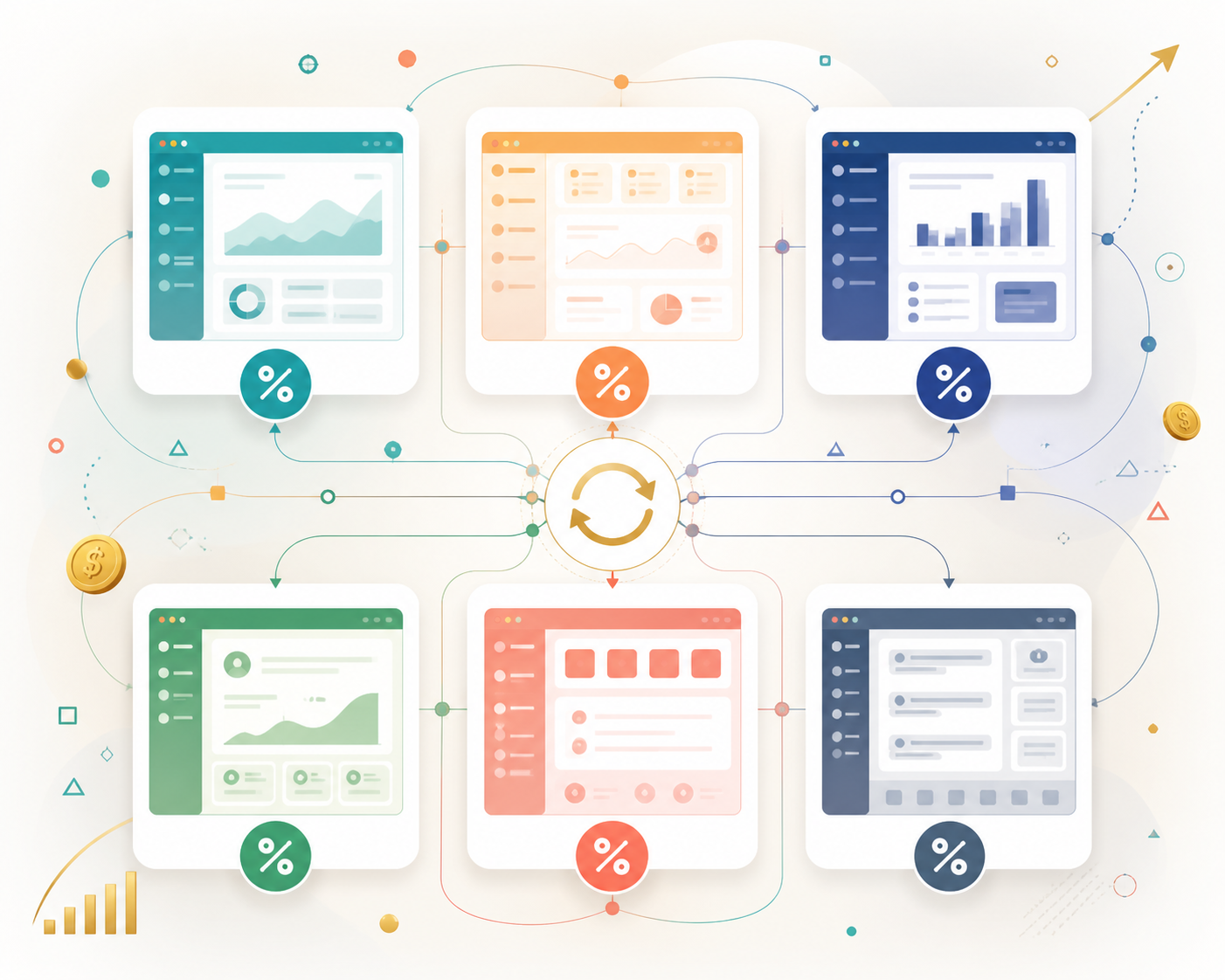
The Funnel Stack That Makes Recurring Commissions Compound
Picking the right programs is step one. Promoting them effectively is where most affiliates stall out.
Here's the framework I'd use:
Step 1: Lead Magnet Anchored to the Tool's Core Problem
Don't create a generic "email marketing guide" to promote ConvertKit. Create something hyper-specific—like "The 3-email welcome sequence that converts cold subscribers into buyers"—and weave the tool recommendation naturally into the content. The lead magnet solves a real problem; the tool is the implementation vehicle.
Step 2: A 5–7 Email Onboarding Sequence
Email 1: Deliver the lead magnet. Email 2: Context—why this problem matters. Email 3: The tool introduction (soft, story-driven). Email 4: Tutorial or walkthrough. Email 5: Social proof or use case. Email 6: Objection handling (cost, complexity, alternatives). Email 7: Direct CTA with a reason to act now.
This isn't complicated. But most affiliates skip straight to the pitch in email 2 and wonder why nobody converts. The email marketing mechanics matter here—sequence structure, send cadence, subject line approach—all of it affects whether your recurring referrals actually stick around long enough to generate meaningful commissions.
Step 3: Content That Captures Search Intent at Multiple Stages
You need content at three levels: awareness ("what is X"), consideration ("X vs Y comparison"), and decision ("X review", "X pricing", "X alternatives"). Most affiliates only build decision-stage content and wonder why traffic is thin. Build the full stack.
Step 4: Paid Traffic as an Accelerant, Not a Foundation
Once you have a converting funnel, paid traffic amplifies it. For SaaS affiliate content, native ads on platforms like Taboola or Outbrain can work at $0.08–0.18 CPC for the right audience segments—but you're typically running to a bridge page or listicle, not directly to the affiliate offer. The economics only work if your email sequence is converting at 2%+ to a paid tool trial.
A Concrete Scenario
Say you're promoting Systeme.io and ConvertKit together—two tools that serve slightly different but overlapping audiences (funnel builders vs. email-first creators). You create a lead magnet: "The Lean Creator Stack: Two tools, one workflow, zero wasted money." You drive 50 leads/week through a mix of Pinterest traffic (free) and $5/day Facebook traffic to a simple opt-in page.
Over 90 days, that's roughly 600 leads at a conservative 3% trial-to-paid conversion = 18 new paying customers. At a blended average of $35/month commission per customer, that's $630/month in new recurring commissions added in quarter one. Repeat that for three more quarters with improving conversion rates, and you're looking at $2,000–$3,000/month recurring by month 12—with the early cohorts still compounding.
The math isn't magic. It's just consistent execution on a system that works.
Practical Implementation Notes
A few things I've observed that don't show up in the polished case studies:
Churn is your silent enemy. I'd estimate 10–15% monthly churn is realistic for most SaaS affiliate referrals unless the product is deeply embedded in the user's workflow. Tools like ConvertKit or Systeme.io that hold customer data (email lists, funnels, contacts) have much lower churn than tools that are more peripheral. Prioritize "sticky" products.
Payment timing matters for cash flow. Many recurring affiliate programs pay on a 30–60 day delay after the commission is earned. If you're running paid traffic, you need to model this gap carefully. Running $500/month in ad spend with a 60-day payment delay means you're floating $1,000 before you see your first commission check. Plan accordingly.
Program terms change. I've seen programs cut commission rates, change cookie windows, or shut down affiliate programs entirely with 30-day notice. Don't build your entire income on a single program. Three to five programs is a reasonable diversification—enough to not be vulnerable to any single change, not so many that you're promoting everything superficially.
The free-trial referral is underrated. Some programs (Systeme.io, ConvertKit's free plan) let you refer people to a free tier. Your conversion job becomes "get them in the door" rather than "get them to buy." The platform then converts them over time. This dramatically increases your top-of-funnel volume and, if the platform's conversion is solid, your downstream commissions reflect it.
Track your EPC, not just your commission rate. A program paying 40% commissions on a $10/month tool ($4/month per referral) is less valuable than a program paying 20% on a $200/month tool ($40/month per referral). Always calculate earnings per click (EPC) across your actual traffic to compare programs fairly.

Revenue Model Reality Check
Here's a realistic revenue range breakdown, not fabricated figures—just the math based on the program structures described above:
| Program | Commission | Avg. Customer Value/Month | Est. Monthly Commission per Referral |
|---|---|---|---|
| ConvertKit | 30% recurring | $79–$199/mo (typical) | $24–$60/mo |
| Systeme.io | 40% recurring | $27–$97/mo | $11–$39/mo |
| Beehiiv | 50% for 12 months | $42–$99/mo | $21–$50/mo |
| Jasper/Writesonic | 20–30% recurring | $49–$129/mo | $10–$39/mo |
Stack 30–50 active referrals across two or three of these programs and the $2,000–$5,000/month recurring target becomes very tangible. The ceiling is higher if you're driving serious volume—but don't skip the foundation to chase scale too early.
You'll Know It's Working When...
Concrete signals that your recurring affiliate strategy is on track:
- Your affiliate dashboard shows commission income in month 2 or 3, even if small ($50–$200). Early signals matter.
- Your email open rates stay above 25% through email 5 of your sequence—meaning people are engaged, not just opted in.
- You're seeing returning visitors to your comparison content, not just first-time traffic. That's research behavior, and it precedes purchase decisions.
- Month-over-month, your total active referrals number grows, even if slowly. As long as new referrals outpace churn, the line trends up.
- You stop thinking about one-time commission offers as your primary income strategy. That's the mindset shift that separates people who build sustainable affiliate income from those who are perpetually chasing the next launch.
Recurring affiliate income isn't passive in the way the gurus describe it. But it is compounding—and that's genuinely powerful if you're patient enough to let it build. Pick programs with sticky products, build a real funnel, and keep feeding it. That's the whole framework.
This article contains affiliate links. We may earn a commission at no extra cost to you. Full disclosure.
Editorial Team
Senior Digital Marketing Strategist
The Prophet Visionary editorial team covers affiliate marketing, paid traffic, funnels, and digital product strategy with hands-on practitioner experience.
Learn more about our editorial team →Monetize Smarter With Funnels + Email in One Place
Order bumps, upsells, automated email sequences, and your own affiliate program — Systeme.io gives you the full monetization stack without the bloated monthly spend.
See the Monetization StackThis page contains affiliate links — I may earn a commission at no extra cost to you.
Disclaimer: The information on this site is for educational purposes only and does not constitute financial, legal, or business advice. Results vary based on individual effort, market conditions, and other factors. Always do your own due diligence before making business or investment decisions.