How to Run Native Ads for ClickBank Offers Profitably in 2026
Most affiliate marketers burn through their budgets faster than a Tesla Cybertruck burns rubber when they try running native ads for clickbank offers. I've watched countless campaigns crash and burn because people think native advertising is just "Facebook ads but on different websites."
Wrong approach entirely.
Native advertising for ClickBank requires a completely different mindset—one that prioritizes editorial-style content over flashy sales copy. After running thousands in native ad spend across platforms like Taboola, Outbrain, and MGID, I've identified the exact framework that separates profitable campaigns from money pits.
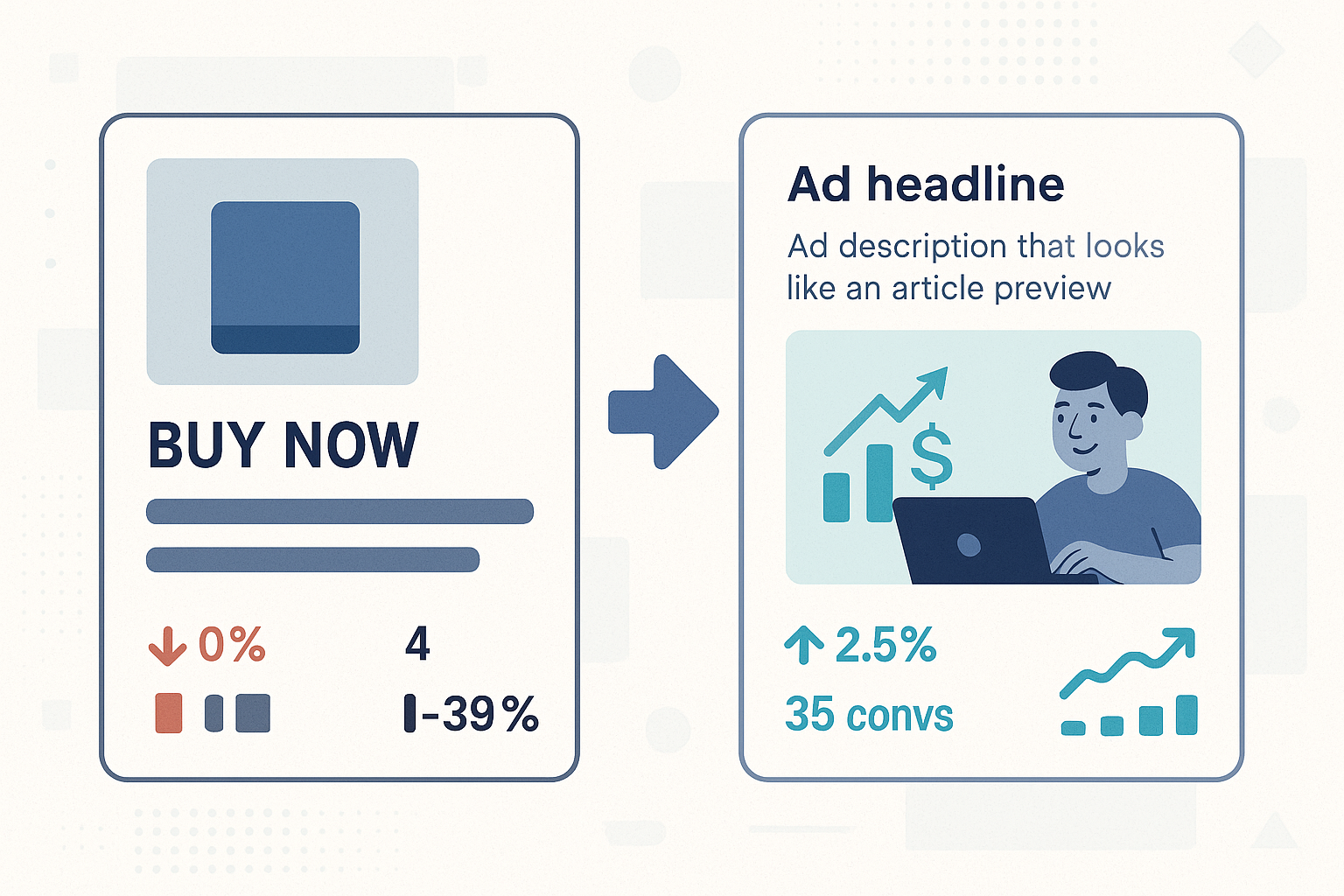
Here's what most people get wrong: they try to sell directly from the native ad. That's like proposing marriage on the first date. Native audiences are in discovery mode, not buying mode.
Step 1: Choose the Right ClickBank Offers for Native Traffic
Not every ClickBank offer works with native traffic. I've learned this the expensive way.
The best-performing offers share three characteristics:
- Problem-aware audiences: Weight loss, financial struggles, relationship issues, health concerns
- Evergreen appeal: Avoid seasonal or trendy products that lose relevance quickly
- Strong pre-sell angle: Offers that can be introduced through educational or story-driven content
Your sweet spot is offers in the $30-$150 price range with gravity scores between 20-100. Too low and there's no market validation. Too high and you're competing against seasoned media buyers with deep pockets.
I typically focus on health, wealth, and relationship niches because they generate consistent emotional engagement—exactly what native platforms reward with lower CPCs.
Red Flags to Avoid
Skip any offer that requires immediate action or has aggressive sales pages. Native traffic converts through education and trust-building, not high-pressure tactics.
Also avoid anything that looks too "salesy" in the creative department. If the vendor's promotional materials scream "BUY NOW," your native campaigns will struggle.
Step 2: Master the Bridge Page Strategy
This is where 90% of affiliates fail with native advertising.
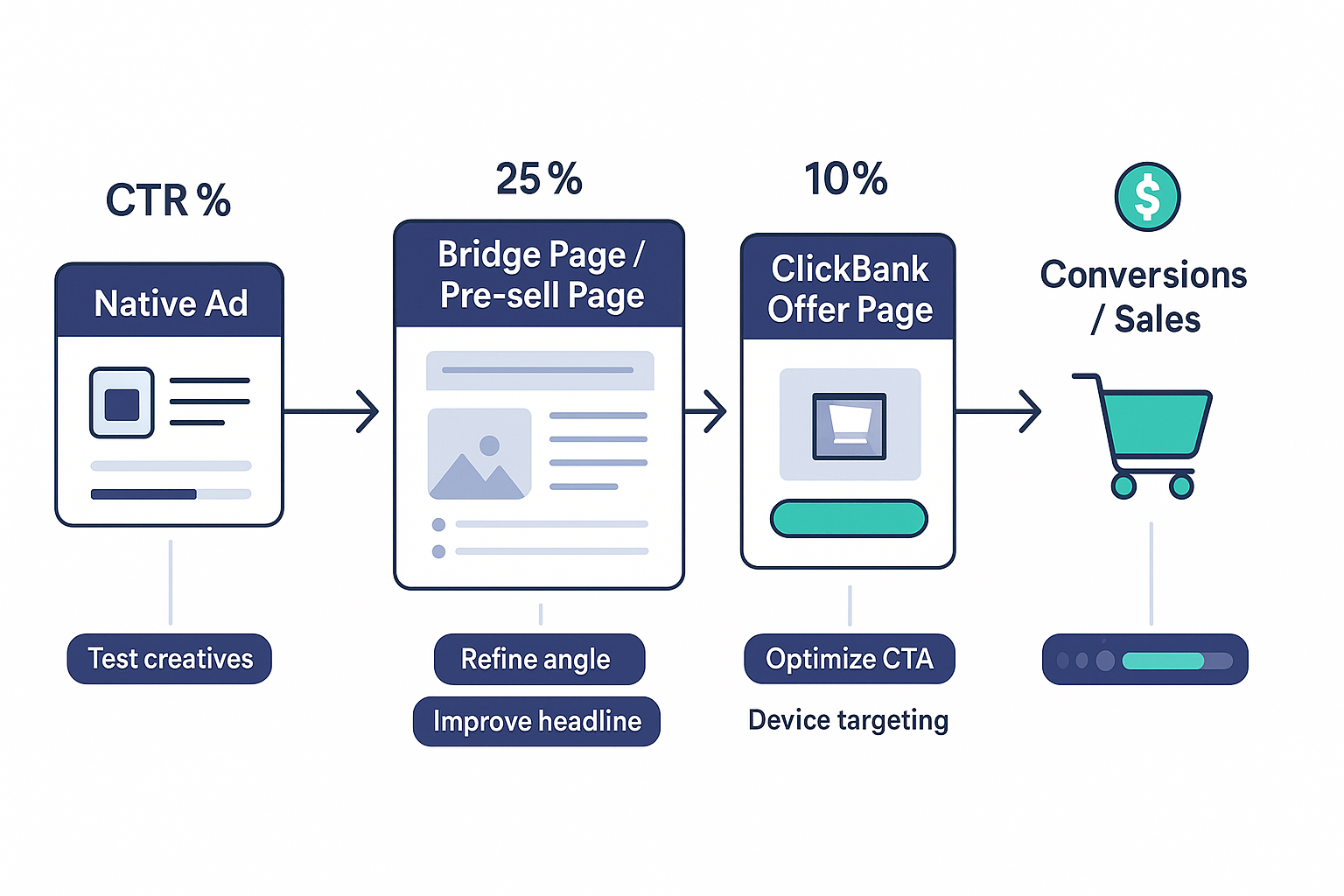
You absolutely cannot send native traffic directly to ClickBank sales pages. The disconnect is jarring—people click expecting editorial content and land on a sales page. Your conversion rates will be abysmal.
Instead, you need what I call a "soft bridge page"—content that feels like a natural continuation of your native ad but gradually introduces your offer. Think blog post meets sales letter.
Here's my proven structure:
- Hook: Continue the story or promise from your native ad
- Credibility: Personal story or case study (can be general, not fabricated)
- Education: Teach something valuable related to your offer
- Soft introduction: "I discovered this system that changed everything"
- Call-to-action: "Check it out here" (not "BUY NOW")
I typically aim for 800-1200 words on bridge pages. Long enough to build trust, short enough to maintain attention. The key is making it feel like genuine editorial content, not a disguised sales page.
For more detailed strategies on creating effective bridge pages, check out our guide on bridge pages that actually convert.
Step 3: Platform Selection and Budget Allocation
Not all native platforms are created equal for ClickBank offers.
Based on my testing, here's how I rank the major players:
| Platform | Best For | Typical CPC Range | Minimum Daily Budget |
|---|---|---|---|
| Taboola | Health/Finance offers | $0.15-0.45 | $50+ |
| Outbrain | Self-improvement/Business | $0.20-0.60 | $50+ |
| MGID | Broader audiences, testing | $0.08-0.25 | $25+ |
| RevContent | Entertainment-angle offers | $0.12-0.35 | $30+ |
I always start with MGID for initial testing because of the lower minimum spend requirements. Once I identify winning creatives and audiences, I scale to Taboola and Outbrain where the traffic quality is typically higher.
For platform comparisons, our Taboola vs Outbrain analysis dives deeper into the nuances of each platform.
Budget Allocation Strategy
Here's my standard approach for a new campaign:
- Week 1: $25-50/day for initial testing across 3-5 creative variations
- Week 2: Double budget on winning creatives, pause losers
- Week 3+: Scale winning campaigns to $100-200/day
The key is patience. Native campaigns take 7-14 days to gather meaningful data due to the longer consideration cycle.
Step 4: Creative Development That Converts
Your creative is everything in native advertising. I'm talking about both the image and headline combination that appears in native feeds.
Forget everything you know about Facebook ad creatives. Native creatives need to blend seamlessly with editorial content while still driving clicks.
Headline Formulas That Work
After testing hundreds of headlines, these patterns consistently outperform:
- "This [Age] [Location] [Profession] Discovered..." (specificity builds credibility)
- "Doctors Hate This [Benefit] Trick" (classic but still effective in health niches)
- "Why [Common Belief] Is Actually Wrong" (curiosity + contrarian angle)
- "The [Number] [Thing] That Changed My [Area of Life]" (personal story angle)
Keep headlines between 60-90 characters. Shorter headlines often lack context, while longer ones get truncated on mobile.
Image Selection Strategy
Your images should look like they belong in a news article, not an advertisement.
What works:
- Real people (not obvious stock photos)
- Before/after comparisons (subtle, not dramatic)
- Product images that look editorial
- Infographic-style images with data
What doesn't work:
- Obviously promotional images
- Text overlays with prices or offers
- Bright, flashy graphics
- Anything that screams "advertisement"
I typically test 3-5 image variations per headline to find winning combinations.
Step 5: Targeting and Audience Development
Native platform targeting is more limited than Facebook, but that's actually an advantage—it forces you to focus on what matters most.
Start broad, then narrow based on performance data. Here's my standard targeting approach:
Geographic Targeting
For ClickBank offers, I typically start with English-speaking countries:
- Tier 1: US, UK, Canada, Australia
- Tier 2: New Zealand, Ireland (if budget allows)
The US generates the highest conversion rates for most ClickBank offers, but competition is fierce. Canada often provides a good balance of volume and cost-efficiency.
Device and OS Targeting
Mobile generates 70-80% of native ad clicks, but desktop often converts better for higher-priced ClickBank offers.
My approach: Start with all devices, then analyze performance after 1000+ clicks. If desktop CPA is significantly lower, consider mobile/desktop split campaigns with different budgets.
Interest and Behavioral Targeting
Most native platforms offer limited interest targeting compared to social platforms. Focus on:
- Website categories: Health, finance, lifestyle sites
- Content categories: Match your offer's niche
- Audience segments: Demographics like age and gender when relevant
Don't over-target initially. Let the platform's algorithm find your audience, then optimize based on actual performance data.
Step 6: Campaign Launch and Initial Optimization
Launch day isn't set-it-and-forget-it. You need active monitoring, especially in the first 48 hours.
Here's my launch day checklist:
- Morning launch: Start campaigns between 9-11 AM EST for maximum data collection
- Budget pacing: Set to "accelerated" initially to gather data quickly
- Bid strategy: Start with automatic bidding, 20% above suggested CPC
- Monitoring schedule: Check every 2-3 hours for the first day
First 24 Hours: What to Watch
Your primary focus should be click-through rate (CTR). If your CTR is below 0.3% after 500 impressions, pause and adjust creatives.
Don't worry about conversions yet—native traffic needs time to "warm up." I've seen campaigns that looked terrible on day one become profitable after a week of optimization.
Key Metrics to Track
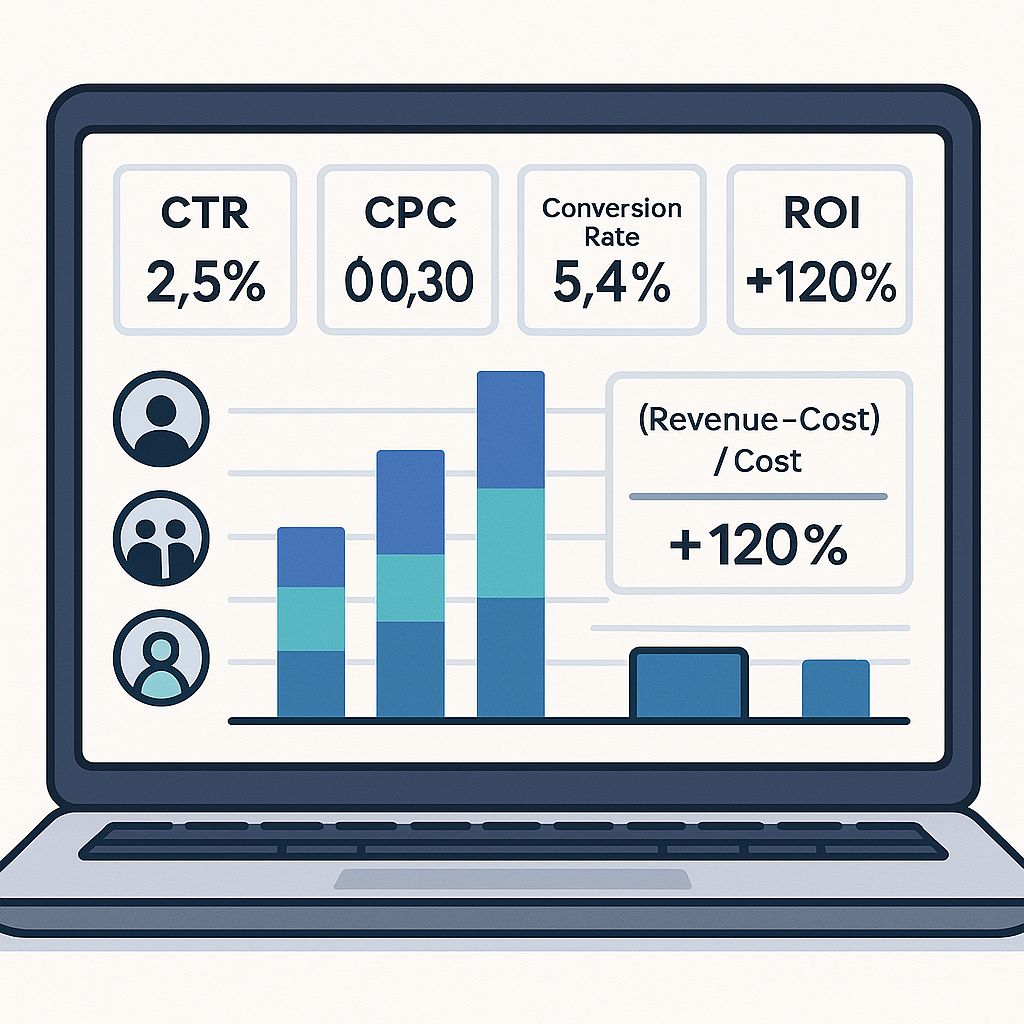
- CTR: Target 0.5%+ (varies by niche)
- CPC: Should align with platform benchmarks
- Time on site: 60+ seconds indicates engaged traffic
- Bounce rate: Under 70% for bridge pages
Use Google Analytics or your preferred tracking platform to monitor these metrics beyond what the native platform provides.
Step 7: Advanced Optimization Techniques
Once your campaigns are running, optimization becomes a daily discipline.
Creative Rotation Strategy
Native audiences develop "banner blindness" faster than other traffic sources. I refresh creatives every 7-14 days, even for winning campaigns.
Keep your best performers running while testing new variations. My rule: never test more than 2-3 new creatives at once to maintain statistical significance.
Dayparting and Schedule Optimization
ClickBank offers often perform differently throughout the day and week. Health offers typically convert better in the evenings and weekends when people have time to read and consider purchases.
After collecting 2 weeks of data, analyze performance by:
- Hour of day
- Day of week
- Weekend vs. weekday patterns
Then adjust your campaign schedules accordingly. This single optimization often improves ROI by 20-30%.
Publisher and Website Optimization
Not all websites within a native network are created equal. After your campaigns run for a week, dive into publisher-level data.
Look for:
- High-converting publishers: Increase bids by 10-20%
- High-volume, low-converting publishers: Reduce bids or exclude
- Irrelevant placements: Block immediately
This granular optimization is where experienced native advertisers separate themselves from beginners.
Real-World Implementation Notes
Here's what actually happens when you implement this strategy—the stuff nobody talks about in theory guides.
Week 1: The Reality Check
Your campaigns will probably lose money. That's normal and expected. You're paying for data, not immediate profits.
I budget for 2-3x my target CPA during the testing phase. If a ClickBank offer converts at $50 CPA long-term, I'm comfortable spending $100-150 per conversion during initial optimization.
Week 2-3: The Optimization Grind
This is where most people quit. Your data starts becoming meaningful, but you're still not profitable. You're making dozens of small adjustments daily—bid changes, creative swaps, targeting refinements.
The key insight: focus on improving one metric at a time. If CTR is low, work on creatives. If clicks aren't converting, optimize your bridge page.
Week 4+: Scale or Kill
By week four, you'll know if a campaign has potential. Profitable campaigns should be scaling to higher budgets. Marginal campaigns need major pivots or should be paused.
I use this decision framework: If a campaign isn't at least break-even after $500-1000 in spend, kill it and start fresh with new angles.
Tracking and Attribution Setup
Proper tracking separates successful affiliates from those flying blind.
You need tracking at multiple levels:
- Native platform tracking: Basic click and conversion data
- Third-party tracking: Tools like Voluum or RedTrack for detailed attribution
- Google Analytics: User behavior and engagement metrics
- ClickBank tracking: HopLink tracking for commission attribution
For detailed tracking setup, our affiliate tracking guide covers the technical implementation.
Attribution Challenges
Native traffic often has longer conversion cycles than search or social traffic. People might click your ad, bookmark your bridge page, and convert days later.
I typically analyze campaigns using both 1-day and 7-day attribution windows to get a complete picture of campaign performance.
Scaling Profitable Campaigns
Once you've found a winning combination, scaling becomes the priority.
But here's the counterintuitive part: you can't just increase budgets and expect linear returns. Native platforms have limited inventory for your specific audience.
Horizontal Scaling Strategy
Instead of just increasing budgets, expand successful campaigns across:
- Additional platforms: Take winning creatives from MGID to Taboola
- New geos: Expand from US to Canada, UK, Australia
- Similar offers: Test comparable ClickBank products with proven creatives
- Creative variations: Develop new angles based on winning themes
This approach maintains performance while increasing overall volume.
Budget Scaling Guidelines
When increasing budgets on winning campaigns:
- Increase by 25-50% every 3-4 days
- Monitor CPA closely during scaling
- Be prepared to dial back if performance degrades
- Consider splitting campaigns at higher budgets for better control
Common Troubleshooting Issues
Every native campaign faces predictable challenges. Here's how to handle the most common ones:
Low Click-Through Rates
Symptoms: CTR below 0.3%, high impression volume, low clicks
Solutions:
- Test more compelling headlines with stronger hooks
- Refresh creative images—try different styles
- Check ad placement quality—exclude poor-performing publishers
- Adjust targeting to more relevant audiences
High CTR, Low Conversions
Symptoms: Good CTR (0.5%+), but bridge page isn't converting
Solutions:
- Analyze bridge page analytics—where are people dropping off?
- Test different ClickBank offers with same traffic
- Adjust bridge page copy to better match ad promises
- Check for technical issues (slow loading, mobile optimization)
Campaign Fatigue
Symptoms: Previously profitable campaigns declining in performance
Solutions:
- Refresh creatives immediately
- Expand to new publisher networks
- Test different angles for the same offer
- Consider seasonal factors affecting your niche
The key to troubleshooting is systematic testing. Change one variable at a time so you can identify what's actually moving the needle.
Long-Term Profitability Strategy
Running profitable native campaigns for ClickBank offers isn't just about launching successful campaigns—it's about building systems that generate consistent returns.
After managing campaigns for months, I've identified three pillars of long-term success:
1. Diversification
Never rely on single campaigns, offers, or platforms. My profitable accounts typically run:
- 3-5 different ClickBank offers simultaneously
- Campaigns across 2-3 native platforms
- Multiple creative angles per offer
- Both direct-to-offer and email capture funnels
2. Continuous Testing
Allocate 20-30% of your budget to testing new:
- Creative angles and formats
- landing page variations
- Offer types within profitable niches
- Audience segments and targeting options
3. Data-Driven Decision Making
Successful native advertisers are obsessive about data. Track everything, analyze patterns, and make decisions based on performance metrics rather than gut feelings.
This means regular analysis of:
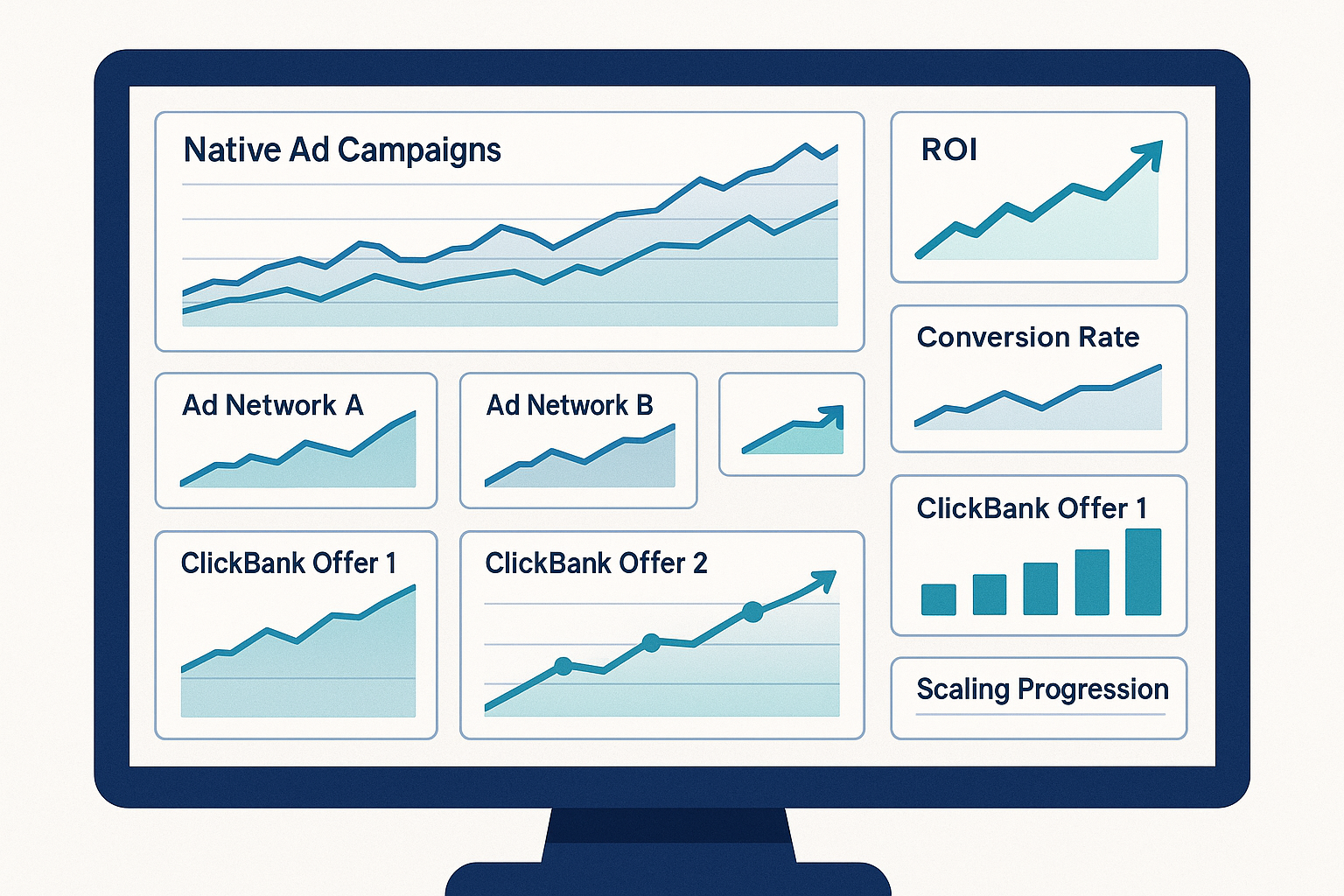
- Weekly and monthly ROI trends
- Seasonal performance patterns
- Creative fatigue cycles
- Platform-specific optimization opportunities
The most successful native advertisers I know treat this like a business, not a side hustle. They reinvest profits into testing, maintain detailed records, and constantly optimize their processes.
Running profitable native ads for ClickBank offers requires patience, systematic testing, and continuous optimization. It's not a get-rich-quick strategy, but it can be incredibly profitable for marketers willing to put in the work.
The framework I've outlined here—from offer selection through scaling—represents thousands of dollars in testing and optimization. But the real value comes from implementation and adaptation to your specific niche and audience.
Start with small budgets, focus on one platform initially, and scale based on data rather than emotions. The native advertising landscape rewards methodical, data-driven marketers who understand that sustainable profits come from building systems, not chasing quick wins.
This article contains affiliate links. We may earn a commission at no extra cost to you. Full disclosure.
Editorial Team
Senior Digital Marketing Strategist
The Prophet Visionary editorial team covers affiliate marketing, paid traffic, funnels, and digital product strategy with hands-on practitioner experience.
Learn more about our editorial team →Your Traffic Is Only as Good as Your Follow-Up
You're paying for clicks — but are you capturing emails and automating sequences? AWeber makes it dead simple to turn paid traffic into a monetized email list.
See How AWeber WorksThis page contains affiliate links — I may earn a commission at no extra cost to you.
Disclaimer: The information on this site is for educational purposes only and does not constitute financial, legal, or business advice. Results vary based on individual effort, market conditions, and other factors. Always do your own due diligence before making business or investment decisions.