Most comparison articles about these two platforms start with the good stuff. I'm going to do the opposite—because if you're evaluating GoHighLevel or clickfunnels for affiliate funnel automation right now, the failures matter more than the feature lists.
I've spent time inside both platforms, running cold traffic funnels, building out email sequences, and testing lead capture flows for digital product promotions. And here's what the glowing YouTube reviews won't tell you: both tools have meaningful gaps for affiliate marketers specifically—and pretending otherwise wastes your time and money.
So let's get into what breaks first, then work backward to what actually holds up.
What Fails First: The Honest Problems With Each Platform
GoHighLevel's Affiliate Problem
GoHighLevel was built for agencies. That's not a criticism—it's just the truth. The platform's core architecture is designed around client sub-accounts, CRM pipelines, and local business workflows. When you try to bend it into an affiliate funnel machine, you're fighting the tool's native logic at almost every turn.
The funnel builder itself is functional but clunky. Page load speeds—which matter enormously when you're paying $0.90+ CPCs on Meta or running native traffic from Taboola—aren't where they need to be out of the box. I've seen bridge pages built in GHL load in 3.8–4.2 seconds on mobile, which is a conversion killer when industry benchmarks suggest anything past 2.5 seconds costs you 15–20% of your clicks.
Then there's the email deliverability question. GHL uses its own sending infrastructure (LC Email, powered by Mailgun), and while it's improved, it's not in the same league as dedicated platforms like ConvertKit or ActiveCampaign for affiliate-heavy lists. If you're mailing ClickBank offers or promoting recurring commission programs to a cold-to-warm list, deliverability variance is not a minor issue—it's the difference between a profitable sequence and one that quietly bleeds money.
ClickFunnels' Automation Problem
clickfunnels 2.0 fixed a lot of what made the original feel dated. But the automation side—specifically the "Smart Funnels" and workflow builder—still lags behind what marketers who've used ActiveCampaign or even Klaviyo expect from a 2026 tool.
Behavioral triggers are limited. You can't easily fire a sequence based on specific link clicks within emails, page scroll depth, or quiz responses without layering in third-party integrations. For affiliate marketers who rely on behavioral segmentation to recover abandoned funnel leads, this is a real constraint—not a minor inconvenience.
The other thing nobody talks about? ClickFunnels' terms of service around affiliate promotions. Certain offer categories—particularly in health, finance, and biz-op—require careful review before you build a funnel there. Platform risk is real. If your account gets flagged mid-campaign, you don't just lose a page; you lose your entire funnel infrastructure.

Who Each Platform Is Actually Built For
This matters more than any feature comparison. Matching a tool to the wrong use case is how affiliates end up paying $297/month for something that fights them daily.
GoHighLevel is a fit if: You're running an affiliate operation that doubles as an agency or coaching business. If you're also managing client funnels, sending appointment reminders, or running SMS follow-ups for a local service brand you promote, GHL's all-in-one structure makes economic sense. The $297/month Agency Starter plan (or $497 for Agency Unlimited) becomes justifiable when you're replacing four or five other tools simultaneously.
ClickFunnels 2.0 is a fit if: You're primarily a funnel-first affiliate—meaning your business model is built around front-end opt-in pages, bridge pages, and linear email sequences rather than complex CRM workflows. The $147/month Basic plan is accessible, and the funnel templates for digital products are genuinely well-designed. If you're promoting offers through WarriorPlus, JVZoo, or ClickBank with a relatively straightforward funnel structure, CF2.0 gets out of your way faster.
Core Use Cases: Where Each Tool Holds Up
Lead Capture & Bridge Pages
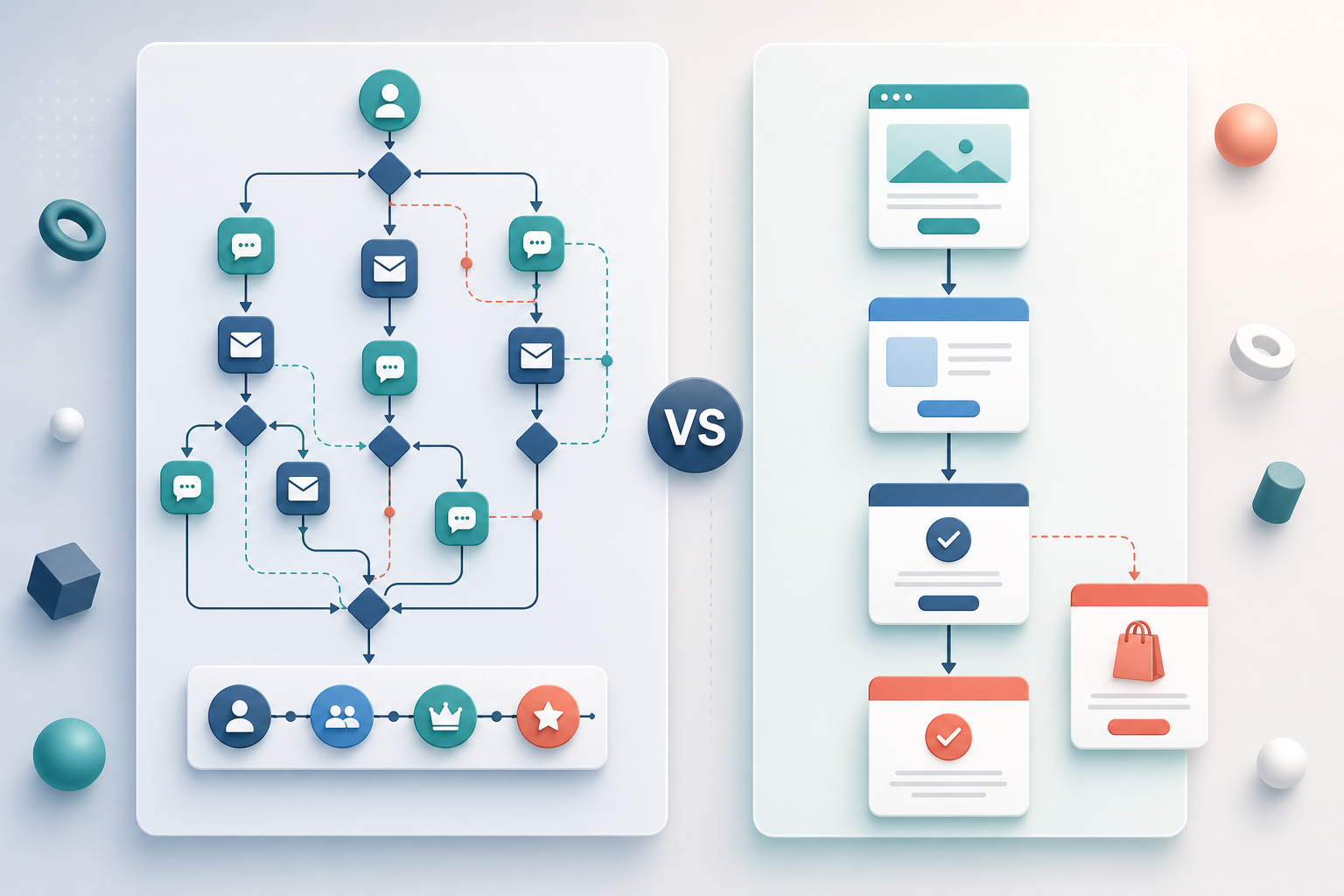
ClickFunnels wins here, and it's not close. The template library for opt-in pages, VSL funnels, and bridge pages is more affiliate-native. Pages render faster (typically 1.8–2.4 seconds on a well-optimized build), and the A/B testing functionality on the Basic plan is usable without a developer. If you're driving paid traffic from native ad networks and need a bridge page that converts cold traffic, ClickFunnels is the faster path to a working setup.
GHL can do this, but expect an extra 4–6 hours of configuration time for a first build. The funnel editor has improved in recent updates, but it still feels like a secondary feature rather than the platform's core competency.
Email Automation & Follow-Up Sequences
Here's where it gets more nuanced. GHL's workflow builder is actually more powerful than ClickFunnels' for complex conditional logic—IF/THEN branching, wait steps based on contact behavior, and SMS/email hybrid sequences. If you're building a 7-part sequence that pivots based on whether someone clicked a specific link or watched a video, GHL can handle that natively.
ClickFunnels' email automation is simpler. A 3-email welcome sequence or a 5-day indoctrination series? Fine. A 14-step behavioral sequence that segments buyers from non-buyers and routes them into different offer tracks? You'll hit walls fast. For affiliates serious about email automation sequences that actually sell affiliate offers, GHL's workflow engine is the more capable tool—if you're willing to invest the setup time.
Upsells, Order Bumps & Funnel Monetization
ClickFunnels was designed for this. One-click upsells, order bumps, and OTO pages are baked into the funnel builder logic. If you're stacking offers—say, a $27 front-end digital product with a $97 OTO and a $197 high-ticket back-end—the flow is intuitive to build and test.
GHL added order forms and upsell functionality, but it's less polished. The checkout experience has quirks that show up under real traffic volume, particularly with mobile users. That said, if you're primarily capturing leads (not processing sales) and then routing buyers to external affiliate offers on ClickBank or Digistore24, this matters less.
Pricing: What You're Actually Paying
| Plan | GoHighLevel | ClickFunnels 2.0 |
|---|---|---|
| Entry Level | $97/mo (Starter) | $147/mo (Basic) |
| Mid Tier | $297/mo (Agency Starter) | $197/mo (Pro) |
| Full Features | $497/mo (Agency Unlimited) | $297/mo (Funnel Hacker) |
| Email Sending | Included (LC Email / Mailgun) | Included (Basic limits apply) |
| Sub-accounts | Yes (Agency plans) | No |
| CRM | Full CRM included | Limited contact management |
The $97 GHL Starter plan is a legitimate entry point for solo affiliates who don't need agency sub-accounts. But be realistic: to unlock the automation depth that makes GHL worth the switch from something like Systeme.io, you're looking at the $297 plan minimum. ClickFunnels' $147 Basic plan is more accessible for a single affiliate operation, though the funnel and page limits can become constraints faster than you'd expect at scale.
Honest Pros & Cons (No Sugarcoating)
GoHighLevel
What it does well:
- All-in-one infrastructure—CRM, email, SMS, funnels, calendar, and membership in one platform genuinely reduces tool sprawl
- Workflow automation depth is real; conditional branching and multi-channel sequences are more capable than most competitors at this price
- White-label option means affiliates who also consult or coach can resell the platform itself as a recurring income stream
- Snapshot system lets you clone entire funnel + automation setups across accounts—useful if you're running multiple niche campaigns
- SaaS mode (Agency Unlimited) is a legitimate business model extension, not just a feature checkbox
Where it falls short:
- Funnel page builder is slower and less intuitive than ClickFunnels for pure affiliate use cases—expect a steeper learning curve
- LC Email deliverability is inconsistent for affiliate-heavy content; cold list warm-up requires extra attention
- Support quality is variable; complex technical issues can take 48–72 hours to resolve through standard channels
- The platform's agency-first design means you're constantly navigating features you don't need as a solo affiliate
ClickFunnels 2.0
What it does well:
- Funnel building is genuinely fast—a working opt-in + bridge + thank-you page sequence can be live in under 2 hours for an experienced user
- Template quality for digital product and affiliate offer funnels is high; the design defaults are conversion-oriented
- A/B testing is built in and functional without third-party tools
- OTO and order bump mechanics are the most polished of any funnel builder at this price point
- Analytics are clean and readable—traffic, opt-in rate, and conversion data are surfaced without custom dashboard configuration
Where it falls short:
- Email automation is shallow for affiliates who need behavioral triggers and complex segmentation
- No native CRM—contact management is basic, and serious list segmentation requires integrating ConvertKit, ActiveCampaign, or similar
- Platform risk is real; terms of service enforcement on certain affiliate categories has caught marketers off guard
- Price-to-feature ratio feels off at the $297 Funnel Hacker tier compared to what GHL offers at a similar price
Alternatives Worth Considering
Systeme.io — Genuinely underrated for solo affiliates on a budget. Free plan handles up to 2,000 contacts, includes funnel building, email automation, and membership sites. The automation logic won't satisfy power users, but for a lean affiliate operation promoting one or two offers, it's hard to argue against free.
Kartra — More expensive ($119–$549/month), but the behavioral email automation and built-in affiliate management are genuinely strong. If you're running your own digital product with an affiliate program and need to manage both sides of that equation, Kartra is worth the price comparison.
ActiveCampaign + separate funnel builder — The hybrid stack approach. Use ClickFunnels or even a simple page builder for front-end funnels, then pipe leads into ActiveCampaign for email automation. More moving parts, but you get best-in-class deliverability and segmentation without compromise. This is what I'd recommend for affiliates who are serious about high-ticket offer stacking through email sequences—the automation depth justifies the added complexity.
Practical Implementation Notes
After working inside both platforms across different campaign types, here's what the setup actually looks like in practice—not in theory.
For a standard affiliate lead funnel (paid traffic → opt-in → bridge → offer): ClickFunnels wins on speed of deployment. A Meta or Taboola campaign can be feeding a live funnel within a day. The native analytics make early traffic decisions fast. If you're testing a new offer and need to validate the funnel concept quickly, CF2.0 is the right tool for that job.
For a longer-cycle affiliate operation (lead capture → nurture sequence → multiple offer promotions over 30–60 days): GHL's workflow engine earns its cost. Building a sequence that tags contacts based on email opens, link clicks, and page visits—then routes them into offer-specific tracks—is genuinely more powerful in GHL than anything ClickFunnels can do natively. The setup takes longer, but the backend monetization potential is higher.
One workflow I've found effective in GHL: a 5-day email indoctrination sequence that tags anyone who clicks a specific affiliate link as "warm," then automatically enrolls them in a separate 3-email sequence pushing a related upsell or complementary offer. That kind of behavioral fork is what separates a $0.40 EPC list from a $1.20 EPC list over time.
The counterintuitive part: most affiliates don't need the platform with the most features. They need the platform that removes the most friction between "traffic lands" and "email goes out." On that metric, ClickFunnels is faster to deploy and GHL is more powerful once deployed. Pick based on where you are, not where you want to be.
Also worth noting—page compliance for paid traffic is a real consideration on both platforms. Native ad networks like Taboola and Outbrain have specific landing page requirements, and both GHL and CF2.0 pages can run into issues if you're not building with compliance in mind from the start.

The Measured Verdict
There's no universal winner here—and anyone who tells you otherwise is either selling one of these platforms or hasn't actually run campaigns inside both.
If you're a solo affiliate running paid traffic to a single niche with a straightforward opt-in + offer funnel, ClickFunnels 2.0 at $147/month is the more practical choice. Faster to build, cleaner analytics, better templates for affiliate-native use cases. Pair it with ConvertKit or ActiveCampaign for email automation and you've got a competitive stack without overcomplicating things.
If you're building something bigger—multiple campaigns, complex email segmentation, SMS follow-ups, or a hybrid affiliate-plus-agency model—GoHighLevel's depth justifies the learning curve and the higher entry cost. The all-in-one economics make sense at scale, and the workflow automation can do things ClickFunnels simply can't.
What most people get wrong is treating this as a permanent decision. It's not. Start with the tool that matches your current operation, not your aspirational one. You can always migrate. What you can't recover is the time spent fighting a platform that wasn't designed for your use case.
Both tools have free trials. Use them. Build an actual funnel—not a test page—and see where you hit friction. That friction point will tell you more than any comparison article, including this one.
Visit GoHighLevel → gohighlevel.com | See ClickFunnels 2.0 features and pricing → clickfunnels.com