Why Email List Segmentation Actually Works for Affiliate Promos
If you've been blasting the same affiliate offer to your entire list and watching open rates crater while unsubscribes climb, here's the core truth: segmentation is why some affiliates consistently outperform the market, and it's almost certainly what's missing from your setup. Sending one message to everyone on your list treats a brand-new subscriber the same as someone who's clicked your links three times—and those are fundamentally different people who need fundamentally different conversations. Proper segmentation means you're matching the right offer to the right person at the right moment in their buying journey, and that alignment is what actually moves affiliate commissions.

Why Is Everyone on My List Getting the Same Email?
Honestly, because most email platforms default to "send to all," and most people never change that setting. ConvertKit, ActiveCampaign, Mailchimp—they all make it just easy enough to fire off a broadcast that the friction of setting up segments feels like extra work you'll do "later." Later never comes.
But here's the thing: the default setting is built for convenience, not performance. When you send a ClickBank weight loss offer to someone who opted in for a free SEO checklist, you're not just wasting an email—you're actively training that subscriber to ignore you. And once someone mentally files you as "irrelevant," getting them back is an uphill battle most affiliates never win.
The fix isn't complicated. Start with lead source tags. Every opt-in form, every traffic source, every lead magnet gets its own tag. Someone who downloaded your "keto meal plan" freebie gets tagged keto-lead. Someone who clicked through from a Facebook ad about budgeting gets tagged finance-fb. From day one, you know something meaningful about why they showed up—and that context shapes every email they receive afterward.
Why Do My Affiliate Emails Get Ignored Even with a Big List?
List size is the vanity metric that kills affiliate businesses slowly. I've seen people with 40,000 subscribers pulling worse numbers than someone with 4,000—because the larger list is a graveyard of mismatched expectations and burned goodwill.
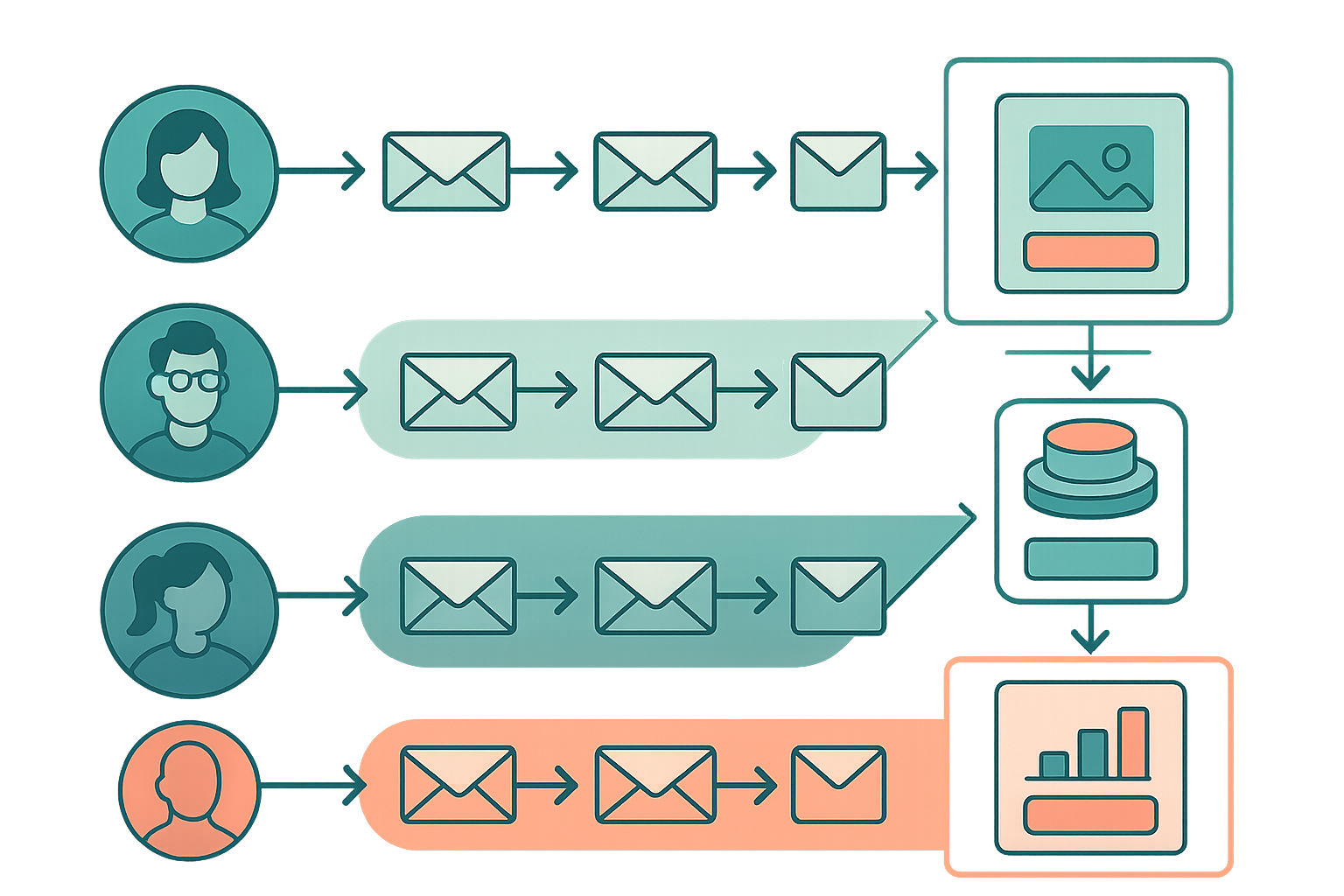
What most people get wrong is treating "subscriber" as a monolithic identity. Your list contains at least four distinct types of people: brand-new subscribers still figuring out who you are, engaged readers who open consistently but haven't bought, past buyers who already trust you, and cold subscribers who haven't opened in 60+ days. Sending the same promotional email to all four is like using the same sales pitch on a first date and a ten-year customer. It doesn't work.
Engagement-based segmentation is the fastest fix here. In ConvertKit or ActiveCampaign, you can build segments based on open behavior over the last 30, 60, or 90 days. Your warm segment—people who've opened at least 2 of your last 10 emails—should get your affiliate promos first, with full context and enthusiasm. Your cold segment needs a re-engagement sequence before they see any offer. That separation alone can double your effective click-through rate without adding a single new subscriber. If you're not sure which platform handles this best for affiliate use cases, this breakdown of email platforms built for affiliate marketers covers deliverability and segmentation features in detail.
Why Does Segmentation Feel So Complicated to Set Up?
Because people try to build the perfect system before sending a single email. That's backwards.
Start with three segments. Just three. New subscribers (0-7 days), active subscribers (opened in last 30 days), and inactive subscribers (no opens in 60+ days). That's it. You can add behavioral tags, purchase history segments, and interest clusters later—but those three buckets alone will immediately sharpen your targeting in ways that matter.
The practical workflow in something like Systeme.io or ActiveCampaign looks like this: when someone joins your list, they enter a welcome automation that tags them as "new." After 7 days, an automation checks whether they've opened at least one email. If yes, they move to your "active" segment. If no, they get a second-chance sequence before you write them off. It's a few automation rules, not a software engineering project. If your welcome sequence isn't converting, the problem often starts here—before you ever get to segmentation.
- Tag by lead magnet topic — this tells you what problem they're trying to solve
- Tag by traffic source — paid cold traffic behaves differently than organic search traffic
- Tag by engagement — opens, clicks, and link-specific clicks all tell different stories
- Tag by purchase behavior — buyers get a completely different track than prospects
Why Are My Segmented Emails Still Not Driving Affiliate Sales?
Segmentation gets you in front of the right person. It doesn't automatically mean your message is right. This is where a lot of people get frustrated—they do the segmentation work, see improved open rates, and then watch conversions stay flat. The segment is correct; the offer-to-segment match is still off.
Think about it this way: someone who joined your list because they wanted to learn Facebook ads is probably not ready to buy a $997 high-ticket coaching program in week one. But they might absolutely buy a $47 swipe file of high-converting ad copy. Segmentation tells you who they are; your offer stack needs to reflect where they are in their readiness to buy.
The counterintuitive part is that sometimes the best affiliate email to a cold-but-segmented audience isn't a promotional email at all. It's a value email that references the offer casually. One link. No urgency. Just genuine usefulness with a soft mention. That approach, done consistently over 2-3 emails, warms the segment up in a way that a hard pitch never could. For a deeper look at how to sequence offers by buyer temperature, this guide on stacking high-ticket affiliate offers inside email sequences is worth reading.
Why Should Buyers Be Separated from Non-Buyers?
Because they're in a completely different psychological state, and treating them the same is leaving serious money on the table.
Someone who's already bought through your recommendation has demonstrated three things: they trust you, they have purchasing intent, and they're willing to act. That's an incredibly valuable signal. Sending them the same entry-level pitch you'd send a skeptical new subscriber is almost insulting—and it definitely underperforms.
Buyer segments should get post-purchase sequences that deepen the relationship and introduce complementary offers. If someone bought a $37 ClickBank course on email copywriting through your link, the natural next offer is a $97 tool that helps them implement what they just learned—not another beginner-level course on the same topic. The sequencing logic matters enormously here. Your buyer segment is also your most likely source of repeat commissions, so the nurture emails between promotions should feel like insider communication, not generic newsletters. Post-purchase email sequences are one of the most underused revenue levers in affiliate marketing—most affiliates ignore them entirely.
Why Does Interest-Based Segmentation Matter More Than Demographics?
Demographics tell you who someone is. Interests tell you what they actually want to buy. For affiliate marketers, the second one is almost always more actionable.
Here's a real scenario: you run a general personal finance newsletter. Your list includes people interested in investing, people trying to get out of debt, and people building side income. Those are three completely different buyer profiles—and the affiliate offers that convert for each are radically different. A debt payoff program that crushes it with the debt-reduction segment might get zero clicks from the investing crowd. If you send it to everyone, your aggregate numbers look mediocre and you conclude the offer doesn't work. But the offer worked fine—you just sent it to the wrong people.
Building interest segments doesn't require a complex quiz funnel (though those work well). You can do it simply by tracking which links people click inside your emails. Someone who clicks a link about index fund investing in three separate emails? Tag them investing-interested. Someone who clicks every link about freelancing income? Tag them side-income-interested. Over 30-60 days, your list self-sorts in ways that make your affiliate promotions dramatically more targeted—without you having to guess.
Why Do Re-Engagement Campaigns Matter Before Affiliate Promos?
Deliverability. Full stop.
When you send affiliate promotions to a list full of cold, non-engaging subscribers, email providers like Gmail and Outlook take note. High send volume to people who never open trains the algorithm to route your emails to spam—not just for cold subscribers, but eventually for your warm ones too. Your deliverability is a shared resource across your entire list, and cold subscribers are quietly poisoning it.
A simple 3-email re-engagement sequence before any major affiliate push can clean this up. Email one: "Still there? Here's something I thought you'd find useful" (no pitch, just value). Email two: a direct question—"Is this still relevant to you?" with a click-to-confirm link. Email three: "I'm going to remove you from this list unless you'd like to stay" with a simple stay-subscribed button. People who don't engage with any of these three get suppressed before your promo goes out. Your open rates climb. Your deliverability improves. And the people who do re-engage are now warm enough to actually see your affiliate offer.
Why Is Click-Based Segmentation More Powerful Than Open-Based?
Opens are noisy. Apple Mail Privacy Protection has been inflating open rates since 2021, and in 2026 the signal is even less reliable—Apple, and increasingly other clients, pre-load tracking pixels regardless of whether a human actually read anything. Opens still matter as a rough signal, but they're not the action that predicts buying behavior.
Clicks are intent. When someone clicks a link in your email, they made a conscious decision to take action. That's a fundamentally different signal than a pixel that fired because a mail client loaded a preview. Building segments around click behavior—specifically, which categories of links someone clicks—gives you a much sharper picture of actual purchase intent.
Practically, this means tagging link clicks inside your email platform. In ActiveCampaign, you can set automation triggers for specific link clicks. Someone clicks your affiliate link for a copywriting tool? Tag them copywriting-interested. Someone clicks your link to a webinar about paid traffic? Tag them paid-traffic-interested. Over time, these behavioral tags build a profile that's far more predictive than anything a demographic survey could give you.
From the Field: What Actually Works in Practice
I want to be straight with you about what the implementation reality looks like, because the theory and the practice diverge in a few important ways.
First: most affiliate email lists don't need 20 segments. They need 4-6 well-maintained ones. The complexity of maintaining 20 segments usually means none of them get the attention they need, and you end up defaulting back to broadcast sends anyway. Start lean, add segments only when you have enough volume in each to make the distinction meaningful—usually 500+ subscribers per segment before it's worth the extra management overhead.
Second: the tag hygiene problem is real. I've seen ConvertKit accounts where the same subscriber has 40+ tags accumulated over two years, many of them contradictory. Build a quarterly audit into your workflow. Remove tags that are older than 90 days if they're behavior-based (interests change). Keep purchase tags and lead source tags permanently—those don't expire.
Third: Systeme.io is genuinely underrated for affiliate marketers who want segmentation without the ActiveCampaign price tag. It handles basic tag-based segmentation, automation rules, and list filtering well enough for most affiliate operations doing under $500k/year in revenue. Once you're scaling paid traffic and need deep behavioral scoring, ActiveCampaign or Klaviyo become worth the jump.
Fourth: don't forget to segment by acquisition channel when you're running paid traffic. Someone who came in from a $0.09 CPC native ad on Taboola is in a very different mental state than someone who found you through a Google search for a specific product review. The Taboola lead is curiosity-driven and needs more nurturing. The search lead has higher purchase intent and can handle a faster offer sequence. Treating them identically in your email funnel is a missed opportunity that compounds over time.

Why Does Segmentation Compound Over Time?
This is the part that doesn't get talked about enough. Segmentation isn't just a tactic that improves individual campaigns—it's an asset that gets more valuable the longer you maintain it.
Every email you send adds behavioral data. Every click, every non-open, every purchase sharpens the profile of each subscriber. After six months of consistent tagging and segmentation, you have something genuinely valuable: a list where you know, with reasonable confidence, what each major segment wants to buy and when they're likely to buy it. That knowledge is not easily replicated by competitors who are still blasting their full list and hoping for the best.
The practical implication: don't expect segmentation to pay off in week one. The first month, you're mostly building infrastructure. By month three, you'll notice that certain segments reliably convert on certain offer types. By month six, you can plan your promotional calendar around those patterns—knowing that your buyer segment is ready for a high-ticket offer after a 30-day nurture cycle, or that your cold-traffic leads need 45 days before they're ready to see anything above $97. That kind of predictability is what separates affiliates who build sustainable income from those who are always chasing the next spike.
Still Have Questions?
If you're still figuring out how long your sequences should run before you introduce an affiliate offer, this FAQ on affiliate email sequence length covers the most common questions on timing and cadence. And if you're building out your segmentation inside a newer funnel platform and wondering which tools play nicely together, it's worth getting clear on your tech stack before you build automation rules that might need to be rebuilt later.
The bottom line: segmentation isn't a luxury for big lists. It's the difference between an email list that's a genuine business asset and one that's just a contacts database slowly decaying toward irrelevance. The work is front-loaded, but the compounding returns are real—and they're why the affiliates who do this consistently tend to outperform everyone else in their niche, quietly, without much fanfare.
This article contains affiliate links. We may earn a commission at no extra cost to you. Full disclosure.
Editorial Team
Senior Digital Marketing Strategist
The Prophet Visionary editorial team covers affiliate marketing, paid traffic, funnels, and digital product strategy with hands-on practitioner experience.
Learn more about our editorial team →Your List Is Only as Good as Your Email Platform
AWeber has 25+ years of inbox deliverability, drag-and-drop automation, and AI-powered copywriting built in. Free plan for up to 500 subscribers.
See Why Affiliates Use AWeberThis page contains affiliate links — I may earn a commission at no extra cost to you.
Disclaimer: The information on this site is for educational purposes only and does not constitute financial, legal, or business advice. Results vary based on individual effort, market conditions, and other factors. Always do your own due diligence before making business or investment decisions.