How Post-Purchase Emails Can Quietly Double Your Backend Affiliate Revenue
I remember staring at a ClickBank dashboard at around 11pm, genuinely confused. The front-end offer was converting fine. Traffic was coming in. The numbers looked okay on the surface. But the backend? Practically silent. And I couldn't figure out why.
It took me longer than I'd like to admit to realize the problem wasn't the offer. It wasn't the traffic source. It was what happened — or more accurately, what didn't happen — after someone bought.
A lot of us have been through exactly this. You spend weeks optimizing your funnel pages, A/B testing headlines, agonizing over button colors. Then someone actually buys, and the experience just... stops. Maybe there's a thank-you page. Maybe there's an OTO they ignored. And then silence. No follow-up. No nurture. No second conversation.
That silence is where money goes to die.
Why the Moment After the Sale Is the Most Valuable Moment You're Ignoring
Here's something counterintuitive: the highest-intent moment in a buyer's journey isn't when they're browsing. It's the 20-30 minutes right after they've pulled out their credit card and completed a purchase. Their brain is already in "yes" mode. They've already overcome the friction of buying. They feel good about the decision — and they're subconsciously looking for validation that they made the right call.
That's your window.
Most affiliate marketers treat post-purchase email as a formality. A receipt. A "thanks, here's your download link" message. And then they pivot straight into a weekly broadcast schedule that treats this new buyer exactly like every other cold subscriber on their list.
What most people get wrong is the assumption that a buyer needs to be "warmed up" the same way a cold prospect does. They don't. They've already bought. The relationship is different. The conversation should be different.
I've found that the 5-7 days immediately following a purchase are more valuable for backend affiliate conversions than any cold traffic campaign I've ever run. Not because the emails are magical — but because the timing is right and the trust is already there.
The Shared Struggle Nobody Talks About in Facebook Groups
Look, there's a version of this conversation that happens in every affiliate marketing community, and it usually sounds like this: "My funnel's making money but I feel like I'm leaving so much on the table." People nod. Someone recommends split testing. Someone else says "add more upsells." And then the thread dies.
Nobody really digs into what happens after the initial conversion. It's treated like an afterthought — or worse, like something only the "big players" with massive lists need to worry about.
That's a mistake I made for a long time. And honestly, it's a mistake I see repeated constantly by people who are otherwise doing everything right.
The truth is, building a post-purchase sequence feels vulnerable in a weird way. It requires you to think about your buyer as a person — someone with a specific problem they just paid to solve — rather than a conversion event. That's a different kind of writing. It's more personal. And it exposes you to the possibility that if you do it wrong, you'll come across as pushy or tone-deaf right at the moment when trust is at its peak.
That fear is real. But the cost of doing nothing is higher.
If you've been wrestling with why your welcome sequence isn't converting affiliate offers, there's a good chance the same root issue is showing up in your post-purchase flow — or the absence of one.
What a Real Post-Purchase Sequence Actually Looks Like
I'm not going to give you a generic 5-step framework with placeholder subject lines. What I'll share is how I've approached this in practice, what I've adjusted over time, and where the real leverage points tend to be.
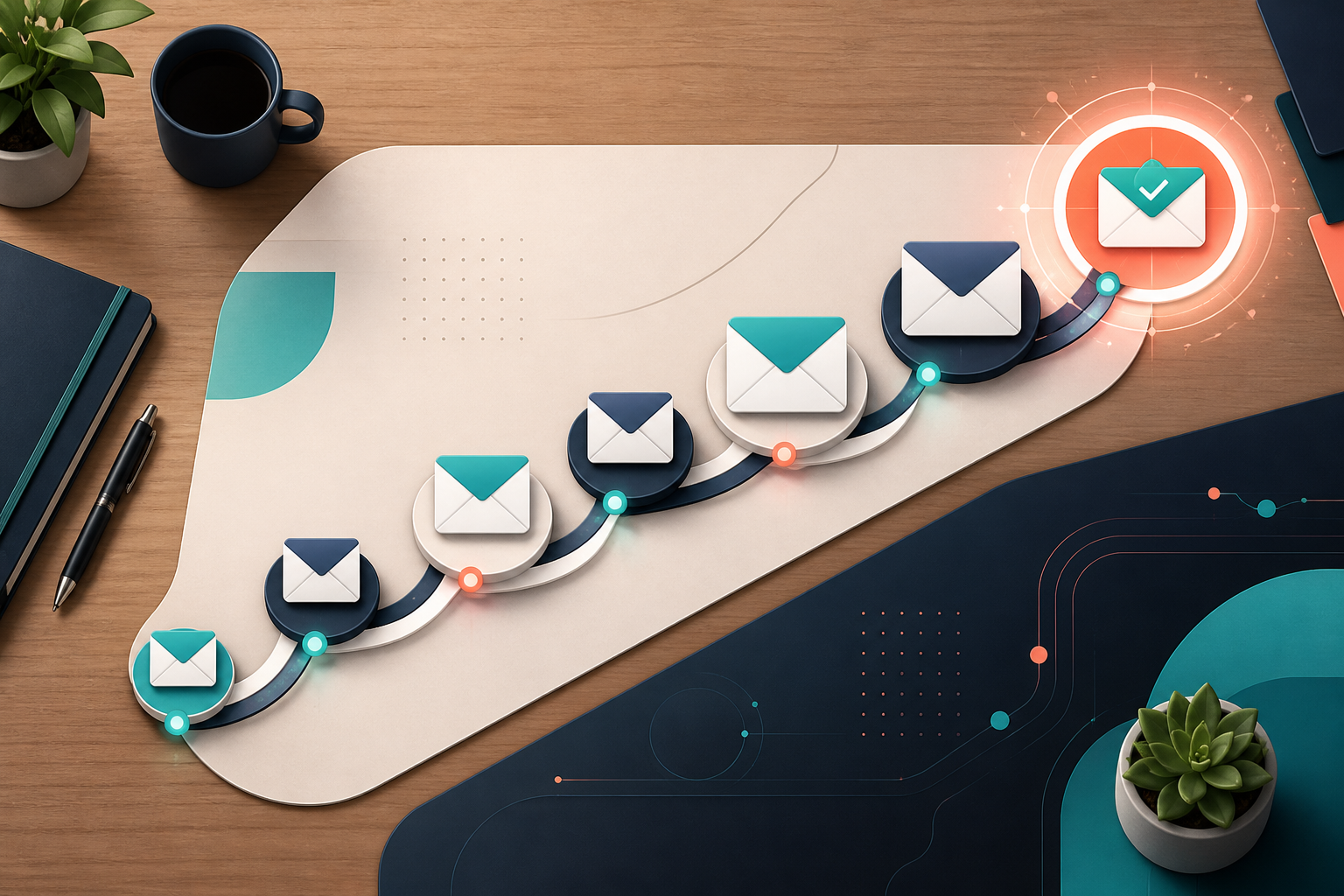
Email 1: Confirmation + Context (Send Immediately)
This one does two things. First, it confirms the purchase and delivers whatever access or content they bought. That's table stakes. But the second job — and this is where most people stop — is to set the frame for what comes next.
Not in a "here's what I'm going to sell you" way. In a "here's what your life looks like now that you've made this decision" way. Acknowledge where they are. Remind them why they bought. Make them feel seen.
One sentence I've used in variations of this email: "You made a decision a lot of people think about but never follow through on — that matters." It's small. But it lands.
Email 2: Quick Win (Day 1 or 2)
Give them something actionable they can do in the next 15 minutes that produces a visible result. This is critical for backend conversion later. If someone implements something from your content and it works — even something small — they trust you more. And trust is what converts backend offers.
Don't pitch anything in this email. Seriously. Not even a soft mention. Just deliver value and let it sit.
Email 3: The Story Bridge (Day 3)
This is where you start building toward the backend offer — but indirectly. Share a story. Either your own or a scenario that mirrors your buyer's situation. The story should naturally surface a problem that your front-end offer addresses partially but doesn't fully solve.
You're not manufacturing a gap. You're being honest about the limits of what they just bought — and positioning the next offer as the natural continuation, not an upsell.
This is also a good place to reference complementary tools or resources. If your front-end product is about building a lead magnet funnel, and your backend affiliate offer is a platform like systeme.io or ConvertKit — this is where you mention that without those tools, the strategy is harder to execute. You're not selling. You're connecting dots.
Email 4: The Offer (Day 4-5)
Now you can make a direct recommendation. By this point, if you've done emails 1-3 well, this email doesn't feel like a pitch. It feels like a friend saying "by the way, here's the thing I use to do exactly what we've been talking about."
Be specific. Don't say "a great email marketing tool." Say "I run my sequences through ConvertKit specifically because the automations don't break when subscribers change behavior mid-sequence — something I've had happen on other platforms at the worst possible time."
Specificity is what separates an affiliate email from a spam email.
Email 5: Objection Handling (Day 6)
Most people skip this one. Don't. The people who didn't buy from email 4 aren't necessarily saying no — they're usually saying "I'm not sure yet." Address the most common hesitations directly. Price, complexity, timing. Pick the one that's most relevant to your specific offer and speak to it plainly.
Email 6: Last Call (Day 7)
If there's a deadline or bonus attached to the offer, use it. If there isn't — create a soft one. "I'm moving on to a different topic next week" is a legitimate reason to close the loop. Don't manufacture fake scarcity. It erodes trust faster than it converts.
From the Field: Practical Implementation Notes
A few things I've observed that don't make it into the "how to write post-purchase emails" tutorials:
Segmentation matters more than sequence length. If someone bought a $27 course on Facebook ads and your backend offer is a $497 coaching program, the bridge between those two things needs to be explicit. I've seen sequences that convert beautifully for one offer completely tank for another — not because the writing was different, but because the logical connection wasn't there. Before you write a single email, map the problem-solution chain from front-end to backend. If you can't articulate it in one sentence, the sequence won't convert it either.
Delivery timing is not just a best-practice — it's a technical issue. If you're running post-purchase sequences through a platform with known deliverability problems, your carefully timed Day 3 story email might land on Day 5 — or in spam. I've had this happen with lower-tier ESPs during high-volume periods. If you're not sure where your platform stands, this breakdown of email platforms that actually deliver for affiliate marketers is worth reading before you build out anything complicated.
The "quick win" email is the most underrated email in the sequence. I've split-tested sequences with and without it. The version with a genuine quick-win email — something that actually helps the buyer do something useful — consistently outperforms on backend conversion. Not by a small margin. The trust signal it creates is real and measurable in downstream click-through rates.
Don't ignore buyers who came through paid traffic differently. Someone who clicked a Taboola native ad at $0.11 CPC and bought a $17 front-end offer is in a different psychological state than someone who found you through an organic search and bought a $97 product. The former may need more trust-building before a backend pitch lands. The latter may be ready sooner. Your traffic source should influence your sequence pacing.
High-ticket backend offers need more runway. If you're sequencing something in the $500-$2,000 range, six emails probably isn't enough. I'd point you toward how to sequence high-ticket affiliate offers in email funnels for a deeper treatment of that specific challenge — it's a different animal than promoting a $47 software tool.
What I'd Do Differently If I Was Starting Over
Honestly? I'd stop treating post-purchase email as a "sequence" and start treating it as a conversation. The word "sequence" implies something mechanical — step 1, step 2, step 3. But the best post-purchase emails I've written read like they came from a person who actually cares what happens to the buyer next.
I'd also start with the backend offer first, then write the sequence backward. Sounds weird, but it works. If you know exactly what you're trying to help someone understand or believe by Day 5, every prior email becomes easier to write — because you're building toward something specific, not just filling days with content.
And I'd be more patient. The instinct is always to pitch sooner. But the sequences that have worked best for me — the ones where someone replies to say "this is exactly what I needed to hear" before clicking through on an affiliate link — those sequences gave the relationship room to breathe first.
The Bigger Picture Most Affiliates Miss
Post-purchase sequences aren't just about converting one backend offer. They're about establishing what kind of marketer you are in the mind of your buyer. Do you disappear after the sale? Or do you show up, add value, and treat the purchase as the beginning of something rather than the end?
That reputation compounds. Buyers who feel well-served after a purchase become the subscribers who open your emails six months later when you launch something new. They become the people who click your links not because they were retargeted or because you used urgency tactics — but because they've decided they trust your judgment.
That trust is worth more than any single backend conversion. And it's built — or destroyed — in the emails you send in the first seven days after someone hands you their money.
If you're still figuring out the structural side of how long these sequences should run, or whether to merge them with your general broadcast schedule, this piece on how long your affiliate email sequence should actually be addresses those questions directly and without the usual vague non-answers.
You're not alone in feeling like you've been leaving money on the table. Most of us have been there. The good news is that the fix doesn't require more traffic, a bigger list, or a more expensive funnel builder. It requires paying attention to the people who already said yes — and continuing the conversation like it matters.
Because it does.

This article contains affiliate links. We may earn a commission at no extra cost to you. Full disclosure.
Editorial Team
Senior Digital Marketing Strategist
The Prophet Visionary editorial team covers affiliate marketing, paid traffic, funnels, and digital product strategy with hands-on practitioner experience.
Learn more about our editorial team →Your List Is Only as Good as Your Email Platform
AWeber has 25+ years of inbox deliverability, drag-and-drop automation, and AI-powered copywriting built in. Free plan for up to 500 subscribers.
See Why Affiliates Use AWeberThis page contains affiliate links — I may earn a commission at no extra cost to you.
Disclaimer: The information on this site is for educational purposes only and does not constitute financial, legal, or business advice. Results vary based on individual effort, market conditions, and other factors. Always do your own due diligence before making business or investment decisions.