How Long Should Your Affiliate Email Sequence Actually Be?
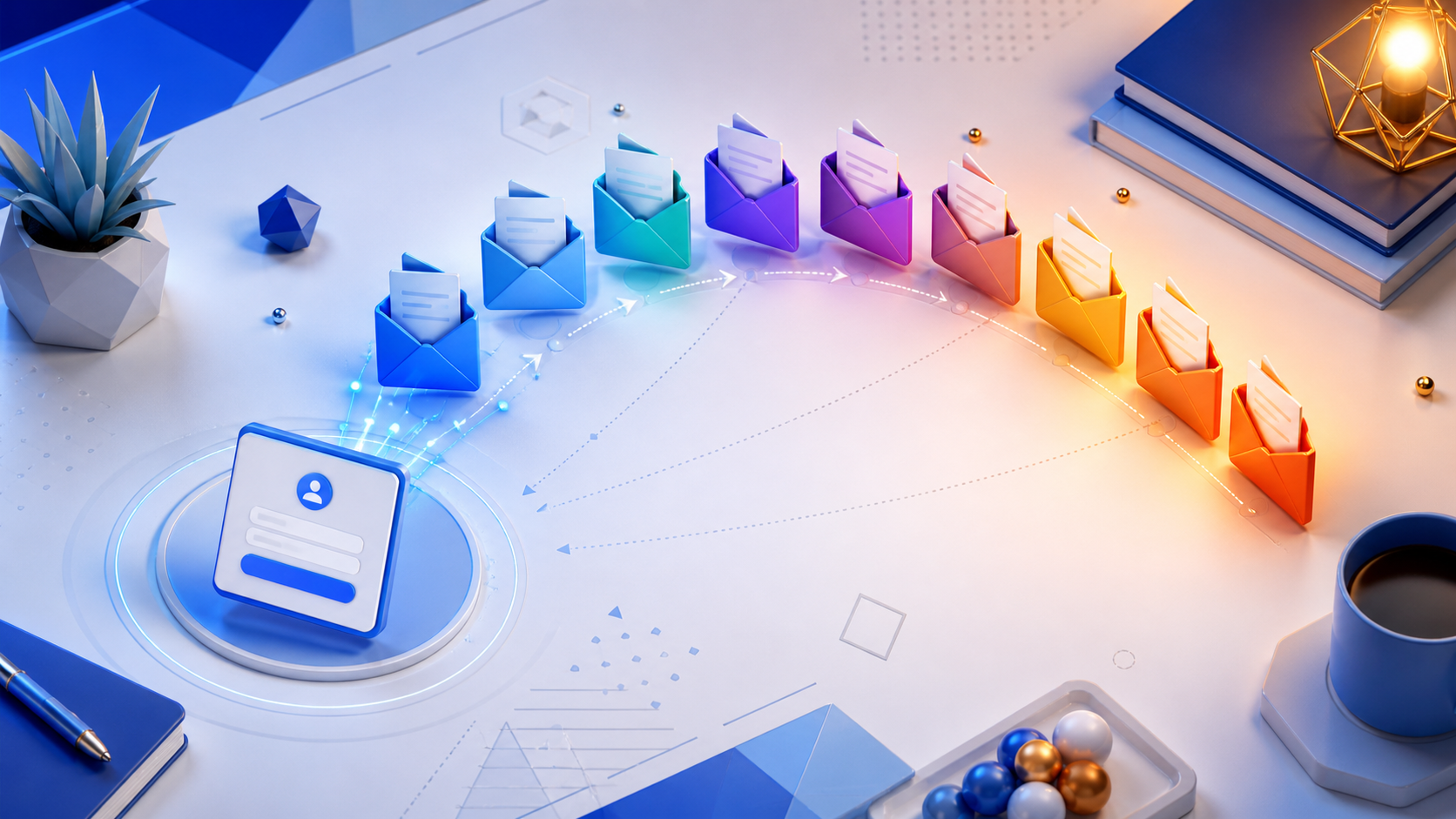
The honest answer: for most digital product affiliate promotions, a 5-to-7 email sequence hits the sweet spot—enough to build trust, handle objections, and close without burning your list. But that number shifts depending on your traffic source, offer price point, and where someone is in their relationship with you. A cold lead from a paid Taboola campaign needs more warming than someone who opted in after watching your YouTube breakdown of a product. The sequence length question is really a relationship depth question, and most guides miss that entirely.
If you've been spinning your wheels trying to figure out why your 3-email sequence isn't converting, or why your 14-email marathon is torching your unsubscribe rate, you're not alone—and you're not doing it wrong because you're bad at marketing. The conflicting advice out there is genuinely confusing. Let's sort it out.
Why Does Everyone Give a Different Answer on Sequence Length?
Because they're answering different questions without telling you. When a ConvertKit blog post says "5 emails is plenty," they're probably talking about a warm audience—existing subscribers who already know the brand. When a clickbank affiliate guru says "you need at least 10 emails," they're working with cold paid traffic that took weeks to warm up before converting. Both can be right. Both are incomplete without context.
The other issue is that most advice is based on what worked in a specific niche, with a specific offer, at a specific price point. A $27 impulse-buy digital product on ClickBank doesn't need the same sequence architecture as a $297 coaching program. The former might convert on email 2. The latter might need email 8 just to get someone to click the sales page seriously. What most people get wrong is treating sequence length as a fixed rule rather than a variable that responds to offer complexity and audience temperature.
There's also survivorship bias baked into most case studies. You hear about the 5-email sequence that crushed it—you don't hear about the 200 affiliates who ran the same 5-email sequence and got mediocre results because their list was colder or their offer was priced differently.
Why Do Short Sequences (3 Emails or Fewer) Often Underperform?
Three emails is almost never enough for a digital product affiliate promotion unless you're mailing an already-engaged list that trusts you deeply. Here's what happens with a 3-email sequence on cold or lukewarm traffic: email 1 gets opened out of curiosity, email 2 gets a "maybe later" reaction, and email 3 feels like a hard close before the reader has any real reason to care. You're essentially asking someone to buy from a stranger on the third interaction.
The psychology matters here. Most people need to see an offer 5-7 times before they act—that's not a made-up number, it's a consistent pattern observed across direct response marketing for decades. A 3-email sequence compresses that exposure window so aggressively that you're filtering for only the most impulse-driven buyers. That's not necessarily bad if your offer is a low-ticket, high-urgency product. But for anything over $47, you're leaving money on the table.
I've found that sequences cutting off at email 3 also miss the objection-handling window entirely. Most buyers don't convert because they haven't had their core objection addressed—"is this right for me?", "what if it doesn't work?", "is this person credible?" Those answers take more than three emails to deliver convincingly.
Why Do Long Sequences (12+ Emails) Hurt Open Rates Over Time?
Fatigue is real. After a certain point—and in my experience that inflection point is usually around email 8-9 for a non-segmented list—open rates start dropping not because people hate you, but because you've exceeded their mental budget for how much time they're willing to invest before a decision. They either bought, or they've silently decided "not for me" and are just deleting without unsubscribing.
The problem with ignoring this is that it damages your sender reputation over time. Emails getting deleted unopened—or worse, marked as spam—affects your deliverability in systeme.io, ConvertKit, ActiveCampaign, wherever you're sending from. A 14-email sequence that burns 15% of your list into unengaged subscribers isn't just a sequence problem. It's a future deliverability problem that makes your next promotion harder to land in the inbox.
That said, long sequences aren't inherently wrong. The counterintuitive part is that a 12-email sequence with aggressive segmentation can outperform a 7-email sequence without it. If you're pulling buyers out of the sequence after email 3 and continuing to mail only non-buyers, you're not fatiguing people who already converted—you're just working the fence-sitters harder. That's smart list management, not email spam.
Why Does Offer Price Point Change How Many Emails You Need?
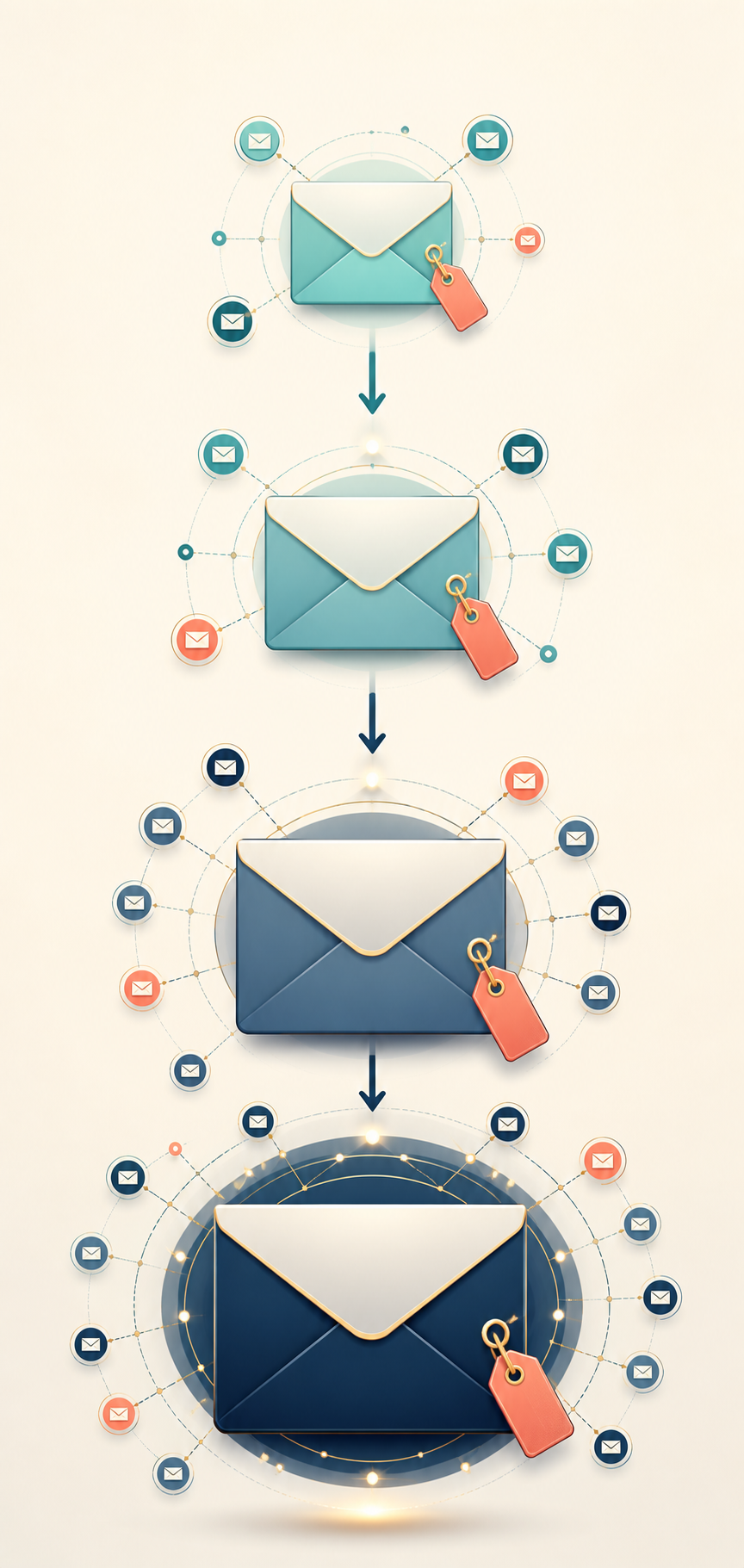
Trust scales with price. That's the simple version. A $17 ebook on ClickBank doesn't require much trust—the financial risk is low enough that someone can buy on a whim and not feel burned even if it's mediocre. But a $197 course or a $497 software bundle? That's a different cognitive process entirely. The buyer needs to feel genuinely confident that this is worth the money, that you're credible enough to recommend it, and that the product delivers on its promise.
As a rough working framework I've used across different niches:
- $7–$37 offers: 3–5 emails, lead with value fast, close with urgency
- $47–$97 offers: 5–7 emails, mix education with social proof, handle 1-2 objections explicitly
- $97–$297 offers: 7–10 emails, build a story arc, dedicate at least 2 emails to objection handling
- $297+ or recurring offers: 10–14 emails, consider a webinar bridge, segment aggressively after email 5
These aren't gospel. But they're a more honest starting point than "just send 5 emails and see what happens." For deeper thinking on how to structure high-ticket promotions inside a longer sequence, this breakdown on stacking high-ticket affiliate offers inside email sequences is worth your time.
Why Does Traffic Source Affect Sequence Length So Much?
Because traffic source determines how warm or cold someone is when they hit your list. This is probably the most underappreciated variable in the whole sequence length debate.
Someone who clicked a native ad on Taboola or MGID and opted in for a free lead magnet has almost zero pre-existing relationship with you. They were scrolling content, saw something that caught their eye, and gave you their email. That's a cold lead. A 5-email sequence might not even finish warming them up before you start pitching. Contrast that with someone who found your list through a search-intent article, read 800 words of your content, and opted in because they wanted more—that person is already in buying mode. They might convert on email 2.
Organic search traffic and referral traffic from trusted sources consistently convert faster than paid cold traffic, which means you can run shorter sequences without sacrificing results. Paid traffic from platforms like Facebook or Taboola—especially broad targeting campaigns—generally needs that extra runway. I've seen affiliates cut their sequence from 10 emails to 6 after shifting from cold paid traffic to SEO-driven leads, and their conversion rate actually went up because the shorter sequence matched the audience's readiness to buy.
Why Is the First Email in Any Sequence the Most Important?
Because it sets the entire expectation framework. If email 1 is weak—generic, overly formal, or immediately pitchy—you've already lost the psychological thread that carries someone through emails 2 through 7. Open rates on email 2 are almost always a direct reflection of how good email 1 was. Not the subject line of email 2. Email 1.
The welcome email (or first sequence email after opt-in) has the highest open rate you'll ever see from that subscriber—often 40-60% for a warm list, sometimes higher. That's your moment. Waste it on "thanks for signing up, here's your freebie" and you've squandered your best shot at establishing a relationship. Use it to tell them exactly what they're going to get, why you're the right person to help them, and—critically—set up anticipation for what's coming next.
If your welcome sequence isn't doing this work, this piece on why welcome sequences fail at upsells diagnoses the most common failure patterns I see affiliates repeat.
Why Do Most Affiliates Plateau at the Same Conversion Rate Regardless of Sequence Length?
Because they're optimizing the wrong variable. Sequence length matters, but it matters less than sequence quality. I've seen affiliates send 10 mediocre emails and get a 1.2% conversion rate, then cut to 6 well-crafted emails and hit 3.8%. The number of emails wasn't the problem—the emails themselves were.
Specifically, most affiliate sequences plateau because they're missing three things:
- A clear story arc — each email should feel like it advances something, not just repeat the pitch with different subject lines
- Explicit objection handling — at least one email should directly address the most common reason someone wouldn't buy
- A genuine reason to act now — urgency that's real (a deadline, a bonus expiring, a price change) rather than manufactured and obviously fake
If your sequence has all three and it's still flat, then length and frequency become worth testing. But most affiliates jump to "I need more emails" when the actual fix is "I need better emails." For a structured look at sequences that actually move offers, this roundup of email automation sequences that sell affiliate offers covers the architecture in detail.
Why Should You Treat Sequence Length as a Moving Target, Not a Fixed Rule?
Because your list changes. What worked for a 2023 launch won't necessarily work for the same offer in a re-mail to the same list in 2026. Subscribers age. Engagement patterns shift. Offer fatigue sets in. The affiliate who treated their 7-email sequence as a permanent fixture—never testing, never adjusting—is the one sitting at a 0.8% conversion rate wondering why the sequence that "used to work" doesn't anymore.
The practical move is to review sequence performance every 90 days at minimum. Look at where open rates drop off. If email 4 consistently gets 40% fewer opens than email 3, that's your signal—something's breaking down there. Either email 3 isn't setting up email 4 well, or you've hit the fatigue threshold for your specific audience. That data is telling you to either cut the sequence at email 3 or rewrite email 4 to re-earn attention.
Sequence length is a hypothesis, not a formula. Test it like one.
From the Field: Practical Implementation Notes
Here's what I've actually observed running affiliate email promotions across different setups—not theory, just patterns that keep showing up.
On segmentation timing: If you're not pulling buyers out of your promotional sequence by email 3 at the latest, you're mailing people who already converted with more sales emails. That's how you train your best customers to tune you out. Set up a simple automation in ConvertKit or ActiveCampaign that tags buyers and removes them from the active sequence immediately on purchase confirmation. This alone can lift your overall sequence metrics noticeably because your open rates stop being diluted by people who've already bought and aren't opening sales emails anymore.
On re-engagement inside long sequences: If you're running a 10+ email sequence, drop a pattern-interrupt email around email 6 or 7. Not a pitch—something genuinely useful or entertaining that has nothing to do with the offer. A short story, a surprising stat, a counterintuitive take on something in your niche. It resets attention and often spikes open rates on the following email by 15-25% in my observation. The sequence feels like a conversation again instead of a drip campaign.
On frequency: Daily emails during a 5-7 day launch window consistently outperform every-other-day sending for time-sensitive offers. The urgency rhythm matters. But daily emails for a 14-day sequence? That's where you start seeing significant unsubscribe spikes after day 7. If you need a long sequence, consider daily for the first 5 days, then every other day for the remainder.
On deliverability: Whatever length you choose, your sender reputation is the invisible factor. A well-crafted 5-email sequence landing in the primary inbox will outperform a brilliant 10-email sequence landing in promotions or spam. If you're seeing declining open rates across a sequence, check your deliverability before blaming your copy. Tools like GlockApps can give you inbox placement data without much setup friction.

Still Have Questions?
The "right" sequence length is the one that matches your offer complexity, your audience temperature, and your willingness to actually look at the data and adjust. Start with 5-7 emails for most digital product affiliate promotions. Segment buyers out immediately. Test one variable at a time—length, frequency, or copy—not all three at once. And don't let anyone convince you there's a universal number that works for every offer on every list.
If your post-opt-in sequence isn't converting despite reasonable length and frequency, the diagnostic is usually in the email quality itself—specifically whether you're handling objections and building genuine anticipation. This piece on why post-opt-in sequences fail to convert walks through the most common breakdowns and how to fix them without starting from scratch.
The sequence length debate is ultimately a proxy for a deeper question: how much relationship-building does this specific buyer need before they trust you enough to act? Answer that honestly for your audience, and the number of emails writes itself.
This article contains affiliate links. We may earn a commission at no extra cost to you. Full disclosure.
Editorial Team
Senior Digital Marketing Strategist
The Prophet Visionary editorial team covers affiliate marketing, paid traffic, funnels, and digital product strategy with hands-on practitioner experience.
Learn more about our editorial team →Your List Is Only as Good as Your Email Platform
AWeber has 25+ years of inbox deliverability, drag-and-drop automation, and AI-powered copywriting built in. Free plan for up to 500 subscribers.
See Why Affiliates Use AWeberThis page contains affiliate links — I may earn a commission at no extra cost to you.
Disclaimer: The information on this site is for educational purposes only and does not constitute financial, legal, or business advice. Results vary based on individual effort, market conditions, and other factors. Always do your own due diligence before making business or investment decisions.