Why Your Welcome Sequence Isn't Selling Affiliate Offers
You built the funnel. You wrote the emails. You set up the automation. And then... crickets. Maybe a trickle of clicks, no real sales, and a nagging feeling that everyone else figured out something you haven't.
I get it. Honestly, the welcome sequence is one of those things that sounds simple on paper—send a few emails, warm up the subscriber, pitch the offer—but in practice it consistently underperforms for affiliate marketers in ways that aren't immediately obvious. The problem usually isn't effort. It's architecture.
So before you blow up your entire funnel or switch platforms for the fourth time, let's actually diagnose what's broken.
The Real Bottleneck Nobody Talks About
Most guides tell you to write a welcome sequence like you're writing a newsletter. Be friendly. Deliver value. Don't sell too fast. That advice isn't wrong, but it's dangerously incomplete for affiliate launches specifically.
Here's the thing: affiliate product launches have a timing problem that evergreen nurture sequences don't. You're working against a launch window—cart opens, bonuses expire, early-bird pricing ends. Your welcome sequence needs to do two things simultaneously that most marketers treat as separate: build trust AND create urgency. When you optimize for one at the expense of the other, the sequence collapses.
In my experience, the biggest single failure point is what I call the "trust lag"—you spend emails 1 through 4 delivering pure value with zero commercial intent, then suddenly email 5 is a hard pitch. Subscribers don't make that mental leap. They feel ambushed. Open rates drop, unsubscribes spike, and you're left wondering why your "relationship-building" approach didn't convert.
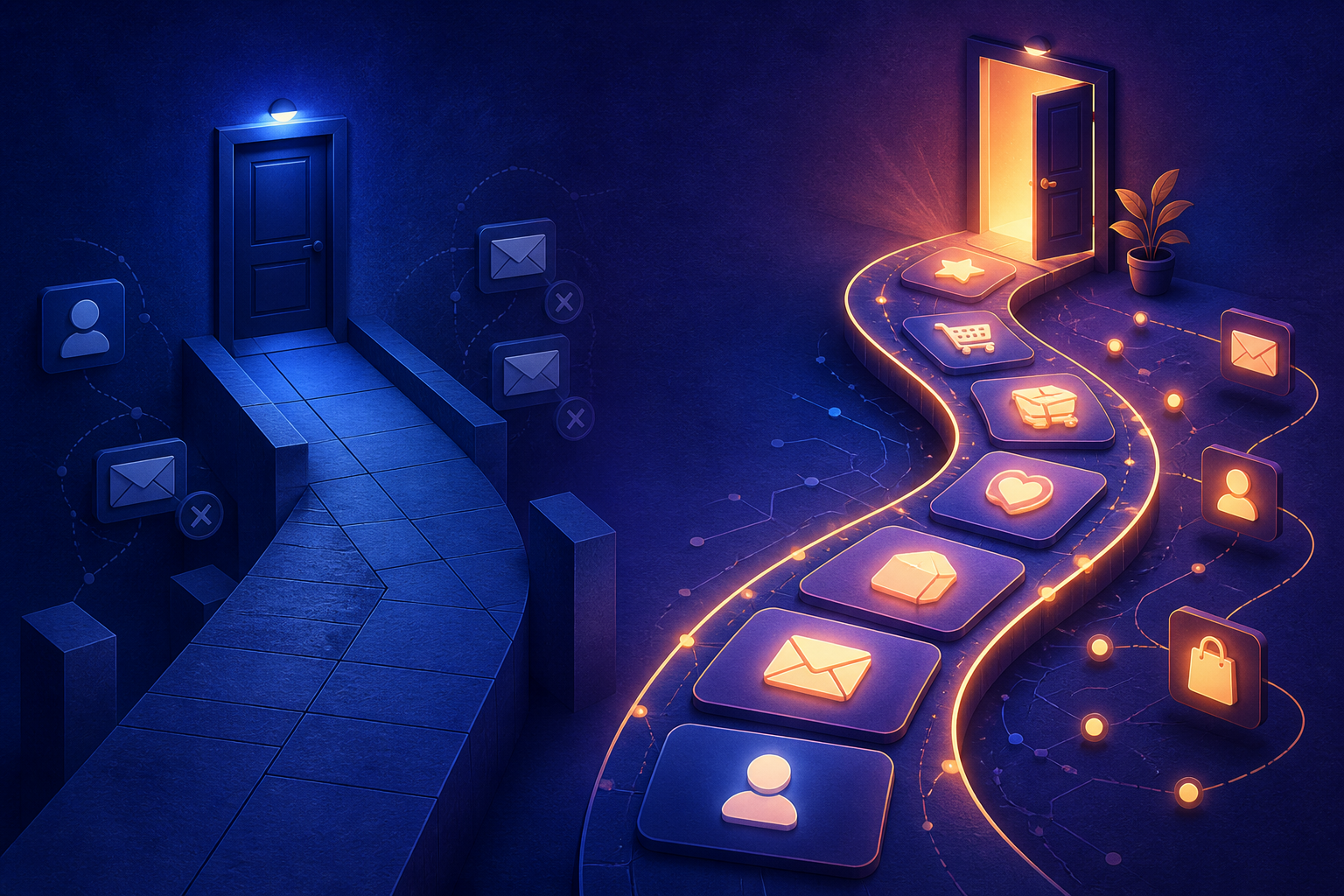
Step 1: Start With the Offer Architecture, Not the Emails
Before you write a single subject line, you need to know exactly what you're promoting and when the launch window opens and closes. This sounds obvious. It almost never happens in practice.
Map it out: When does the cart open? When does it close? Are there bonus stacking windows? Early-bird price breaks? That timeline dictates your sequence length and pacing. A 5-day launch window needs a tighter, more aggressive sequence than a 14-day evergreen funnel pretending to be a launch.
For most affiliate product launches I've structured, a 5-to-7 email welcome sequence hits the right balance. Fewer than five and you haven't built enough trust to overcome purchase resistance. More than seven and you're either padding or overwhelming people who opted in expecting concise communication. (If you're wrestling with this question more broadly, this breakdown on how long your affiliate email sequence should actually be is worth reading before you finalize your plan.)
The architecture matters more than the copy. Get the structure wrong and brilliant writing won't save you.
Step 2: Fix the First Email (It's Almost Certainly Wrong)
The welcome email gets more opens than any other email in your sequence—typically 40-60% open rates versus 20-30% for subsequent emails. And most affiliate marketers waste it on a generic "thanks for subscribing, here's your freebie" message.
That's a catastrophic misuse of your highest-attention moment.
Your first email should do three things: confirm what they signed up for, immediately establish your perspective on the problem they're trying to solve, and hint at what's coming. Not a hard pitch—a preview. Something like: "Over the next few days, I'm going to show you why most [niche] advice fails, and introduce you to something that actually changed how I approach this."
That's it. You're planting curiosity and setting a narrative arc. Subscribers who know something is coming are far more likely to open the next email. It's basic story structure applied to email.
One tactical note: make sure your from-name and subject line are consistent from email one onward. ConvertKit and ActiveCampaign both let you set this at the sequence level—use it. Inconsistent sender identity kills recognition, and recognition drives opens.
Step 3: Stop Treating Emails 2 and 3 as "Value Delivery"
Here's where most sequences die a slow death. Emails 2 and 3 become generic educational content—tips, frameworks, "5 things to know about X"—that could have been written by anyone, for anyone, about anything.
Value delivery is necessary. But it needs to be specifically framed around the problem the affiliate product solves. Everything in your welcome sequence should be pulling a thread toward the offer. Not obviously, not aggressively—but purposefully.
If you're promoting a ClickBank offer in the productivity space, your "value" emails shouldn't be generic productivity tips. They should be stories or frameworks that illuminate the specific gap the product fills. You're not educating neutrally; you're educating with a destination in mind.
The counterintuitive part: this actually makes your value content better, not more salesy. Focused, specific content that solves a real problem is more useful than broad educational fluff. Your subscribers win, and your conversion rate wins.
Step 4: Introduce the Offer Before You Pitch It
Email 4 is where most affiliates either go too soft or too hard. Too soft: another value email that never mentions the offer. Too hard: a full pitch with urgency before you've even named the product.
What works—and I've tested this across multiple niches—is what I call the "soft reveal." Email 4 introduces the offer as something you discovered or tested, explains why you're recommending it, and gives subscribers a reason to care. No hard CTA to buy yet. Just: "This is what I've been building toward, and tomorrow I'm going to show you exactly why I think it's worth your attention."
This approach does something psychologically important: it removes the ambush. Subscribers aren't surprised by the pitch in email 5 because you've been transparent about where you're going. That transparency builds trust faster than any amount of pure value delivery.
For high-ticket offers especially, this transition matters enormously. If you're stacking multiple offers or promoting something north of $500, the soft reveal needs even more runway. Understanding how to structure high-ticket offer stacking will save you from burning your list on premature pitches.
Step 5: Write the Pitch Email Like a Human, Not a Copywriter
Email 5 is your first real pitch. And this is where affiliate marketers tend to either copy the vendor's swipe copy verbatim or write something so heavily formatted with bold headers and bullet points that it reads like a sales page, not an email.
Both approaches underperform.
The best pitch emails I've written—and seen work—read like a personal recommendation from someone who genuinely used the thing. Conversational. Specific. A little imperfect. They acknowledge objections without being defensive. They use the word "I" a lot. They sound like a person, not a marketing department.
Include your affiliate link early and late. Don't bury it at the bottom after 800 words of copy. Put it in the second paragraph with context, then again near the end. Two links per pitch email is the minimum—three is fine if the email is long enough to justify it.
Subject lines for pitch emails: stop being clever. Clarity beats cleverness every time. "Here's the [Product Name] I mentioned yesterday" outperforms "The secret they don't want you to know" in almost every split test I've run. Your subscribers aren't stupid—treat them accordingly.

Step 6: Build in Behavioral Triggers, Not Just Time Delays
This is the step that separates basic automations from sequences that actually adapt. If your welcome sequence fires every email on a fixed time delay regardless of subscriber behavior, you're leaving significant conversions on the table.
What should you be triggering on? At minimum: link clicks and email opens. A subscriber who clicked your pitch email link but didn't buy needs a different email than someone who didn't open at all. Most email platforms—ActiveCampaign, Drip, even Systeme.io at higher tiers—let you branch sequences based on these behaviors.
The click-but-no-purchase segment is your highest-value group. They're interested. Something stopped them. Your job is to find out what—price objection, trust gap, timing issue—and address it directly in a follow-up email sent within 24 hours of the click.
This isn't complicated to set up, but it requires thinking about your sequence as a decision tree rather than a linear drip. If your current platform doesn't support basic conditional logic, that's a platform problem worth solving. There's a solid comparison of email platforms that actually support affiliate marketing workflows that can help you evaluate your options without the usual vendor bias.
For a deeper look at which behavioral triggers consistently move the needle in launch sequences specifically, this breakdown of behavioral triggers in affiliate launch sequences goes further than I can here.
Step 7: Close the Cart Like You Mean It
Urgency emails are awkward to write. They feel pushy. They feel desperate. And if you've been burned by fake countdown timers, you might be tempted to skip them entirely.
Don't.
Real urgency—actual cart close dates, genuine bonus expirations, authentic price increases—is one of the most powerful conversion drivers in affiliate email marketing. The problem isn't urgency itself; it's fake urgency, which destroys trust the moment a subscriber realizes the "24-hour offer" is still available three weeks later.
Your final 1-2 emails in the sequence should be urgency-based, specific, and short. Not another pitch. Not another value dump. Just: "Cart closes tonight at midnight. Here's why I think you should act before it does." That's the whole email. Three paragraphs max. One link. Clear subject line with the deadline in it.
Send the last email 2-4 hours before close, not the morning of. People make decisions in the evening. Hit them when they're actually in a position to buy.
Practical Implementation Notes
A few things I've observed running these sequences that don't fit neatly into step-by-step format:
Platform choice matters for deliverability. If you're running affiliate offers, not all ESPs will let you. Mailchimp is notoriously restrictive. ConvertKit has gotten stricter. GetResponse and AWeber tend to be more affiliate-friendly, but deliverability varies by list hygiene and sending history. Systeme.io is worth considering if you're building an integrated funnel—it's less polished but surprisingly capable and won't ban you for promoting ClickBank offers.
Warm your list before launch. If you've been quiet for 60+ days, don't launch a welcome sequence into a cold list without a re-engagement campaign first. Spam complaint rates spike when inactive subscribers suddenly get 5 emails in 7 days. Send one reactivation email, purge non-openers, then launch.
Test subject lines before the sequence goes live. Broadcast a subject line variation to a small segment first if your platform allows it. A 5% open rate difference in email 1 compounds across the entire sequence.
Mobile formatting is non-negotiable. Over 60% of your subscribers are reading on mobile. Long paragraphs, tiny fonts, and image-heavy templates kill readability. Plain-text or minimal-design emails consistently outperform heavily designed ones for affiliate promotions. This isn't aesthetic preference—it's conversion data.
Troubleshooting: Why It's Still Not Working
Opens are fine but clicks are low: Your CTAs are buried or your pitch isn't specific enough. Rewrite the paragraph immediately before your link to make the benefit of clicking crystal clear.
Clicks are decent but no purchases: The offer landing page isn't matching the expectation set in your email. Review what you're promising in the email versus what the vendor page delivers. Mismatched messaging kills conversions at the last step.
Unsubscribes spike at email 3 or 4: You're either emailing too frequently or pivoting too hard from the opt-in promise. If someone signed up for a free checklist, emails 3 and 4 should still feel related to that checklist—not a completely different topic.
Deliverability is dropping: Check your spam complaint rate (should be under 0.1%) and your bounce rate. Clean your list. Stop emailing people who haven't opened in 90 days. Use a dedicated sending domain, not a shared one.

Your 10-Minute Action Plan Right Now
Stop overthinking. Here's what you do in the next 10 minutes:
- Minutes 1-2: Write down your launch window dates. Cart open. Cart close. Any bonus deadlines. If you don't have these, you can't build a functioning sequence—get them first.
- Minutes 3-4: Audit your current welcome sequence. Count the emails. Note which ones mention the offer and which don't. Mark the first pitch email. If the pitch appears before email 4 or after email 6, that's your first fix.
- Minutes 5-6: Open your email 1 and read it out loud. Does it set up a narrative arc? Does it hint at what's coming? If it's just a "thanks for subscribing" email, schedule 30 minutes tomorrow to rewrite it using the three-part structure from Step 2 above.
- Minutes 7-8: Check your platform for behavioral trigger support. Log into ConvertKit, ActiveCampaign, or whatever you're using and see if you can create a conditional branch based on link clicks. If you can, make a note to set up a "clicked but didn't buy" branch for your pitch email.
- Minutes 9-10: Verify your from-name, sending domain, and subject line format are consistent across all emails in the sequence. Fix any inconsistencies. This takes 5 minutes and directly impacts open rates.
That's it. You're not going to overhaul the entire sequence today, and you don't need to. Pick the highest-leverage fix from that audit and do it before your next launch window opens.
The welcome sequence isn't magic. But when it's built with actual intention—matching offer timing, subscriber psychology, and behavioral logic—it's one of the most reliable conversion assets you have. The frustration you're feeling right now is almost always a structural problem, not a talent problem. Fix the structure first. Everything else follows.
This article contains affiliate links. We may earn a commission at no extra cost to you. Full disclosure.
Editorial Team
Senior Digital Marketing Strategist
The Prophet Visionary editorial team covers affiliate marketing, paid traffic, funnels, and digital product strategy with hands-on practitioner experience.
Learn more about our editorial team →Your List Is Only as Good as Your Email Platform
AWeber has 25+ years of inbox deliverability, drag-and-drop automation, and AI-powered copywriting built in. Free plan for up to 500 subscribers.
See Why Affiliates Use AWeberThis page contains affiliate links — I may earn a commission at no extra cost to you.
Disclaimer: The information on this site is for educational purposes only and does not constitute financial, legal, or business advice. Results vary based on individual effort, market conditions, and other factors. Always do your own due diligence before making business or investment decisions.