Pricing a Tripwire for Cold Traffic: The Sub-$27 Playbook
Here's the outcome this article is built around: a cold-traffic funnel where your tripwire, priced under $27, covers at least 70-100% of your front-end ad cost within 14 days of launch. Not profit. Not riches. Just a funnel that pays for its own traffic, so everything after the tripwire (upsells, email, backend affiliate offers) is margin.
That's a specific, measurable target. And honestly, it's the only one worth chasing with a low-priced offer. I've watched too many people price a $9 product, celebrate a 6% conversion rate, and then discover they spent $14 to get each $9 sale.
Define the Outcome: Breakeven on Cold Traffic
A tripwire has one job. Convert a cold subscriber into a buyer fast, so you know they'll pull out a card. It's not your main revenue source and it shouldn't pretend to be.
Your target metric is simple:
- Cost per lead (CPL) from your traffic source
- Tripwire take rate (percentage of leads who buy)
- Revenue per lead (RPL) = price × take rate, plus any order bump or upsell revenue
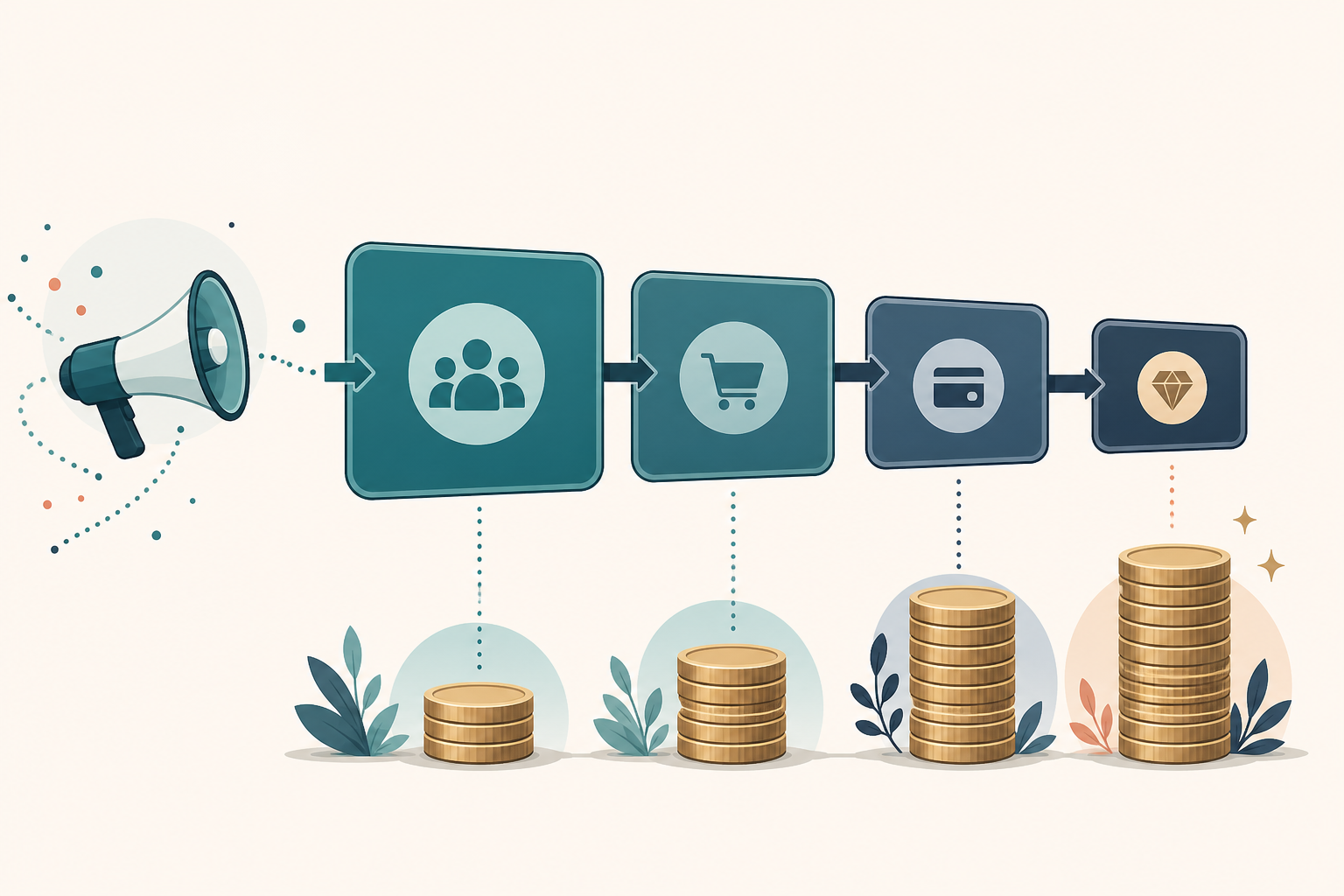
The goal: RPL ≥ 0.7 × CPL by day 14. Hit 1.0 and you've got a self-liquidating funnel. Above that, you can scale.
The Pricing Math (Why $7, $9, $17, and $19 Behave Differently)
Under $27 isn't one price. It's a range with distinct psychology, and what most people get wrong is treating $7 and $19 as interchangeable.
| Price | Typical role | Break-even take rate at $2.00 CPL | Break-even take rate at $4.00 CPL |
|---|---|---|---|
| $7 | Impulse buy, max volume | 28.6% | 57% |
| $9-$12 | Low-friction sweet spot | 16.7-22% | 33-44% |
| $17 | Perceived-value product | 11.8% | 23.5% |
| $19-$24 | Serious mini-product | 8.3-10.5% | 16.7-21% |
Read that table twice. At $4.00 CPL, a $7 offer needs more than half your leads to buy. That's not happening on cold traffic. In my experience, cold-lead take rates on a tripwire usually land somewhere in the 1-8% range, depending on traffic temperature and how well the offer matches the lead magnet. Your mileage will vary, so treat those numbers as a planning range, not a promise.
The counterintuitive part: higher prices often win. A $17-$19 tripwire at a 4% take rate returns $0.68-$0.76 per lead. A $7 tripwire needs a 10% take rate to return $0.70. Which is more realistic? The first.

Milestones and Timeline
Here's the path I'd map out, from zero to a funnel you can trust.
- Days 1-3: Build. Lead magnet, thank-you page with the tripwire, checkout, and a 3-email welcome sequence that restates the offer.
- Days 4-7: Test traffic. Spend enough to collect roughly 150-300 leads. On native platforms like Taboola or NewsBreak, CPCs often sit in the low cents to a few tens of cents, so a $75-$150 test can be enough to start reading signals. Don't judge on 30 leads.
- Days 8-14: Read and adjust. Compare RPL against CPL. Change one variable only: price, headline, or bump.
- Days 15-30: Add the backend. Layer in an upsell or an affiliate offer in email, once the front end is at 70%+ breakeven.
Step-by-Step: Setting Your Price
Step 1: Anchor to your CPL, not your product
Work backwards. If your cold CPL is $1.80, a $17 offer needs about a 10.6% take rate to fully break even. A 5% take plus a 25% order bump acceptance on a $9 add-on gets you closer than you'd think: (17 × 0.05) + (9 × 0.05 × 0.25) = $0.96 per lead. Still under $1.80, so you need to either fix traffic cost or add an upsell.
Step 2: Pick a price in the $12-$19 range first
Starting there gives you the best balance of friction and revenue. Go lower only if your traffic is extremely cheap (think sub-$1 CPL), and go higher ($21-$27) only if the lead magnet strongly pre-qualifies the buyer.
Step 3: Match the tripwire to the lead magnet
If the lead magnet is a checklist on email subject lines, the tripwire is a swipe file of 50 tested subject lines. Not a course on funnels. Same problem, deeper solution. Mismatch kills take rate faster than any pricing tweak.
Step 4: Add one order bump
A $7-$10 checkbox add-on on the checkout page. In my experience, bumps at roughly 20-35% of the tripwire price tend to get taken more often than ones priced equal to it. systeme.io and clickfunnels both support this natively.
Step 5: Add a time-limited window
Offer the tripwire at the special price for 15-30 minutes on the thank-you page, then repeat it in your welcome emails for 48-72 hours. Real deadlines only. Fake countdown timers that reset burn trust (and refund rates show it).
Scenario: A Worked Example (Illustrative, Not a Case Claim)
Say you're driving cold traffic to a lead magnet in the personal finance niche. Your CPL is $1.60. You offer a $15 budgeting template pack with a $7 bump.
- 1,000 leads cost $1,600
- 4% buy the tripwire: 40 × $15 = $600
- 30% of those take the bump: 12 × $7 = $84
- Total front-end revenue: $684, or roughly 43% of ad spend
That's not breakeven. It's a signal. If you can lift take rate to 7% by tightening the match between magnet and offer, you're at about $1,200, or 75%. Then a one-click upsell at $27-$37 or a backend affiliate promo closes the gap. The numbers above are hypothetical to illustrate the method, so run your own.
Tools and Platforms
- Systeme.io: Budget-friendly for funnels, checkout, bumps, and email in one place. See features and pricing on their site.
- ClickFunnels: Strong for one-click upsells and split tests. If you're comparing, I covered the tradeoffs in ClickFunnels vs GoHighLevel for affiliate funnels.
- ConvertKit: Clean for the welcome sequence that sells the tripwire after the thank-you page.
- Taboola / NewsBreak: Common cold traffic sources for sub-$27 offers, where low CPCs make small ticket sizes workable.
Pitfalls I See Constantly
- Pricing for value, not for math. A product being "worth $97" doesn't mean cold traffic will pay it.
- Testing too early. Changing price after 40 leads is noise-chasing.
- Ignoring refunds. A $9 offer with 15% refunds and processing fees leaves very little.
- No warm-up. Cold native traffic often needs context before the offer. If this sounds familiar, read why cold native traffic ignores your offer.
- Skipping the email follow-up. Many tripwire sales happen on days 1-3 after opt-in, not on the first page view.
Real-World Implementation Notes
A few things I've noticed building these funnels that rarely get written down.
First, the thank-you page does most of the work. Put the tripwire there, not behind another click. Second, keep the sales page short: a headline, three to five bullets, a single screenshot or preview, and a guarantee. Long copy for a $12 product often backfires.
Third, track revenue per lead daily in a simple spreadsheet. Column for spend, leads, sales, bump sales, RPL. That's it. Fourth, segment buyers from non-buyers immediately. Buyers get a post-purchase sequence, and non-buyers get a 3-5 email push with a final deadline. I've written about both, in post-purchase email sequences and welcome sequence fixes.
Finally, a quick honesty check: results depend on niche, creative, and traffic quality. I can't tell you your take rate. The test will.
Revenue Model Analysis
Think in ranges, not promises. For planning purposes:
- Front-end take rate: roughly 1-8% on cold leads
- Order bump acceptance: roughly 15-35% of buyers
- Upsell acceptance: roughly 5-20% of buyers, highly offer-dependent
- Target at day 14: 70-100% of CPL recovered on the front end
If you're below 50% after 300+ leads and two rounds of testing, the problem is usually traffic-to-offer fit, not price. Rework the lead magnet before touching the price again.
How It Fits With Other Methods
A tripwire pairs well with a pre-sell bridge page upstream. I covered one such approach in how a pre-sell bridge page cut native ads CPA. It also feeds nicely into higher-ticket affiliate promotions later, once buyers have shown they'll spend.

You'll Know It's Working When...
- Your day-14 RPL is at least 70% of CPL (and trending up as you add an upsell).
- Take rate holds steady across at least 300 leads, not just the first 50.
- Refund rate stays under roughly 5-8%.
- Buyers open and click your backend emails at a visibly higher rate than non-buyers.
- You can raise ad spend by 20-30% without RPL dropping more than a few points.
That last signal is the one that matters. Pricing is a lever, not a destination. Start in the $12-$19 range, do the math before you launch, test one variable at a time, and let the numbers tell you when it's time to scale.
This article contains affiliate links. We may earn a commission at no extra cost to you. Full disclosure.
Editorial Team
Senior Digital Marketing Strategist
The Prophet Visionary editorial team covers affiliate marketing, paid traffic, funnels, and digital product strategy with hands-on practitioner experience.
Learn more about our editorial team →Monetize Smarter With Funnels + Email in One Place
Order bumps, upsells, automated email sequences, and your own affiliate program — Systeme.io gives you the full monetization stack without the bloated monthly spend.
See the Monetization StackThis page contains affiliate links — I may earn a commission at no extra cost to you.
Disclaimer: The information on this site is for educational purposes only and does not constitute financial, legal, or business advice. Results vary based on individual effort, market conditions, and other factors. Always do your own due diligence before making business or investment decisions.