From $7 Tripwire to $2,000 Backend: The Upsell Sequence
Here's the outcome I'm going to walk you through: a funnel where a cold visitor buys a sub-$20 tripwire, gets moved into a short email and retargeting sequence, and a small slice of those buyers purchase a $1,000-$3,000 affiliate high-ticket offer. Not everyone. Roughly 1-3% of tripwire buyers, if the offer fit is right. That's the realistic target, and it's enough to make paid traffic profitable.
I've built and rebuilt this structure enough times to have strong opinions about it. Most affiliates botch it in the same two places: the tripwire has nothing to do with the backend, and the pitch for the big offer arrives either too early or too late.
Define the Outcome Before You Build Anything
Pick a number. Mine, when I start a new funnel, is break-even on ad spend within 7 days of the first click, with the high-ticket commission as profit. Not "make money eventually." A specific payback window.
To get there, you need three metrics to cooperate:
- Tripwire conversion rate: 2-5% of cold clicks on a bridge/sales page is a workable range for a $7-$19 product.
- Tripwire-to-high-ticket rate: 1-3% of buyers purchasing the backend (or booking and closing a call, if the program uses one).
- High-ticket commission: typically $300-$1,500 per sale depending on the program's payout structure.
Run the math on 1,000 clicks. At a 3% tripwire rate you get 30 buyers. At 2% backend conversion, that's roughly 0.6 sales. At a $500 commission, that's about $300 from the backend plus about $400 in tripwire revenue (30 × ~$13). Those are illustrative numbers, not promises. Your own data will differ, and you should treat my ranges as starting hypotheses.

Milestones and Timeline
Don't expect the whole thing to work in week one. Here's the timeline I actually plan around.
| Window | Milestone | Signal to hit |
|---|---|---|
| Days 1-5 | Build tripwire, bridge page, thank-you page, 5-email sequence | Everything tracked end to end |
| Days 6-12 | Test traffic, 300-500 clicks per source | Tripwire conversion above 2% |
| Days 13-20 | Email sequence runs on first 30-60 buyers | Open rate above 35%, backend clicks above 8% |
| Days 21-30 | Adjust and scale or kill | Projected 14-day payback or better |
Thirty days gets you a read. It doesn't get you a verdict, because high-ticket sales lag. Buyers who purchased on day 4 sometimes close on day 19.
The Step-by-Step Path
Step 1: Choose the backend first
This is the part everybody reverses. Pick the high-ticket affiliate offer, then design the tripwire to sit one step before it. If you haven't vetted offers yet, read how to pick high-ticket affiliate offers that actually convert on paid traffic first. Check cookie length (30+ days preferred), whether the vendor has a real follow-up process, and whether they pay on calls closed or on enrollments.
Step 2: Build a tripwire that pre-qualifies
A tripwire isn't a cheap product. It's a filter. If your backend is a $2,000 course on email list building, your tripwire is a $9 swipe file of subject lines or a template pack for that exact problem. Someone who buys it has raised their hand about the same problem the backend solves.
On price, I've landed in the $7-$17 band for cold traffic, and the reasoning is covered in the sub-$27 tripwire pricing playbook. Under $10 mostly buys you impulse customers. Between $12 and $19 tends to buy you people with a budget and intent. Test both.
Step 3: Warm the cold click
Cold native or social traffic won't buy anything from a bare offer page. A short pre-sell does a lot of the lifting. I covered the mechanics in the quiz bridge page that cut my cold native CPA by 38%, and a quiz is a great way to tag buyers by problem type before they ever see the tripwire.
Step 4: The post-purchase page (your first upsell moment)
Right after the tripwire checkout, show one thing: a low-friction next step toward the backend. Not the $2,000 offer itself. A free training, a case-study video, or a 15-minute diagnostic from the vendor. Conversion on that click is often 10-20% because the buyer's wallet just opened and their attention is at peak.
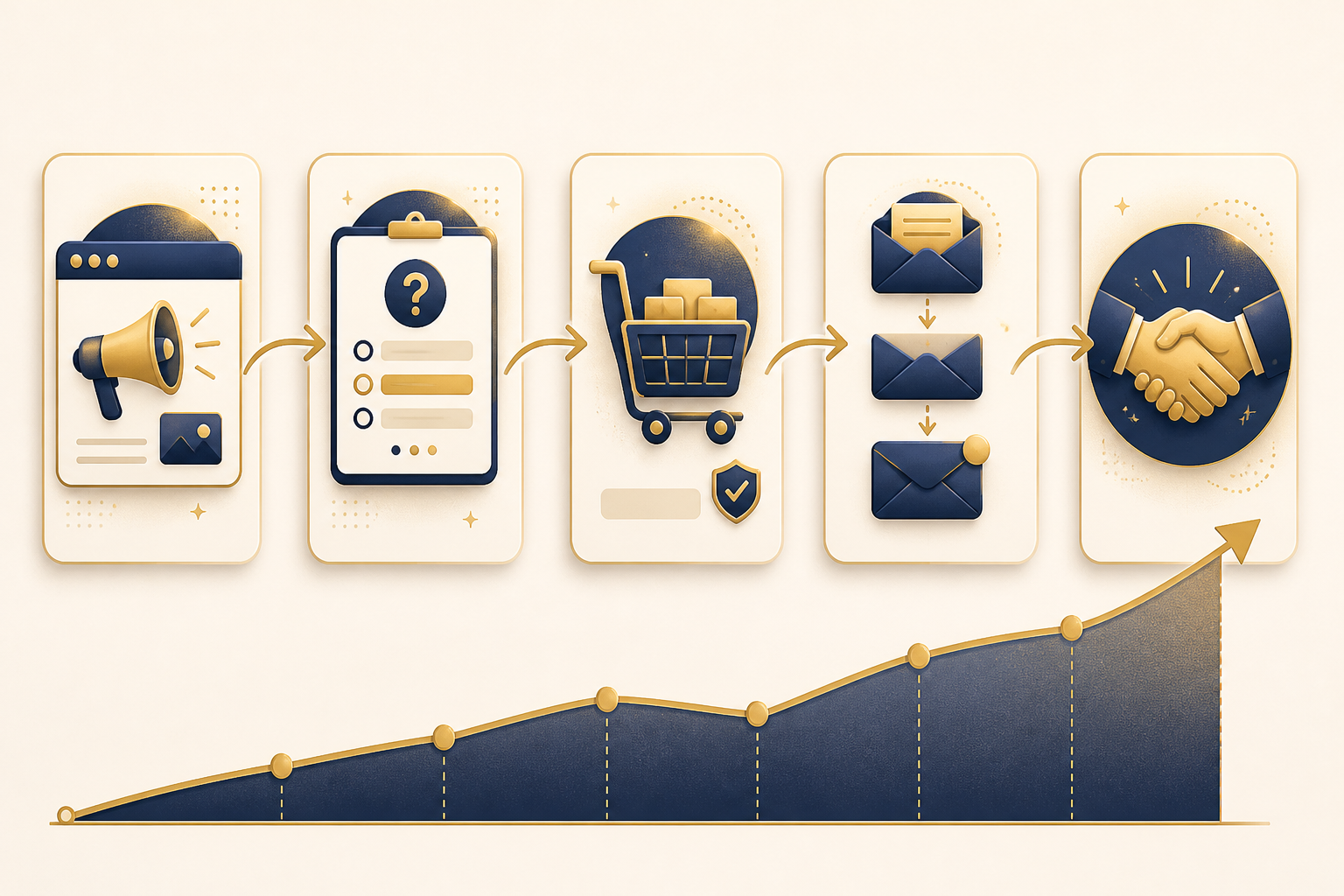
Step 5: The 5-email bridge sequence
This is where the money's made. My default:
- Email 1 (immediately): deliver the tripwire, one quick-win tip.
- Email 2 (day 1): story of the problem the tripwire starts to solve, soft mention of the bigger solution.
- Email 3 (day 3): proof from the vendor's own public case studies. Use only what the vendor publishes, and never invent results.
- Email 4 (day 5): objection handling: price, time, "will it work for me."
- Email 5 (day 7): clear deadline or bonus, if the vendor allows one. Your own bonus works fine.
Honestly, email 4 is the one that earns the most. People don't buy high-ticket because of hype. They buy once the specific fear has a specific answer.
Step 6: Retarget the non-openers
Upload buyers who didn't click any backend link into a Meta or Google custom audience, and run a modest $5-$10 a day on a testimonial-style or explainer creative. Keep frequency below 3 per week. Over-retargeting a $9 buyer is a good way to get a refund request.
A Realistic Scenario
Picture this (a composite, not a client): an affiliate promoting a $1,497 freelance-writing program. The tripwire is a $12 pitch-email template pack. Traffic comes from native ads at roughly $0.10-$0.20 CPC. A bridge page converts about 3.5% to the tripwire. After 600 clicks, that's about 21 buyers and $252 in front-end revenue against maybe $90 in ad spend.
Front-end alone is already positive. Then the sequence runs, and if one of those 21 buyers enrolls at a $400 commission, the funnel earns around $560 above costs. One sale. That's the thing about this model: the tripwire covers the traffic, and the backend sale is the profit, so you can sit through slow stretches without bleeding.
If cold traffic keeps ghosting your pages, this breakdown of why cold native clicks ghost your offer is worth reading before you blame the offer.
Tools and Platforms
You need a page builder, a checkout, and an email platform that tolerates affiliate content. For page-building, ClickFunnels or Systeme.io are the two I compare most often; Systeme.io is cheaper, clickfunnels has deeper funnel features. On the email side, deliverability policies matter more than features, so check which email platform won't get affiliate marketers banned before you load a list. Visit each tool's site to see current features and pricing.
Real-World Implementation Notes
A few things I've noticed that rarely show up in guides:
- Tag by tripwire behavior. Buyers who open the delivery email within an hour convert on the backend noticeably better in my experience. Segment them and send them the sequence sooner. This is the same principle behind email list segmentation for affiliate promos.
- Tracking breaks at the handoff. The click from your email to the vendor's page is where attribution dies. Use a unique tracking ID per email, and confirm the vendor's cookie actually sets.
- Read the vendor's funnel yourself. Buy the front end, take the call, watch the sales video. If the vendor's close process is weak, your lead quality won't save it.
- Refunds lag. High-ticket commissions often have 30-60 day holds. Budget your cash flow around that, not around the sale date.
Revenue Model Analysis
Ranges, not guarantees. A reasonable scenario set per 1,000 cold clicks:
| Scenario | Tripwire rate | Backend rate (of buyers) | Outcome |
|---|---|---|---|
| Weak | 1.5% | 0.5% | Front-end below ad cost; backend rarely closes |
| Middle | 3% | 1.5-2% | Front-end near break-even; occasional backend sale is profit |
| Strong | 5% | 3% | Front-end profitable; 1-2 backend sales per 1,000 clicks |
Your traffic cost, tripwire price, and commission will move all of this. Build your own spreadsheet and update it weekly.
Pitfalls That Kill the Sequence
- Mismatched tripwire. A generic "marketing ebook" funneling to a niche coaching program attracts the wrong buyers.
- Pitching the backend on the thank-you page. A $9 buyer isn't ready for $2,000 in 40 seconds.
- Overclaiming. Income promises invite chargebacks, platform bans, and FTC trouble. Quote only what the vendor publicly substantiates.
- Ignoring list health. Sending five emails to a cold, unengaged segment tanks your sender reputation. See what your deliverability stack should cost.

How It Fits With Other Methods
This sequence pairs well with quiz bridge pages, native ads, and any list-building traffic source. It's less suited to pure search-intent traffic, where a direct offer page often outperforms a tripwire detour. And if you're already running webinars, treat the tripwire as the registration filter rather than a separate step.
You'll Know It's Working When...
- Your tripwire revenue covers 70-100% of ad spend within the first week.
- Delivery email open rates stay above 50%, and the full sequence holds 35%+ average opens.
- At least 8-10% of buyers click through to the backend page by day 7.
- You see your first backend commission inside 30 days on roughly 500-1,500 buyers' worth of data, or you've got clear evidence on where the leak is.
If you hit the first two but not the last two, the problem is almost always the match between tripwire and backend. Fix that before touching traffic.
This article contains affiliate links. We may earn a commission at no extra cost to you. Full disclosure.
Editorial Team
Senior Digital Marketing Strategist
The Prophet Visionary editorial team covers affiliate marketing, paid traffic, funnels, and digital product strategy with hands-on practitioner experience.
Learn more about our editorial team →Monetize Smarter With Funnels + Email in One Place
Order bumps, upsells, automated email sequences, and your own affiliate program — Systeme.io gives you the full monetization stack without the bloated monthly spend.
See the Monetization StackThis page contains affiliate links — I may earn a commission at no extra cost to you.
Disclaimer: The information on this site is for educational purposes only and does not constitute financial, legal, or business advice. Results vary based on individual effort, market conditions, and other factors. Always do your own due diligence before making business or investment decisions.