Most affiliate marketers pick their email platform the wrong way. They Google a comparison list, see a familiar name at the top, and sign up. Then six months later they're wondering why their broadcast open rates are sitting at 8% and half their sequences are landing in promotions tabs—or worse, spam folders.
The platform matters. A lot. And not just for deliverability—though that's the biggest factor most people underweight. Pricing tiers, affiliate-friendliness policies, automation depth, and the hidden costs that don't show up on the pricing page all factor into what you'll actually spend and what you'll actually earn.
This breakdown is built for someone who's about to pull out a credit card. I'll tell you what each tier actually gets you, where the gotchas are, the cheapest legitimate path to start, and what the premium options justify in ROI terms.
What "High Deliverability" Actually Means for Affiliate Marketers
Before we rank anything, let's be clear about what we're measuring. Deliverability isn't just "does the email arrive." It's inbox placement—specifically, does it land in the primary inbox vs. promotions, social, or spam. For affiliate marketers promoting ClickBank offers, Digistore products, or anything with a commission link, this distinction is everything.
The problem is that most ESPs (email service providers) don't publish inbox placement rates. They report delivery rates—which just means the email wasn't bounced. A 99% delivery rate can coexist with 40% of your mail going to spam. You need to look at third-party tests, community reputation, and—critically—whether the platform actually allows affiliate links in the first place.
Some don't. Or they allow them conditionally, then suspend accounts without warning when you promote something they don't like. I've seen affiliates lose lists of 50,000+ subscribers because they promoted a weight loss offer on a platform that quietly prohibited "health claims." That's not a deliverability problem. That's an existential one.

So the criteria I'm using to rank these tools: affiliate-link tolerance, inbox placement reputation, automation capability, pricing transparency, and real-world usability for someone running paid traffic funnels.
The 7 Best Email Autoresponders for Affiliate Marketers
1. GetResponse — Best All-Around for Affiliate Funnels
Pricing: Free plan (500 contacts, limited features) → $19/mo (email marketing, 1,000 contacts) → $59/mo (Marketing Automation) → $119/mo (Ecommerce Marketing) → MAX plans from $1,099/mo
GetResponse has been around since 1998 and is one of the few mainstream ESPs that explicitly allows affiliate marketing—including promoting third-party offers—as long as you're not spamming. That policy clarity alone puts it ahead of half the field.
The automation builder is genuinely powerful at the $59/mo tier. You can build conditional sequences based on link clicks, page visits, and purchase behavior. For affiliate marketers running traffic from Taboola or Facebook into a lead magnet funnel, the ability to segment by engagement depth (did they click the offer link but not buy?) is where the real money is. If you want to understand how behavioral triggers can rescue cold leads, this pairs well with how behavioral segmentation rescued our abandoned funnel leads.
Hidden costs: The free plan is genuinely limited—no automation, no segmentation. You'll hit the $19 plan ceiling fast if you're running any volume. Contact-based pricing means a list of 10,000 costs $79/mo on the Marketing Automation tier. Webinar features (included in higher tiers) are nice but not what you're paying for.
Best for: Affiliates who want one platform for email + basic funnel pages + automation without stitching together three tools.
2. AWeber — Most Affiliate-Friendly Policies, Solid Deliverability
Pricing: Free (500 subscribers) → $15/mo (Lite, 500 subscribers) → $30/mo (Plus) → $899/mo (Unlimited)
AWeber's reputation in affiliate circles is earned. They've been explicitly affiliate-friendly for years—you can promote ClickBank products, digistore24 offers, even some nutraceutical offers that would get you banned on other platforms. Their deliverability is consistently strong in independent tests, partly because they enforce list hygiene aggressively (which helps everyone on shared IPs).
The platform itself is less flashy than newer options. The automation is functional but not sophisticated—you're working with tag-based sequences and basic conditionals, not complex behavioral trees. For a 5-7 email welcome sequence promoting a single offer? Perfect. For multi-product affiliate stacks with 30+ automation rules? You'll feel the limitations.
Hidden costs: The Lite plan at $15/mo is genuinely usable. But you're capped at one email list and limited landing pages. The Plus plan at $30/mo unlocks multiple lists, which matters the moment you're segmenting by traffic source or offer type. Billing is subscriber-based—10,000 subscribers runs $65/mo on Plus.
Best for: New affiliates who want reliable deliverability and clear ToS without complexity. The cheapest legitimate entry point for affiliate email marketing.
3. ActiveCampaign — Deepest Automation, Premium Price
Pricing: Starter from $15/mo (1,000 contacts) → Plus from $49/mo → Pro from $79/mo → Enterprise from $145/mo
ActiveCampaign is where serious affiliate operations end up when they need automation that actually thinks. The conditional logic is the best in class at this price point—you can build sequences that branch based on email opens, specific link clicks, site visits (with their tracking script), custom field values, and purchase events via integrations.
The deliverability is strong, though not always top-ranked in raw inbox placement tests. What matters more is that ActiveCampaign's infrastructure is designed for high-volume senders who know what they're doing. If you're mailing 50,000+ subscribers weekly and you've warmed your list properly, you'll see consistent results.
Here's the thing most people miss: ActiveCampaign's affiliate policy is more nuanced than AWeber's. They allow affiliate marketing but have been known to flag accounts promoting certain verticals—MMO (make money online), weight loss, and some financial offers. Read the ToS carefully before migrating a list built on those niches.
Hidden costs: The Starter plan is limited to basic email and simple automations—you need Plus or Pro to access the features that justify ActiveCampaign's reputation. That's $49-79/mo before you account for contact scaling. At 25,000 contacts, you're looking at $139-199/mo depending on tier. CRM features are included but add complexity you may not need.
Best for: Established affiliate marketers with 10,000+ subscribers who need sophisticated behavioral segmentation and are promoting in non-restricted niches.
4. Klaviyo — Best for Affiliates Running Ecommerce-Adjacent Offers
Pricing: Free (250 contacts, 500 emails/mo) → Scales by contact count: $45/mo (1,001-1,500), $100/mo (5,001-6,000), $175/mo (10,001-11,000)
Klaviyo is primarily known as the Shopify email platform, and that's both its strength and its limitation. If you're promoting physical product affiliate offers—supplements, beauty, home goods through Amazon Associates or impact.com—Klaviyo's data model is built for exactly that. The segmentation around purchase behavior, product categories, and browse abandonment is unmatched.
For pure digital affiliate marketing (info products, software, online courses), Klaviyo is overkill and occasionally awkward. The platform assumes you have product catalogs and transaction data to work with. Building a simple 5-email sequence for a ClickBank offer feels like using a sledgehammer on a finishing nail.
Hidden costs: The free plan is genuinely useful for testing. Scaling gets expensive fast—$175/mo at 10,000 contacts is above average. No phone support on lower tiers. SMS is a separate cost layer.
Best for: Affiliates in physical product niches who want deep segmentation tied to purchase behavior.
5. ConvertKit (now Kit) — Built for Creators, Works for Content-First Affiliates
Pricing: Free (10,000 subscribers, limited) → Creator: $29/mo (1,000 subscribers) → Creator Pro: $59/mo (1,000 subscribers)
ConvertKit rebranded to Kit in 2024 and has been doubling down on the creator economy positioning. For affiliates who build audiences through content—YouTube, newsletters, podcasts—and monetize with affiliate links, it's genuinely well-suited. The tagging system is clean, the visual automation builder is intuitive, and deliverability is solid.
The free plan is surprisingly generous at 10,000 subscribers, but you're missing automations and sequences—which defeats the purpose for most affiliate setups. The Creator plan at $29/mo is where it becomes functional. Creator Pro adds newsletter referral programs and advanced reporting.
Hidden costs: ConvertKit's affiliate policy has gotten stricter. They prohibit "affiliate marketing" in their ToS in the traditional sense—meaning building lists primarily to promote third-party offers. Content creators who happen to include affiliate links are fine. Someone running paid traffic to a squeeze page to build an affiliate list? That's a gray area that's gotten accounts flagged. Know what you're getting into.
Best for: Content-first affiliates (bloggers, newsletter writers, YouTubers) who use affiliate links as one revenue stream among several.
6. Systeme.io — The Cheapest Full-Stack Entry Point
Pricing: Free (2,000 contacts, unlimited emails) → Startup: $27/mo → Webinar: $47/mo → Unlimited: $97/mo
Systeme.io deserves more credit than it gets in serious affiliate circles. The free plan includes 2,000 contacts, unlimited email sends, funnels, and basic automation. That's genuinely remarkable. For someone starting out who doesn't want to pay for Leadpages + GetResponse + Zapier separately, Systeme.io consolidates the whole stack at a fraction of the cost.
The deliverability is respectable—not class-leading, but functional. The automation is simpler than ActiveCampaign or even GetResponse, but for a straightforward 3-email welcome sequence followed by an evergreen broadcast schedule, it does the job. The platform is also explicitly built for digital product sellers and affiliates, so there's no ambiguity in the ToS.
The counterintuitive part: some experienced affiliates actually use Systeme.io as a secondary list for lower-value segments while keeping their primary list on a premium platform. The economics make sense when you're managing multiple funnels across different niches.
Hidden costs: Deliverability on shared infrastructure can be inconsistent compared to premium options. If you're mailing a highly engaged list to premium offers, you may see inbox placement differences. The tool limitations become apparent when you need complex conditional branching.
Best for: Affiliates just starting out who want zero monthly cost to test their first funnel, or experienced affiliates managing secondary lists on a budget.
7. Mailchimp — Fine for Beginners, Problematic for Affiliates at Scale
Pricing: Free (500 contacts, 1,000 emails/mo) → Essentials: $13/mo → Standard: $20/mo → Premium: $350/mo
I'll be direct: Mailchimp is not a great choice for serious affiliate marketers, and yet it's probably the most commonly used one by beginners. The pricing looks attractive until you realize the free plan is capped at 500 contacts and 1,000 sends per month—you'll hit that ceiling almost immediately if you're running any paid traffic.
The bigger issue is the ToS. Mailchimp has suspended accounts for promoting affiliate offers, particularly in MMO, health, and financial niches. They're not affiliate-hostile per se, but they're inconsistent. Their compliance team flags accounts based on link patterns and complaint rates, and the appeals process is notoriously slow.
Deliverability is actually quite good—Mailchimp's infrastructure is well-maintained. The problem isn't the technology; it's the risk profile for affiliate-specific use cases.
Best for: E-commerce brands and local businesses. Not my first recommendation for affiliate-first marketers.
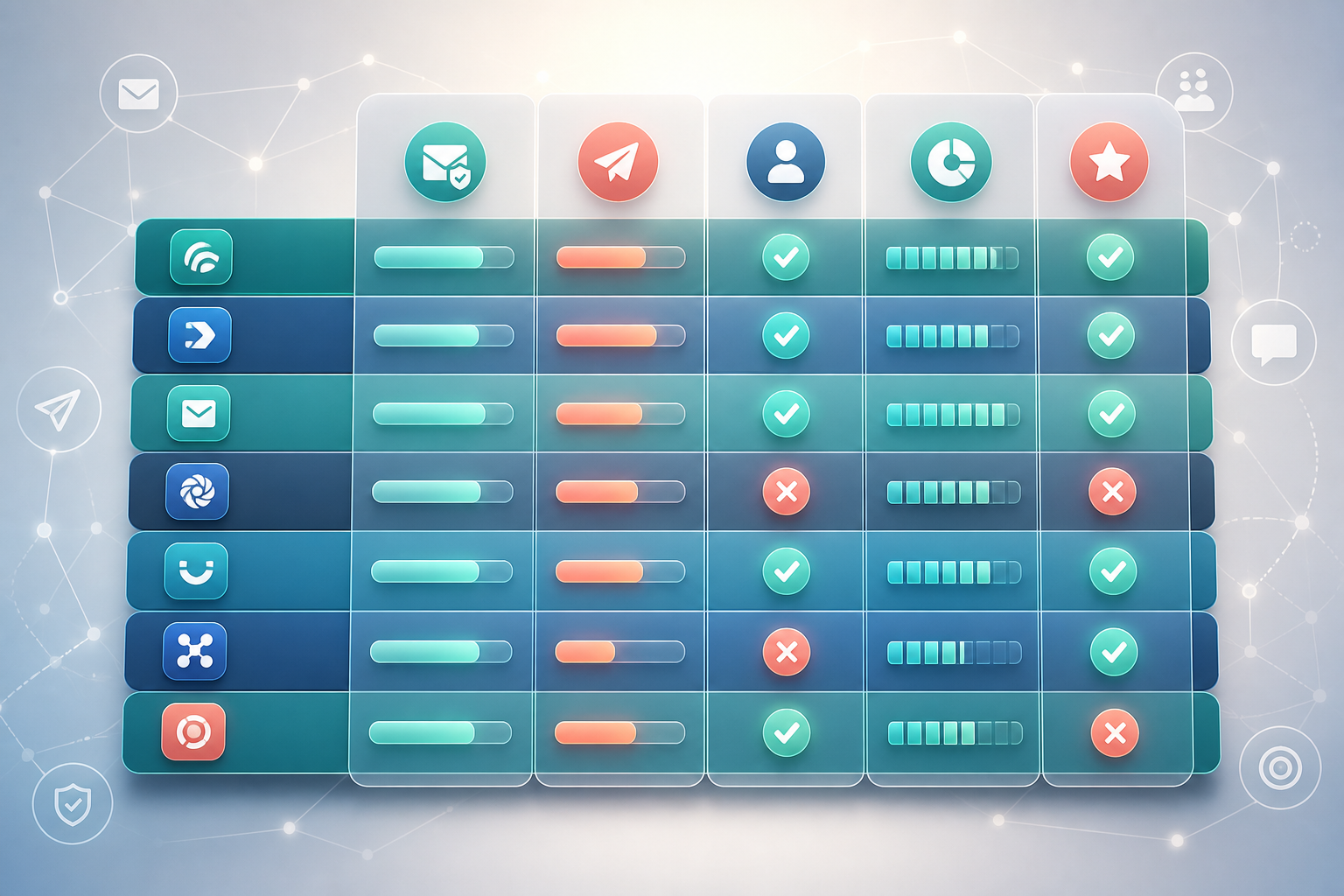
Price Ranges & Tiers: What You're Actually Comparing
| Platform | Entry Price | 10K Contacts | Affiliate-Friendly | Automation Depth |
|---|---|---|---|---|
| GetResponse | Free / $19/mo | ~$79/mo | Yes (explicit) | High |
| AWeber | Free / $15/mo | ~$65/mo | Yes (explicit) | Medium |
| ActiveCampaign | $15/mo | ~$139/mo | Conditional | Very High |
| Klaviyo | Free | ~$175/mo | Yes (ecom-focused) | High (ecom) |
| ConvertKit/Kit | Free / $29/mo | ~$119/mo | Content-only | Medium |
| Systeme.io | Free / $27/mo | $27-47/mo | Yes (explicit) | Basic-Medium |
| Mailchimp | Free / $13/mo | ~$100/mo | Inconsistent | Medium |
Hidden Costs Nobody Talks About
The monthly subscription is the easy number. Here's what actually inflates your real spend:
Contact-based pricing vs. email-based pricing. Most platforms charge by subscriber count, not send volume. If you're mailing 10,000 subscribers twice a week, you're sending 80,000+ emails a month—but you're paying for 10,000 contacts. That's actually favorable. But if you're aggressively building a list with paid traffic and your contacts balloon to 50,000 before you've monetized them, your bill does too. GetResponse at 50,000 contacts on the Marketing Automation tier runs around $250/mo.
List cleaning costs. Unengaged subscribers hurt deliverability and inflate your bill. Tools like NeverBounce ($0.003-0.008 per email) or ZeroBounce ($0.004-0.01 per email) are recurring costs you need to budget for if you're running paid traffic—because paid traffic lists tend to have higher invalid-email rates than organic ones.
Overage fees. Some platforms charge per-email overages when you exceed plan limits. Read the fine print on send caps.
Migration costs. Switching platforms isn't free—it costs time, potential deliverability dips during IP warmup, and sometimes you lose behavioral data that doesn't transfer cleanly. Starting on the right platform matters more than it seems upfront.
SMTP add-ons. Some affiliates run cold outreach or transactional emails through separate SMTP services (SendGrid, Postmark, Mailgun) alongside their marketing ESP. Budget $10-30/mo for this layer if your stack requires it.
The Cheapest Legitimate Path to Start
If you're starting from zero and want to spend as little as possible while building something real, here's the honest answer: Systeme.io free plan + AWeber free plan as a backup.
Systeme.io's free tier gives you 2,000 contacts, unlimited sends, and basic funnel pages. That's enough to run a lead magnet funnel, build a welcome sequence, and start monetizing with affiliate offers before you spend a dollar on email infrastructure. The deliverability won't be class-leading, but it's functional for a list under 1,000 that you're actively warming.
When you're ready to scale past 2,000 contacts and need better automation, AWeber's $15/mo Lite plan is the most affiliate-friendly paid entry point. You get solid deliverability, clear ToS, and enough functionality to run a proper email marketing operation through your first 5,000 subscribers.
Total budget to start: $0-15/mo. That's the real floor.
For context on how these tools fit into a broader funnel setup, our comparison of GoHighLevel vs ClickFunnels for affiliate funnel building covers how your email platform choice interacts with your funnel builder—worth reading before you commit to a full stack.
What Premium Actually Gets You
The jump from $15-30/mo to $79-139/mo isn't just more contacts. It's qualitatively different capability. Here's what premium actually unlocks:
Behavioral automation. The ability to trigger different email sequences based on what a subscriber clicked—not just whether they opened—is worth real money. If someone clicks your affiliate link for Product A but doesn't buy, you can automatically start a 3-email objection-handling sequence. That's not available on basic tiers. And if you're building the kind of sophisticated sequences described in high-ticket offer stacking email sequences, you need this capability.
Dedicated IP options. At higher send volumes (typically 100,000+ emails/month), shared IP reputation becomes a real risk. Premium tiers on platforms like GetResponse and ActiveCampaign offer dedicated IP options, giving you full control over your sender reputation. This alone can improve inbox placement by 10-15 percentage points on competitive niches.
Advanced segmentation. Splitting your list by engagement tier (active openers, clickers, lapsed), by traffic source, by offer interest—this is what separates a 20% open rate from a 35% open rate. Basic plans give you one or two lists. Premium gives you the infrastructure to treat different subscriber segments completely differently.
Priority support. When your account gets flagged or an automation breaks the day before a launch, the difference between chat support and email-only support is measured in hours and dollars.
The honest ROI math: if you're mailing 10,000 subscribers and the difference between 20% and 30% open rates translates to 3-4 additional conversions per broadcast at $40 average commission, that's $120-160 per email. The $60-100/mo premium tier pays for itself in one broadcast.
Practical Implementation Notes
A few things I've observed that don't show up in feature comparison charts:
Warm your list before you hammer it. Regardless of platform, a new list needs warmup—start with your most engaged subscribers, send valuable content before offers, and ramp send volume gradually. Even the best ESP can't save a cold list from spam complaints.
Use a custom sending domain. Every platform on this list supports custom sending domains (your own domain instead of @getresponse.com or @aweber.com). Set this up on day one. It affects deliverability and looks more professional. It requires DKIM and SPF records in your DNS—takes 20 minutes and makes a real difference.
Segment by traffic source from the start. If you're running traffic from multiple sources—say, native ads on Taboola and organic Pinterest—tag subscribers by source at opt-in. You'll discover that different traffic sources produce subscribers with completely different engagement patterns and conversion rates. This data is worth its weight in gold for optimizing spend.
The welcome sequence is your highest-leverage asset. Most affiliates underinvest here. A 5-7 email welcome sequence that runs in the first 10 days after opt-in will outperform any broadcast you send later. This is where deliverability reputation is built and where subscriber expectations are set. If you haven't audited yours recently, why your welcome sequence isn't selling affiliate offers is worth your time.
Don't migrate platforms mid-campaign. I've seen affiliates switch ESPs mid-launch because they wanted a feature the new platform had. The deliverability dip during migration is real—new IP warmup takes 2-4 weeks minimum. Time your migrations during low-volume periods.
Monitor inbox placement, not just open rates. Open rates are tracked by pixel loads, which Apple's Mail Privacy Protection has made increasingly unreliable. Use tools like GlockApps ($79/mo) or Mail-Tester (free, limited) to actually see where your emails are landing across major providers. Do this quarterly at minimum.
What to Budget: A Clear Summary
Starting out (0-2,000 subscribers): $0-15/mo. Systeme.io free or AWeber Lite. Don't overthink it—just start.
Growing (2,000-10,000 subscribers): $30-79/mo. AWeber Plus or GetResponse Marketing Automation. This is where you need real segmentation and conditional automation.
Scaling (10,000-50,000 subscribers): $79-250/mo. GetResponse or ActiveCampaign depending on your niche and automation needs. Add $20-40/mo for list hygiene tools.
High-volume (50,000+ subscribers): $250-500+/mo. ActiveCampaign Pro or GetResponse MAX tiers, dedicated IPs, professional deliverability monitoring. At this level, a 5% improvement in inbox placement is worth far more than the platform cost.
The single most expensive mistake affiliates make isn't picking the wrong platform—it's starting on a cheap platform with bad policies, getting their account suspended, and losing the list they spent months and real money building. Platform risk is a real cost. Factor it in.

Frequently Asked Questions
Can I use any of these platforms to promote ClickBank offers?
GetResponse, AWeber, and Systeme.io are the safest bets for ClickBank promotion. They explicitly allow affiliate marketing in their ToS. ActiveCampaign is workable but read their acceptable use policy for your specific niche. Mailchimp and ConvertKit carry more risk depending on the offer category.
What's the minimum list size where deliverability becomes critical?
Honestly, from day one—but the stakes become financially significant around 5,000 subscribers. At that size, the difference between 25% and 35% inbox placement shows up clearly in your revenue. Before that, focus on list quality over platform optimization.
Do I need a dedicated IP, or is shared infrastructure fine?
Shared infrastructure is fine for most affiliate marketers under 100,000 monthly sends. Above that, dedicated IPs give you control over your sender reputation that shared IPs can't. If you're on a shared IP and another user on that IP triggers spam complaints, your deliverability suffers too. It's a real risk at scale.
Is the free plan on any of these actually usable, or is it just a trial?
Systeme.io's free plan is genuinely usable—2,000 contacts and unlimited sends is real infrastructure. AWeber's free plan (500 contacts) and GetResponse's free plan (500 contacts) are more limited but still functional for initial testing. Mailchimp's free plan is the most restrictive in practice given the 1,000-send monthly cap.
Should I use a separate SMTP service or stick with my ESP's sending infrastructure?
For most affiliates, your ESP's infrastructure is sufficient and simpler. Separate SMTP (SendGrid, Mailgun) makes sense if you're running transactional emails alongside marketing emails, or if you need volume that exceeds your ESP's plan limits. It adds complexity—only add it when you have a specific reason.
How do I know if my deliverability is actually bad?
Run your campaigns through GlockApps or Mail-Tester before sending to your full list. Check your spam complaint rate in your ESP dashboard—anything above 0.1% is a warning sign. Monitor your bounce rates (hard bounces above 2% suggest list quality issues). And watch your open rate trends—a gradual decline over 60-90 days without a content reason usually means inbox placement is degrading.
What happens to my list if my ESP account gets suspended?
This is the nightmare scenario and it happens more than people admit. Most ESPs will give you a data export window—usually 30 days—even after suspension. But you may lose behavioral data, tags, and automation history. The lesson: export your raw contact list regularly (monthly at minimum) and store it somewhere you control. Your list is your asset. Don't let an ESP hold it hostage.
Is it worth paying for a premium platform when I only have 1,000 subscribers?
Probably not on pure economics—but the argument for starting on a platform you'll grow into is that migration is painful. If you know you'll be at 20,000 subscribers in 12 months, starting on ActiveCampaign now means you don't disrupt your automation infrastructure mid-growth. Starting on Systeme.io free and migrating at 5,000 is also reasonable. Just don't start on Mailchimp and have to migrate away mid-list-build.