GoHighLevel vs ClickFunnels for Paid Traffic Affiliates: Honest Verdict
Start With What Breaks
Most comparisons of GoHighLevel and ClickFunnels open with feature lists and pricing tables. That's not where the real story lives. The real story is what happens when you're burning $300/day on Taboola traffic and your funnel behaves in ways the sales page never mentioned.
I've watched affiliate marketers lose thousands in ad spend—not because their offer was wrong or their copy was weak—but because the platform they chose couldn't handle the specific demands of paid traffic campaigns. Page speed issues. Webhook delays. Email deliverability problems that surface only at scale. These aren't edge cases. They're predictable failure points that show up in the first 30 days of serious spend.
So before I tell you which platform wins, I'm going to tell you where each one falls flat. Because if those failure points are dealbreakers for your setup, nothing else in this article matters.
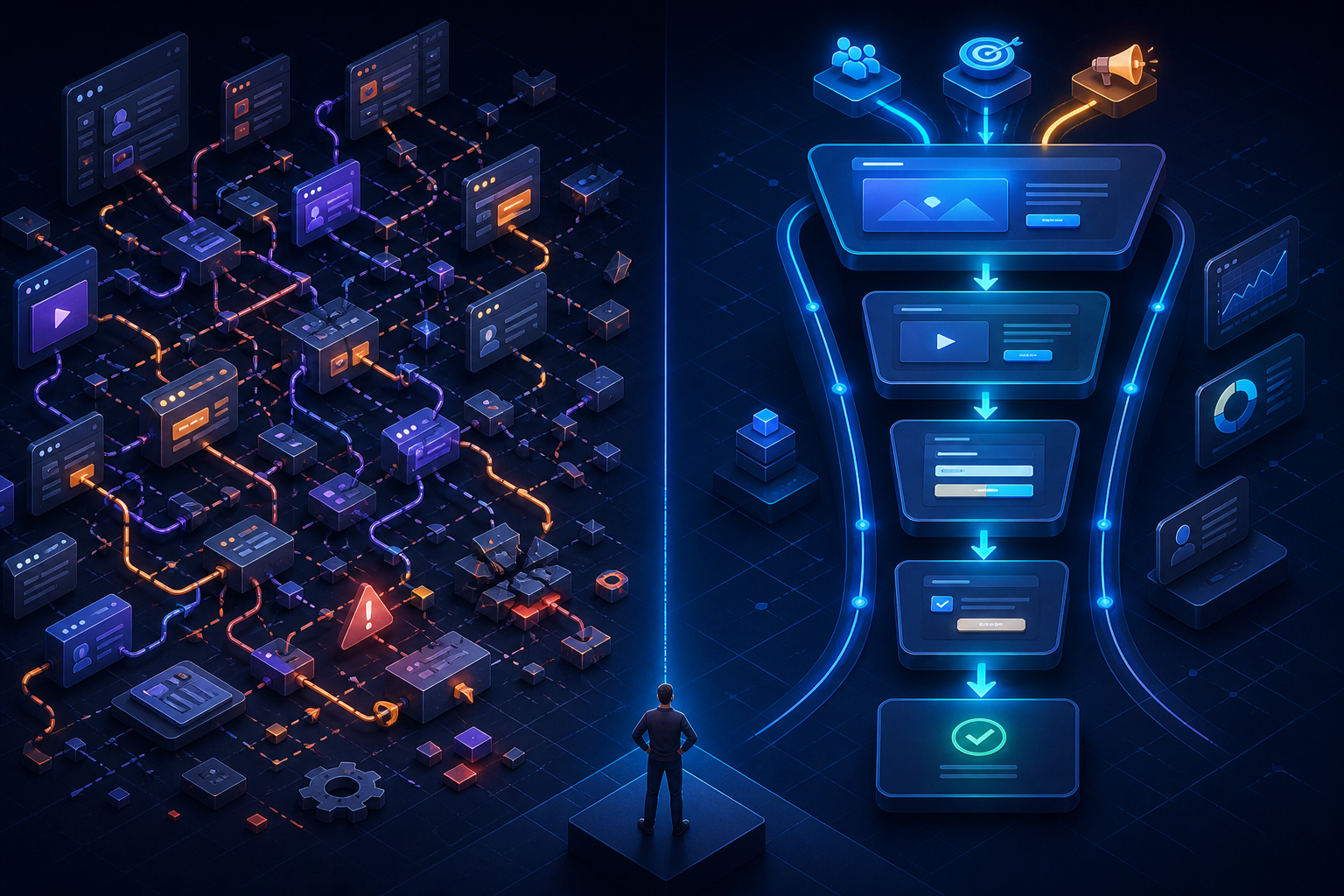
Where ClickFunnels Actually Fails Paid Traffic Affiliates
clickfunnels 2.0 fixed a lot of what made the original version painful. But it introduced new problems—and for affiliates specifically, several of them are serious.
Page speed is still inconsistent. Google's Core Web Vitals data from independent testing in late 2025 consistently shows ClickFunnels 2.0 pages scoring in the 55-70 range on mobile PageSpeed Insights. For native traffic on Taboola or Outbrain, where landing page quality scores affect your CPCs directly, that matters. I've seen campaigns where switching from a ClickFunnels page to a faster-loading alternative dropped CPCs from $0.42 to $0.27 on the same audience—same creative, same offer.
The email side is where ClickFunnels gets genuinely dangerous for affiliates. Their built-in email tool has documented deliverability issues, particularly with affiliate offers that include any health, finance, or biz-op adjacent content. If you're promoting ClickBank offers—think Exipure-style health products or anything in the wealth space—their shared IP infrastructure is not your friend. You'll almost certainly need to route email through an external autoresponder anyway, which raises the question of why you're paying for ClickFunnels' email feature at all.
Affiliate link tracking inside ClickFunnels is also clunky. There's no native postback URL support for network-level tracking, which means integrating with platforms like ClickBank, MaxBounty, or Digistore24 requires workarounds. Zapier bridges. Custom webhook setups. It's doable, but it adds friction—and friction at the tracking layer means blind spots in your data.
Where GoHighLevel Falls Short
GoHighLevel gets positioned as the all-in-one solution that replaces everything. That framing attracts affiliate marketers, and I understand why. But the reality is more complicated.
GHL was built for agencies managing client accounts. The architecture reflects that. Sub-accounts, snapshot templates, white-labeling—these are agency features. When you're a solo affiliate running paid traffic to a single offer stack, a lot of GHL's interface feels like navigating a commercial kitchen when you just want to make breakfast. The learning curve is real, and it's steeper than most people admit.
The funnel builder itself is functional but not exceptional. Split-testing capabilities inside GHL are limited compared to what you get with dedicated tools. You can A/B test pages, but multivariate testing isn't natively supported, and the reporting inside funnel views is less granular than what ClickFunnels 2.0 offers out of the box. For serious paid traffic affiliates who live in their conversion data, that's a gap.
And the email deliverability situation in GHL is mixed. Their LC Email system (built on Mailgun infrastructure) is better than ClickFunnels' native email for most use cases—but GHL still gets flagged by major ISPs when affiliates send aggressive promotional sequences to cold or semi-warm lists. The platform has improved, but it's not ConvertKit or ActiveCampaign. If you're running high-volume email alongside your paid traffic, you'll want to evaluate this carefully. See how GHL's email stacks up against dedicated autoresponders built for affiliate marketers.
What the Data Actually Shows
Here's where I want to be precise about what's verifiable versus anecdotal.
Third-party funnel performance data from tools like BuiltWith and SimilarWeb shows ClickFunnels still dominates raw market share among info-product affiliates—particularly those selling $37-$97 front-end offers with upsell sequences. That's not surprising given how long ClickFunnels has been the default choice in that space.
GoHighLevel's user base has grown significantly among affiliates who are also running some kind of service business or who came from an agency background. Their self-reported numbers (taken with appropriate skepticism) claim over 60,000 agency and business accounts as of 2025. The affiliate-specific use case is a subset of that, not the primary driver.
Independent load testing by SaaS review platforms consistently shows GHL funnel pages loading in 1.8-2.4 seconds on average under standard conditions, while ClickFunnels 2.0 pages range from 2.1-3.8 seconds depending on template complexity. Neither is blazing fast. If page speed is a critical variable for your traffic source—and it is for Facebook and Google paid traffic—you may be better served by a dedicated landing page tool like Unbounce or Landingi sitting in front of either platform's backend infrastructure.
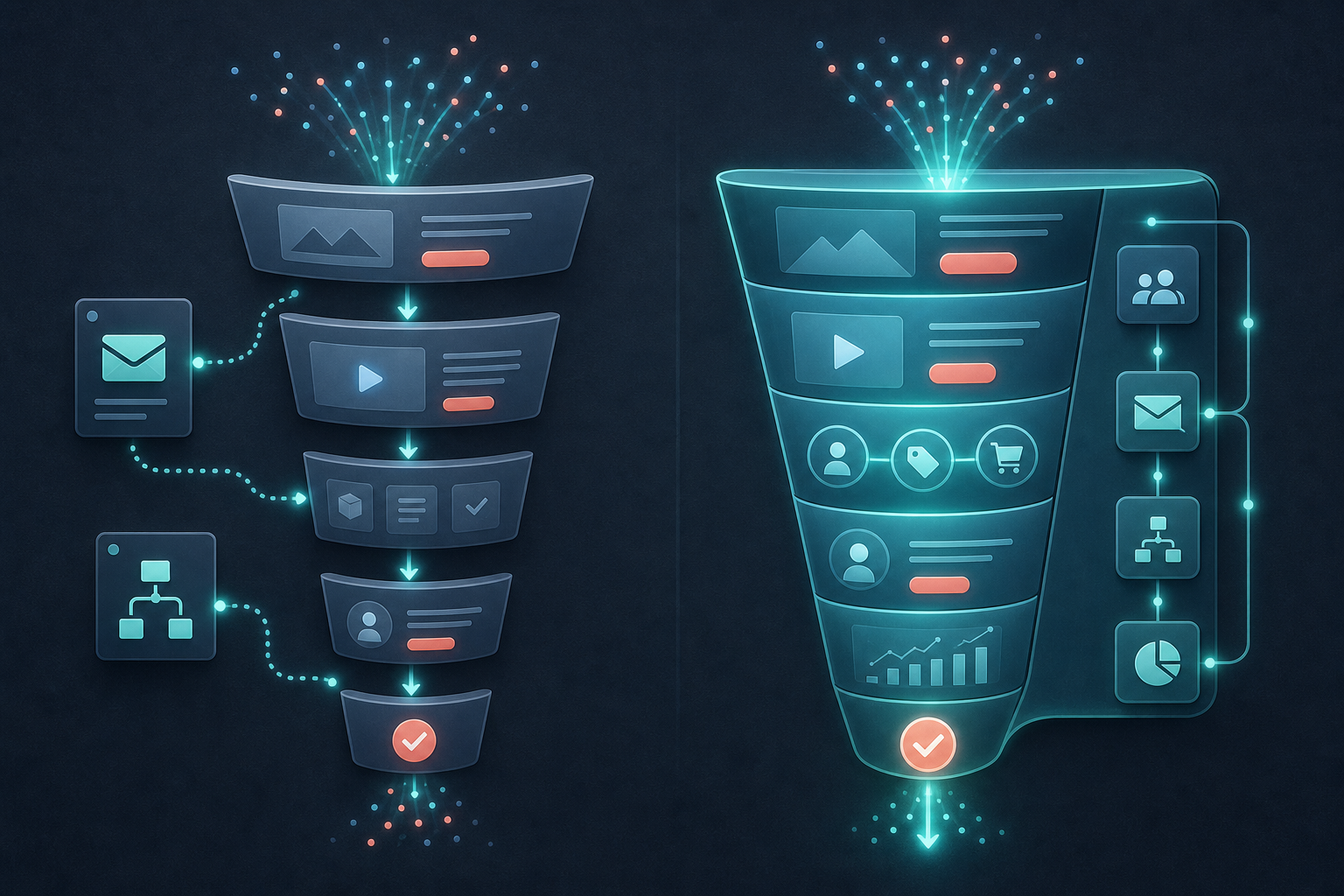
Honest Pros and Cons — No Sugarcoating
ClickFunnels 2.0: The Real Pros
- Funnel templates designed for affiliates. The template library has genuine affiliate-specific designs—bridge pages, VSL pages, product review funnels. Less customization needed out of the box.
- Cleaner split-testing UX. Running an A/B test on a headline or CTA is faster and more intuitive than in GHL. When you're iterating quickly on paid traffic, that matters.
- Stronger community and affiliate-specific education. The ClickFunnels ecosystem has years of documented affiliate use cases. Finding answers to specific paid traffic problems is easier.
- One-click upsell infrastructure. For affiliates selling their own products or running hybrid models, the OTO (one-time offer) mechanics are more polished.
ClickFunnels 2.0: The Real Cons
- Price-to-value ratio is questionable. At $147/month for the base plan (as of early 2026), you're paying premium prices for a tool with real limitations in affiliate-specific use cases.
- Email deliverability for affiliate offers is a liability. Don't rely on their native email for anything volume-based or offer-adjacent to sensitive categories.
- Tracking integration is friction-heavy. No native postback support means extra setup time and more failure points in your attribution chain.
- Page speed lags behind alternatives. Not catastrophic, but measurable—and measurable differences compound at scale.
GoHighLevel: The Real Pros
- CRM and automation depth. If you're building any kind of follow-up infrastructure—SMS sequences, multi-step email automations, pipeline management for high-ticket offers—GHL's backend is genuinely powerful. For affiliates running high-ticket offer stacks through email sequences, this matters.
- All-in-one cost efficiency at scale. The $297/month unlimited plan replaces tools that would cost $500-800/month separately (email platform, CRM, calendar, SMS, funnel builder). If you're actually using those features, the math works.
- White-label potential for hybrid affiliate/agency operators. If you're running affiliate traffic AND doing any client work, GHL's agency model creates an additional revenue layer.
- Better native SMS integration. For affiliates running high-ticket offers where phone follow-up or SMS nurture sequences matter, GHL's Twilio-backed SMS is genuinely useful.
GoHighLevel: The Real Cons
- Steep learning curve for solo affiliates. The interface wasn't designed for your use case. Budget time—and frustration—for the onboarding phase.
- Funnel builder is functional, not exceptional. You won't get the same conversion-focused template depth or split-testing sophistication as ClickFunnels.
- Email deliverability still needs monitoring. Better than ClickFunnels' native email, but not a replacement for a dedicated affiliate-friendly autoresponder if volume is high.
- Support quality is inconsistent. GHL's support has improved, but complex technical issues—especially around tracking integrations—can take days to resolve.
Pricing: What You're Actually Paying
| Platform | Entry Plan | Mid-Tier Plan | What's Included |
|---|---|---|---|
| ClickFunnels 2.0 | $147/month | $197/month | Funnels, pages, basic email, courses |
| GoHighLevel | $97/month | $297/month (unlimited) | Funnels, CRM, email, SMS, calendar, white-label |
The counterintuitive part here: ClickFunnels' lower entry price doesn't stay lower once you add the external tools you'll need to make it work properly for paid traffic affiliate campaigns. Add a decent autoresponder (ActiveCampaign at ~$70/month for 10k contacts), a tracking tool like Voluum or RedTrack ($149-$199/month), and you're at $370+ before you've touched ad spend. GHL's $297 unlimited plan consolidates more of that stack, even if it doesn't replace everything.
Alternatives Worth Considering
Honestly, neither platform is the obvious winner for every affiliate running paid traffic. Here's what I'd actually consider depending on your situation:
Systeme.io — If you're budget-constrained or just starting out, Systeme.io's free plan and $27/month tier cover funnels, email, and basic automation. It's not as powerful as either GHL or CF2, but the price-to-functionality ratio for simple affiliate funnels is hard to argue with. Page speed is also generally better than both major platforms.
Unbounce + external CRM — For serious paid traffic affiliates where conversion rate and page speed are the primary variables, Unbounce's Smart Builder with a connected ActiveCampaign or ConvertKit account outperforms both GHL and ClickFunnels on the metrics that matter most. You're paying more ($99-$249/month for Unbounce plus your email platform), but the landing page performance is noticeably better.
ClickFunnels Classic (v1) — Still running on some affiliate setups. Cheaper, simpler, and for basic bridge page → email opt-in → affiliate redirect funnels, it still works. Not recommended for new builds, but if you're already on it and it's converting, the case for switching isn't obvious.
Practical Implementation Notes
Here's what I've observed across different paid traffic setups when either platform gets deployed in the real world.
For affiliates running Facebook or Instagram traffic to a bridge page → opt-in → affiliate offer redirect funnel, ClickFunnels 2.0 is the faster setup. The templates are closer to what you need, the opt-in mechanics are clean, and if you're connecting to ConvertKit or GetResponse externally via Zapier, it works without much friction. The biggest issue is making sure your Facebook Pixel fires correctly on thank-you pages—CF2 has had intermittent issues with this, and it's worth testing explicitly before scaling spend.
For affiliates running native traffic (Taboola, Outbrain, MGID) where the funnel is longer—advertorial → bridge page → opt-in → email sequence → affiliate offer—GoHighLevel's automation depth starts to justify the complexity. The ability to trigger different email sequences based on which advertorial a lead came from, tag contacts by traffic source, and run conditional automations is genuinely powerful. The length and structure of your follow-up sequence matters as much as the platform you build it on—but GHL makes building sophisticated sequences less painful once you're past the learning curve.
One workflow I've seen work well: Use GHL as the backend CRM and automation engine, but build landing pages in a faster tool (Unbounce, Landingi, or even a well-optimized WordPress page with Elementor) and pass lead data to GHL via webhook. You get GHL's automation power without its page speed limitations. It's more setup work upfront, but it's a cleaner architecture at scale.
For affiliates promoting high-ticket offers where the funnel includes application pages, phone call bookings, or multi-touch nurture sequences, GHL is the clearer choice. The calendar integration, pipeline management, and SMS automation are features ClickFunnels simply doesn't match. And for those building out post-purchase email sequences to convert affiliate upsells, GHL's tagging and segmentation make it easier to trigger the right message to the right buyer.

The Measured Verdict
There's no universal winner here. That's not a cop-out—it's the honest answer, and anyone who tells you otherwise is selling something.
If you're running paid traffic to straightforward affiliate funnels—bridge pages, opt-in pages, VSL pages, product review funnels—and your primary goal is fast setup, clean A/B testing, and a tool that the affiliate community knows well, ClickFunnels 2.0 is the more pragmatic choice. Just don't rely on its native email, and budget for proper tracking infrastructure on top of the subscription cost.
If you're building a more sophisticated operation—multiple traffic sources, high-ticket offers requiring multi-touch nurture, SMS follow-up, or any hybrid model where you're also doing client work—GoHighLevel's depth justifies its complexity. The learning curve is real, but the ceiling is higher. And the all-in-one cost efficiency at the $297/month tier is genuinely compelling once you're using the full stack.
The truth is, the platform is rarely the limiting factor. Most affiliates running paid traffic would see bigger gains from better offer selection, tighter targeting, and a more disciplined email follow-up strategy than from switching funnel builders. But when the platform is actively working against you—slow pages, broken tracking, deliverability failures—those are real problems worth solving. Know your failure points before you build. That's the actual starting point.
Visit GoHighLevel or ClickFunnels to review current features and pricing before committing to either platform.
This article contains affiliate links. We may earn a commission at no extra cost to you. Full disclosure.
Editorial Team
Senior Digital Marketing Strategist
The Prophet Visionary editorial team covers affiliate marketing, paid traffic, funnels, and digital product strategy with hands-on practitioner experience.
Learn more about our editorial team →Tired of Paying for 5 Tools That Don't Talk to Each Other?
Systeme.io replaces your funnel builder, email tool, course platform, and affiliate manager — one login, one bill, zero integration headaches. Free plan available.
See the All-in-One PlatformThis page contains affiliate links — I may earn a commission at no extra cost to you.
Disclaimer: The information on this site is for educational purposes only and does not constitute financial, legal, or business advice. Results vary based on individual effort, market conditions, and other factors. Always do your own due diligence before making business or investment decisions.