Most comparisons of these two platforms read like they were written by someone who opened a free trial, clicked around for 20 minutes, and called it research. I'm going to do something different: tell you what breaks, what costs more than the pricing page admits, and where each platform actually earns its keep for affiliate marketers specifically.
Because here's the thing—both GoHighLevel and ClickFunnels have genuine use cases. But they're not interchangeable. Using the wrong one for affiliate funnels is like showing up to a track meet in hiking boots. You can finish the race. It's just going to be ugly.
What Fails First (And Nobody Talks About)
Start with ClickFunnels. The platform has been around since 2014, and its reputation in affiliate circles is... complicated. The funnel builder itself is solid for simple opt-in → thank you → OTO sequences. But the email deliverability inside ClickFunnels' native follow-up system has been a recurring headache. I've seen open rates on the same list drop 8-12 percentage points when migrating from ConvertKit to CF's built-in Actionetics. That's not a minor hiccup—that's the difference between a profitable sequence and a dead one.
The other thing ClickFunnels gets wrong for affiliates specifically: the affiliate link policies. CF's pages don't play nicely with certain traffic sources. Run Taboola or push traffic to a CF-hosted page promoting a ClickBank offer, and you'll occasionally hit compliance flags from both sides—ClickBank's compliance team and Taboola's review process—because of how CF structures its redirect URLs. It's a solvable problem, but it costs you time and sometimes campaigns.
GoHighLevel's failure mode is different and arguably worse for solo affiliates: it's overbuilt. The platform was designed for agencies managing local business clients. So when you log in expecting a funnel builder, you get a CRM, a reputation management dashboard, a white-label SMS system, pipeline views, and approximately 40 other things you don't need. The cognitive load is real. I've watched experienced marketers spend three hours trying to find where to set up a simple webhook integration that would've taken 15 minutes in any other tool.

The Affiliate Funnel Use Case, Defined
Before going further, let's be precise about what an affiliate marketing funnel actually requires in 2026. You need:
- A landing page or bridge page that pre-sells or qualifies traffic
- An opt-in mechanism that feeds into an autoresponder
- A redirect or thank-you page that sends traffic to the offer (ClickBank, Digistore24, Impact, etc.)
- An automated email sequence—typically a 5-7 email welcome/pitch series—that drives conversions over 3-10 days
- Optional: upsell or cross-sell pages, webinar registration flows, or quiz funnels
That's it. Everything else is noise unless you're operating at scale with a team.
The question isn't which platform has more features. It's which one executes these five things reliably without creating technical debt that eats your margin.
ClickFunnels: Honest Pros and Cons
What Actually Works
- Speed to launch. For a simple bridge page + opt-in + OTO sequence, clickfunnels 2.0 is genuinely fast. Someone with basic funnel knowledge can have a working flow live in under two hours using their template library.
- Built for conversion psychology. The page templates are structured around proven direct-response principles—above-the-fold opt-ins, social proof placement, urgency timers. You're not starting from a blank canvas.
- Native A/B split testing. Straightforward to set up on landing pages. For affiliates running paid traffic from Facebook or native ad networks, this matters.
- Community and ecosystem. The ClickFunnels community (Funnel Hackers) is enormous. If you're stuck, someone's already solved your problem. The documentation is deep.
- ClickFunnels 2.0 course/product hosting. If you're running an affiliate funnel that includes a lead magnet delivered as a mini-course, CF 2.0 handles this natively without a separate platform.
What Doesn't Work
- Pricing vs. value for pure affiliates. The basic plan starts at $97/month. That's defensible if you're doing volume. But for a beginner affiliate doing $500-1,500/month in commissions, CF takes a real bite. And the features you actually need—like email automation beyond basic sequences—push you toward the $297/month tier.
- Email deliverability on native follow-up. Already mentioned this, but it bears repeating. If you're serious about email (and you should be—check out how long your affiliate email follow-up sequence should actually be), you'll want to integrate an external autoresponder like ActiveCampaign or GetResponse rather than relying on CF's built-in system.
- Page load speed. CF-hosted pages have historically been slower than self-hosted alternatives. In 2026, with Core Web Vitals still influencing quality scores on paid platforms, this is a real cost—particularly if you're running Google Ads.
- Funnel sharing is more restrictive than advertised. The "share funnel" feature sounds great until you realize that shared funnels often break custom integrations, domain settings, and third-party scripts when transferred between accounts.
GoHighLevel: Honest Pros and Cons
What Actually Works
- All-in-one infrastructure for serious operators. If you're managing affiliate campaigns across multiple offers, niches, or sub-brands, GHL's white-label capability and sub-account structure is legitimately powerful. One subscription, multiple funnel environments.
- SMS + email automation in one place. For affiliates promoting offers in niches where SMS follow-up is viable (finance, health, local services), having both channels in a single workflow builder is a meaningful advantage.
- Funnel builder has caught up. GHL's page builder was clunky in 2022-2023. By 2025-2026, it's genuinely competitive. Drag-and-drop is responsive, mobile preview is accurate, and the conversion-focused templates have improved substantially.
- CRM for affiliate relationship management. This sounds counterintuitive, but if you're doing high-ticket affiliate promotions where leads require nurturing over weeks, GHL's pipeline view helps you track where prospects are in the sequence. Most affiliates ignore this. The ones running offer stacking strategies for high-ticket sequences shouldn't.
- Pricing scales better for agencies and multi-offer affiliates. At $97/month for the starter or $297/month for unlimited sub-accounts, GHL's value proposition improves dramatically as you add offers and funnels.
What Doesn't Work
- Onboarding is brutal for solo affiliates. There is no gentle learning curve. You're dropped into an enterprise-grade dashboard and expected to figure it out. The YouTube tutorials help, but expect 10-15 hours before you're comfortable.
- Affiliate network integrations are patchwork. Connecting GHL to ClickBank, Digistore24, or Impact requires workarounds—usually Zapier or Make.com webhooks. This adds latency and cost. CF's ClickBank integration, while imperfect, is more direct.
- Support quality is inconsistent. GHL has grown fast. Very fast. And support quality has not scaled proportionally. Expect ticket response times of 24-48 hours on non-critical issues, with occasional responses that clearly missed the point of your question.
Pricing: What You'll Actually Pay
| Platform | Entry Tier | Mid Tier | What Affiliates Actually Need |
|---|---|---|---|
| ClickFunnels 2.0 | $97/mo | $297/mo | $297/mo (for email automation + A/B testing) |
| GoHighLevel | $97/mo | $297/mo | $97/mo if solo; $297/mo for multi-brand or agency |
On paper, the pricing looks identical. In practice, CF's $97 plan is genuinely limiting—you're capped on funnels, pages, and contacts in ways that matter. GHL's $97 starter tier is more permissive for a solo operator running 2-3 affiliate campaigns. That said, neither platform eliminates the need for a dedicated email platform if you're serious about deliverability. Budget an additional $29-79/month for something like ActiveCampaign or GetResponse on top of either tool.
For a realistic all-in cost: a ClickFunnels setup for affiliate marketing typically runs $297-376/month once you factor in email. A GoHighLevel setup runs $97-376/month depending on your scale and whether you need external email.
Alternatives Worth Considering
Systeme.io — Honestly, for affiliates just getting started or running lean operations, Systeme.io deserves more attention than it gets. Free tier includes up to 2,000 contacts, 3 funnels, and basic email automation. The funnel builder isn't as polished, but it works. If your monthly commissions are under $2,000, starting here and migrating later is a legitimate strategy.
Kartra — A closer competitor to both platforms than most people realize. Better native email deliverability than CF, cleaner interface than GHL, and built-in affiliate management if you ever flip to running your own offers. Priced at $99-$229/month depending on list size.
Custom stack (WordPress + Elementor + ConvertKit/ActiveCampaign) — More setup time, more control. If you're already comfortable with WordPress and you're running paid traffic from sources like Taboola ($0.08-0.15 CPC on native) or Google Display, a self-hosted setup gives you cleaner URLs, faster load times, and no platform risk. The tradeoff is maintenance.
Practical Implementation Notes
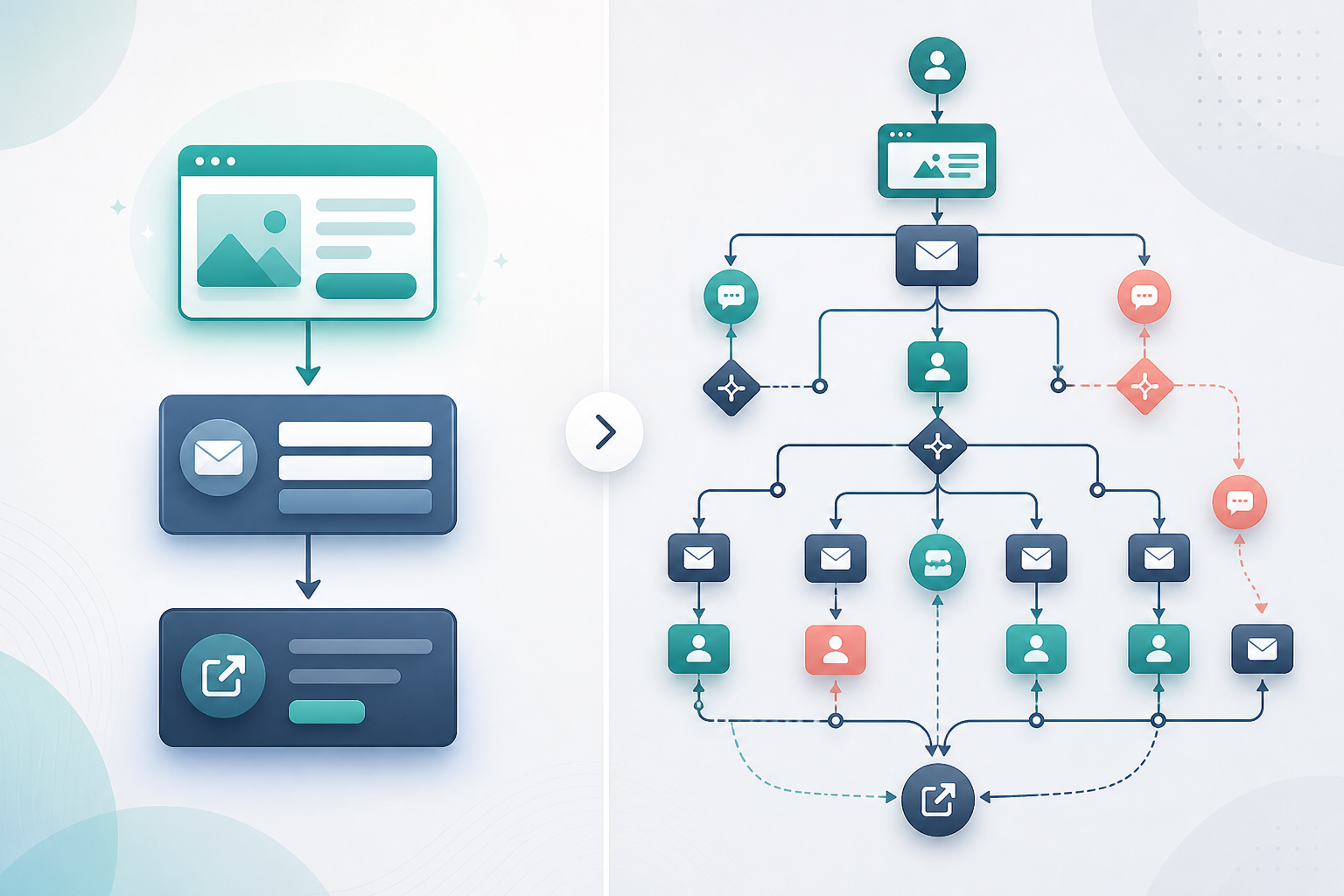
Here's what the actual workflow looks like when you're running an affiliate funnel on each platform—not the idealized version, the real one.
On ClickFunnels: Build your bridge page in CF, connect it to an external autoresponder via webhook (ActiveCampaign or GetResponse—see which email platforms actually work for affiliate marketers before you decide). Set up your 5-7 email welcome/pitch sequence externally. Use CF's built-in page hosting and redirect to your affiliate offer URL. A/B test your opt-in headline and CTA button color. This takes roughly 6-8 hours to set up properly the first time.
On GoHighLevel: Create a sub-account for your affiliate campaign. Build the funnel inside that sub-account using GHL's page builder. Set up the email automation natively inside GHL's workflow builder—the sequence logic is powerful once you understand it, supporting behavioral triggers like link clicks and page visits that CF's basic tier doesn't match. Connect your ClickBank or Digistore24 offer via a custom webhook or direct URL redirect. Plan for 10-12 hours of setup on your first funnel, dropping to 3-4 hours on subsequent ones once you've built templates.
The counterintuitive part: GHL's initial time cost pays dividends faster if you're running multiple offers simultaneously. CF's lower initial time cost is better if you're focused on one offer and want to iterate quickly on that single funnel.
One tactical note—whatever platform you choose, your email sequence is doing more conversion work than your funnel pages. A mediocre bridge page with a great 7-email sequence will outperform a beautiful funnel with weak follow-up almost every time. Don't let the platform choice distract from that.

The Measured Verdict
There's no universal winner here. What there is: a clearer picture of who each platform serves.
Choose ClickFunnels if: You're focused on one or two affiliate offers, you want to launch fast, you value a large support community, and you're comfortable plugging in an external email platform for your follow-up sequences. CF is the better tool for affiliates who think in terms of individual campaigns rather than systems.
Choose GoHighLevel if: You're running multiple offers across different niches, you want CRM-level tracking for high-ticket leads, you're managing campaigns for clients alongside your own affiliate business, or you're building toward a more complex multi-channel operation. GHL rewards operators who think in systems, not just funnels.
And if you're still early—under $1,500/month in affiliate commissions with no team—honestly consider starting on Systeme.io or a simple WordPress setup first. Master the fundamentals of funnel structure, email sequencing, and offer selection before you pay $297/month for platform features you're not ready to use. The tool doesn't make the funnel. The offer, the traffic, and the follow-up do.
Both platforms will be iterated on through 2026. GHL is moving faster in terms of feature releases. CF is more stable. Neither is going anywhere. So choose based on your actual workflow today—not the business you imagine having in two years.